
Your psoas major was built for occasional deep hip flexion during walking, climbing, and ground-level living. Modern chair sitting keeps it in a mild flexed position without the dynamic loads it expects.
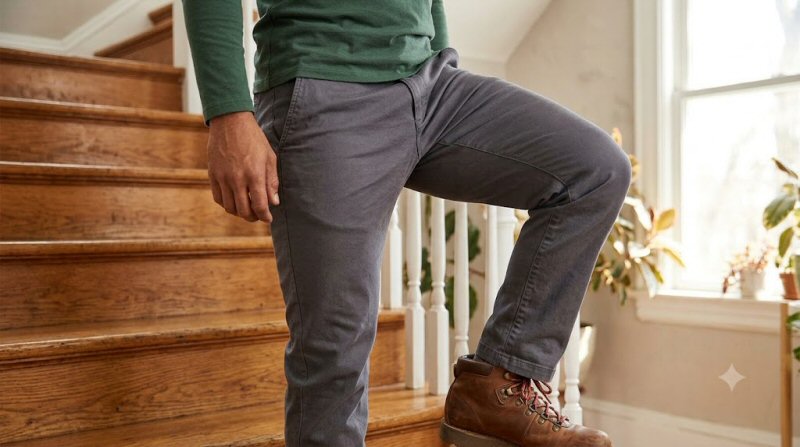
You stand up from your desk after a long stretch of sitting and feel a dull pull deep in the front of your hip, or a faint stiffness when you take the first few steps. Nothing dramatic—just the sense that the muscle which runs from your lower spine to the top of your thigh would rather have been used differently. That muscle is the psoas major, and the quiet complaint is common enough that most people simply stretch it and move on. The deeper story is that this muscle still carries expectations shaped by a life of walking, climbing, and occasionally folding the hip more deeply than a chair ever requires.
What the Psoas Actually Does
The psoas major begins on the sides of the lumbar vertebrae and the discs between them, then travels forward and downward to attach, with the iliacus, on the lesser trochanter of the femur. Classic electromyography work by Basmajian and later regional studies by Park, Tsao, Cresswell, and Hodges show that different portions of the muscle do slightly different jobs. Fascicles arising from the vertebral bodies tend to contribute more to hip flexion, while those from the transverse processes are more responsive to changes in lumbar posture.
In practical terms the psoas is a primary hip flexor, especially once the hip is already somewhat flexed. It also contributes a compressive stabilizing force across the lumbar segments and helps keep the femoral head seated in the acetabulum during the early degrees of hip motion. Neumann’s kinesiology summaries and the cadaver-based kinetic work of Yoshio and colleagues describe a phasic pattern: near full extension the psoas acts more as a stabilizer and mild lumbar erector; around 45–60 degrees of flexion it becomes a more efficient flexor of the thigh.
It is not the only hip flexor—rectus femoris, the iliacus, and the tensor fasciae latae share the load—but it is the only one that also crosses the lumbar spine. That dual role is why prolonged sitting can leave both the front of the hip and the lower back feeling vaguely “off.”
The Ancestral Load the Muscle Still Expects
Human gait and daily movement evolved around repeated hip flexion that was rarely locked at a single mild angle. Walking on uneven ground, stepping up onto rocks or low branches, rising from a squat or a seated position on the ground, and occasionally climbing all produced brief, loaded excursions into deeper hip flexion. Even “rest” postures in many non-industrial groups involved active squatting or kneeling rather than passive chair sitting. Research on Hadza hunter-gatherers by Raichlen and colleagues has shown that their non-ambulatory time often occurs in postures that keep lower-limb muscles more active than modern chair sitting does—an inactivity mismatch that likely includes the psoas.
In that older pattern the psoas experienced regular cycles of lengthening under load (during the late stance phase of walking) and shortening under load (when lifting the thigh or rising). The muscle stayed relatively long overall and received the mechanical signals that maintain its sliding layers of fascia and its force-generating capacity. Modern chairs fix the hip near 90 degrees for hours. The psoas is neither fully lengthened nor asked to produce meaningful force through a useful range. Over months and years many people develop a sense of tightness or, conversely, a subtle loss of control when they finally need deeper flexion.
Related articles on the site explore similar mismatches in the iliacus and the broader hip flexors, as well as the lower back’s expectation of hinging and walking.
How Sitting Changes the Equation
When you sit with the hips flexed and the lumbar spine relatively flat or slightly rounded, the psoas is held at a mid-range length. Fine-wire EMG studies of sitting postures show that certain portions remain mildly active, especially when a modest lordosis is present, yet the activity is low and static. There is little of the intermittent high-load or full-range work that maintains tissue quality.
The common downstream effects are familiar:
- A feeling of stiffness or “stuckness” in the front of the hip when you stand or try to take a long step.
- Increased anterior pelvic tilt once you finally stand, because the shortened-feeling hip flexors pull the pelvis forward.
- Compensatory loading of the lower back or the more superficial hip flexors.
- Reduced ease with activities that require deeper flexion—getting up from the floor, climbing steep stairs, or even tying a shoe.
None of these are inevitable, and none require dramatic intervention for most people. They are simply the predictable result of a muscle whose daily mechanical menu has become narrow.
When the Sensation Is Worth Checking
Most desk-related psoas discomfort is mechanical and improves with ordinary movement variety. A few patterns deserve closer attention:
- Sharp, catching pain deep in the groin that appears with specific movements and does not ease with walking.
- Pain that radiates into the front of the thigh or is accompanied by numbness or weakness.
- Discomfort that worsens at night or is associated with unexplained fever, weight loss, or bowel/bladder changes.
- A noticeable limp or inability to lift the thigh against gravity after an injury or surgery.
These can point to issues beyond simple adaptive shortening—labral irritation, referred lumbar pain, or, rarely, other medical conditions. For the ordinary post-sitting stiffness, the usual advice is still movement rather than rest.
Myths Versus Facts
Myth: A tight psoas always needs aggressive stretching.
Fact: Many people feel better with a mix of gentle lengthening and, more importantly, active use through a fuller range. Over-stretching a muscle that is already under-used can sometimes increase irritability.
Myth: The psoas is the main cause of all lower-back pain.
Fact: It can contribute to postural changes that load the back differently, but the majority of nonspecific back pain has multiple drivers. Treating only the psoas rarely solves the larger picture.
Myth: Sitting is uniquely damaging and must be avoided entirely.
Fact: The issue is the lack of variety. Brief bouts of sitting are fine; uninterrupted hours in the same hip angle are what leave the psoas under-stimulated.
How to Give the Psoas What It Still Expects
The practical goal is not to eliminate sitting but to reintroduce occasional deep hip flexion and dynamic loading:
- Stand and take a few deliberate high steps or march in place for 30–60 seconds every hour. Lift the knee high enough that the hip folds past 90 degrees.
- Include a couple of controlled deep squats or lunges during the day—nothing maximal, just enough to move the hip through a fuller range under your own body weight.
- When rising from the floor or a low seat, use the opportunity rather than always choosing the highest chair.
- Walk on varied surfaces or simply take stairs when available; the slight extra flexion and the alternating load are useful.
- If you stretch, keep it gentle and follow it with active movement (for example, a standing knee lift) so the muscle is asked to work in its lengthened position.
These are small doses. Consistency matters more than intensity. Many people notice the front-of-hip stiffness recede within a week or two of simply breaking up long sitting periods with brief, deeper flexion.
When to See a Doctor or Clinician
Seek professional advice if the discomfort is severe, progressive, or accompanied by neurological symptoms, if it follows a specific injury, or if simple movement changes bring no improvement after a few weeks. A clinician can distinguish ordinary adaptive tightness from other sources of anterior hip or groin pain and can check whether the lumbar spine, hip joint, or surrounding muscles need more targeted attention.
FAQs
Is a “tight psoas” the reason my lower back hurts after sitting?
It can contribute. Prolonged hip flexion often pairs with a change in pelvic position that increases load on the lumbar discs and joints. Addressing the psoas helps some people, but the back usually benefits more from overall movement variety and better load distribution than from psoas work alone.
Should I stretch my psoas every day?
A brief, comfortable stretch can feel good, but daily aggressive stretching is unnecessary for most people. Occasional active use—high steps, controlled squats, or simply walking—usually does more to restore normal function than stretching alone.
Does the psoas get weaker from sitting?
It can lose some of its endurance and coordination for deeper flexion tasks, even if raw strength on a simple test remains adequate. The muscle is rarely “turned off”; it is simply under-challenged in the ranges and loads it was built to handle.
Can strengthening the psoas make sitting more comfortable?
Targeted strengthening (for example, controlled knee lifts or resisted hip flexion in a useful range) can improve control, but the larger benefit usually comes from reducing uninterrupted sitting time and adding the occasional deeper flexion the muscle expects.
Is the psoas different from the iliacus?
Yes. They share a tendon and are often called the iliopsoas together, yet EMG studies show they can activate somewhat independently. The iliacus is more purely a hip flexor; the psoas also influences the lumbar spine. Both benefit from movement variety, but the psoas is the one more directly affected by long periods of seated lumbar posture.
Conclusion
The psoas major is not broken by modern life; it is simply under-used in the ways it evolved to be used. Occasional deep hip flexion—high steps, a few controlled squats, stairs, or rising from a lower seat—gives it the mechanical variety it still expects. Most of the front-of-hip stiffness that appears after long desk days is the ordinary result of a narrowed movement diet, and it usually responds to the same simple remedy: a little more of the motion the muscle was built for.


