
The small plantaris muscle in your calf is often called vestigial, yet it still carries high proprioceptive density and a long tendon shaped for quick, varied steps rather than steady modern walking.
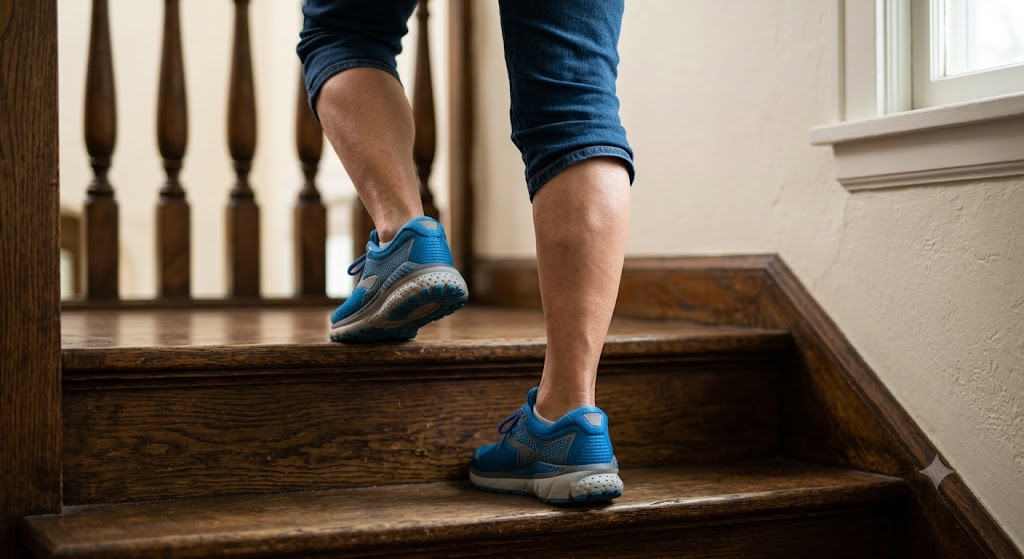
Most people never hear the name plantaris until something goes wrong in the back of the calf. It is a small muscle with a short belly and one of the longest tendons in the body, running from just above the knee down to the heel. Many textbooks still call it vestigial. Yet it is present in most adults, packed with muscle spindles, and anatomically positioned where quick changes in foot position used to matter.
The mismatch is simple. The plantaris appears built for occasional explosive or highly varied steps—short sprints, sudden direction changes, climbing, or uneven ground—while modern days are dominated by steady walking, standing, or sitting.
What the Plantaris Actually Does
The plantaris originates from the lateral supracondylar ridge of the femur, just above the knee, and travels deep to the gastrocnemius before its long tendon joins near the Achilles insertion on the calcaneus. Its force contribution to plantarflexion is tiny compared with the gastrocnemius and soleus. Classic descriptions (Daseler and Anson) already noted its limited mechanical role.
What it does carry is a high density of muscle spindles. These proprioceptive sensors report length and speed of stretch to the nervous system. Comparative work (Hanna and Schmitt, Lovejoy and colleagues) shows the plantaris is better developed in climbing or propulsion-oriented primates and other mammals. In humans it is reduced, yet the spindle-rich structure remains. A 2025 review by Olewnik and colleagues argues it has shifted toward a sensorimotor role rather than pure power.
It is absent in roughly 7–20 % of people, with wide variation by study. When missing, walking and running are unaffected, which is why the “vestigial” label stuck. When present, its tendon is so slender that medical students sometimes mistake it for a nerve—the old “freshman’s nerve.”
Why Evolution Left It in Place
In many non-human mammals the plantaris is continuous with the plantar aponeurosis and contributes more clearly to propulsion or foot stiffness. Across primates the muscle and its related soleus architecture changed as locomotion shifted toward bipedal walking and running (Sakuraya et al.). The human version is smaller, but the high spindle count and long tendon remain.
That combination makes sense for brief, high-demand moments: the first explosive push of a sprint, a quick sidestep on uneven ground, or a climbing step that loads the calf in an unusual angle. Steady, flat-ground walking loads the larger gastrocnemius and soleus far more. The plantaris is therefore easy to under-use without anyone noticing—until a sudden demand arrives.
Modern Life and the Quiet Calf
Desk days, commuting, and even recreational walking on smooth surfaces rarely ask for the short, high-speed stretch or fine positional feedback the plantaris seems tuned for. The larger calf muscles handle most of the work, and the plantaris stays relatively quiet. Over years this can leave the small belly and long tendon less resilient.
When a sudden demand does appear—a tennis serve, a basketball cut, or an unexpected step off a curb—the plantaris can be the first structure to complain. Isolated plantaris rupture (sometimes called tennis leg when it involves the medial gastrocnemius) produces a sharp pop, local swelling, and calf pain. Most cases settle with relative rest; the larger muscles compensate easily. Still, the event highlights how little preparatory loading the muscle receives in ordinary weeks.
Related articles on the site explore the bigger calf players: Why Your Soleus Still Expects You on Your Feet and Why Your Calves Still Expect Hills and Stairs. The plantaris sits in the same neighborhood but with a narrower, more proprioceptive brief.
When the Sensation Becomes a Problem
Most people never feel their plantaris specifically. Occasional mild tightness high in the calf after a long day is far more often the gastrocnemius or soleus. Sharp, sudden pain with a pop during a jump or cut, followed by swelling and difficulty pushing off, deserves attention. In the absence of those features, ordinary stiffness after sitting or standing is unlikely to involve the plantaris.
Red flags that need a clinician include:
- A clear popping sensation followed by significant swelling or bruising in the calf
- Pain that prevents normal walking for more than a day or two
- Symptoms accompanied by chest pain, sudden shortness of breath, or one-sided leg swelling (possible clot)
- Progressive weakness or numbness
For the common, non-traumatic tightness, simple movement is usually enough.
Myths Versus Facts
Myth: The plantaris does nothing and can be ignored.
Fact: Its mechanical contribution is small, yet the high spindle density suggests a useful sensory role. Absence is well tolerated, but presence is the norm for most people.
Myth: Calf pain always means Achilles or gastrocnemius strain.
Fact: Isolated plantaris involvement is well documented in sports medicine, especially with sudden acceleration. Imaging or clinical exam can distinguish it.
Myth: You need heavy calf raises to keep it healthy.
Fact: Because force output is minor, the more relevant stimulus appears to be occasional quick, varied steps rather than pure strength work.
How to Give It Occasional Use
You do not need a special plantaris workout. The practical goal is to restore brief moments of the loading pattern it seems built for:
- Include short bursts of quicker walking or light jogging on varied surfaces a few times a week. A few sets of 10–20 rapid steps on a slight incline or soft grass is enough.
- Practice gentle single-leg balance or slow heel raises with a slight knee bend so the calf experiences a range of positions, not only the straight-knee push of classic raises.
- Climb stairs with deliberate, slightly faster push-offs rather than always taking them one at a time at a steady pace.
- After long sitting periods, stand and do 20–30 quick ankle pumps or small hops in place before walking off. This wakes the whole posterior chain, including the smaller spindle-rich muscle.
These are the same habits that help the larger calf muscles and the venous pump described in Why Your Veins Still Expect the Calf Muscle Pump. The plantaris simply rides along.
When to See a Doctor
See a clinician if you experience a sudden pop and swelling in the calf, if pain persists beyond a few days of relative rest, or if you have risk factors for vascular problems. Most plantaris issues resolve without surgery; the tendon is even harvested sometimes for grafts precisely because its loss is well tolerated. Persistent or unexplained calf pain still deserves proper assessment to rule out other causes.
FAQs
Is the plantaris really vestigial?
It is reduced in size and force compared with other mammals and many primates, and it is missing in a minority of people without functional loss. Recent anatomical and developmental work, however, highlights its consistent presence in fetal life and high spindle density, suggesting a retained sensory role rather than pure uselessness.
Can I tear my plantaris without noticing?
Minor strains may feel like ordinary calf tightness. A true rupture usually produces a noticeable pop, local pain, and swelling, especially during a sudden acceleration or jump. Many people still walk, because the gastrocnemius and soleus take over.
Does everyone have a plantaris muscle?
No. Studies report absence in roughly 7–20 % of limbs, with some populations higher. When absent, the remaining calf muscles handle plantarflexion without difficulty.
Will calf raises strengthen the plantaris specifically?
They load the whole triceps surae group. Because the plantaris contributes little force, the more useful stimulus is occasional rapid or direction-changing steps that stretch and load it in varied positions.
Is plantaris pain different from Achilles pain?
Yes. Plantaris issues tend to be higher in the calf or at the medial edge near the Achilles, often with a sudden onset during sport. Achilles problems are usually lower, closer to the heel, and more related to repetitive loading. Clinical exam or imaging clarifies the distinction.
Can sitting all day weaken it?
Prolonged inactivity reduces the variety of stretch and activation the muscle receives. The larger calf muscles show clearer effects (heaviness, reduced pump efficiency), but the plantaris shares the same under-use environment. Brief daily movement restores the input it expects.
The plantaris is easy to overlook precisely because it does so little of the heavy lifting. Its long tendon and dense sensory endings still reflect an older expectation of occasional explosive or highly varied steps. Giving the calf those brief, varied demands a few times a week is usually all it needs—and the larger muscles benefit at the same time.


