
The sacroiliac joints still expect alternating steps, not hours in a chair. Small motion, muscle slings, and a walking load were the original design. Sitting asks them to hold still.
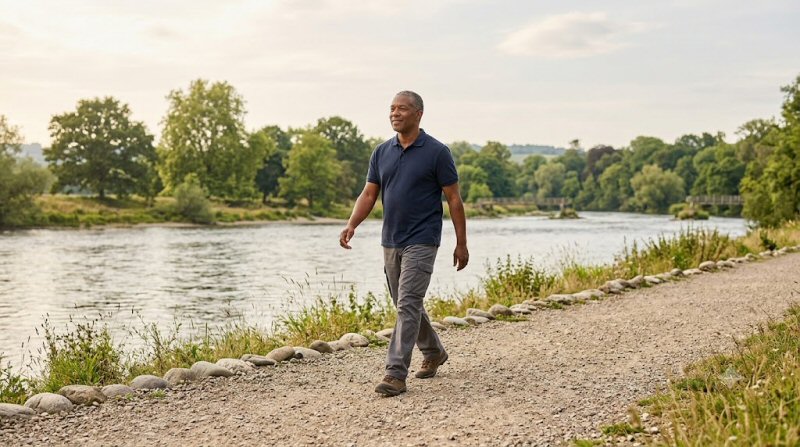
The low back feels fine at the desk. The first ten steps after lunch are the problem. One side of the pelvis has a deep, dull ache, just beside the dimple, and the first stride feels shorter than the second. A car ride does the same thing. So does a meeting where you sat on one hip. By the time you have walked to the end of the block, the catch is usually gone.
That spot is the neighborhood of the sacroiliac joints, the two links between the spine and the pelvic ring. They were not built as hinges you should feel all day. They were built as load-transfer joints that stay quiet while you walk, carry, and change direction. A chair asks them to do the opposite: hold one shape, under body weight, with the big walking muscles switched off.
What a Quiet SI Joint Feels Like When It Is Not
The ordinary version is a one-sided ache at the back of the pelvis, often just under the belt line, that shows up after sitting and eases once you are moving. Some people feel it when they roll over in bed, climb the first few stairs, or stand up from a low car seat. It can refer into the upper buttock. It rarely travels past the knee the way a lumbar nerve root often does.
It likes asymmetry. A wallet in the back pocket, legs crossed the same way, a toddler carried on one hip, or a long drive with one foot braced on the floor can pick a side. The other side may never complain. Coughing or a hard sneeze sometimes sharpens it for a second, because the abdomen and pelvic floor briefly raise pressure across the ring.
A stiffer morning version lasts more than half an hour, swaps sides over weeks, and comes with fatigue elsewhere. That pattern belongs in a different chapter. So does pain after a fall, a fever, or numbness between the legs. The desk-and-first-steps version is the common one, and it is usually a load-transfer complaint, not a joint that has “slipped out.”
What the Joint Was Built to Do
Each sacroiliac joint sits between the sacrum and the ilium. The surfaces are broad, ridged, and slightly wedge-shaped. Andry Vleeming and colleagues described two ways that shape stays stable under load. Form closure is the bony fit: ridges, cartilage, and ligaments that resist shear when the sacrum is settled into the ring. Force closure is the muscle and fascia sling that clamps the joint harder the moment you need it, especially at heel strike.
The motion itself is small. Bengt Sturesson measured it with radiostereometric markers and found rotations on the order of a couple of degrees, and translations well under a few millimeters, even in people with pelvic pain. That is enough to share load between the spine and the legs. It is not enough to “go out” in the way a shoulder can. The pop people chase is often a pressure change in the joint or a nearby facet, not a bone returning home.
Chris Snijders mapped the slings that supply force closure. Gluteus maximus and the opposite latissimus dorsi pull through the thoracolumbar fascia. The biceps femoris tugs on the sacrotuberous ligament. The pelvic floor and the deep abdominal wall, including transversus abdominis, add a gentle hoop of compression. Carolyn Richardson and Paul Hodges later showed that the deep abdominals and pelvic floor can raise stiffness across this region before the limbs even move. Walking turns those slings on in a rhythm. Sitting turns most of them off.
Serge Gracovetsky’s spinal-engine idea and Jacquelin Perry’s gait work point at the same everyday fact from different directions. A stride rotates the pelvis a little, loads one leg, unloads the other, and asks the trunk to counter-rotate. The SI joints live in the middle of that exchange. They still expect it.
Why Chairs and Cars Break the Pattern
Ancestral days were mostly walking, standing shifts of weight, squatting, and carrying. The joint saw alternating compression, a brief unload, and muscles that clamped in time with the step. Modern days are a long static hold. The sacrum sits between the ilia while the glutes and the opposite back muscles idle. Snijders argued that a slumped sit also flattens the low-back curve and reduces the nutated, “settled” position in which the posterior ligaments are tautest. The joint is not injured by one meeting. It is under-briefed by a hundred of them.
Asymmetry makes it worse. One crossed knee drops one ilium. A thick wallet tips the pelvis. A car seat that is slightly twisted, with one arm on the wheel and one foot on a dead pedal, holds that twist for an hour. The spine still expects you to walk more than you sit, and the pelvic ring is the floor of that same bargain.
Pregnancy is the clearest natural stress test. Ligaments soften, the abdomen can no longer brace the same way, and one-leg stands become harder. Hans Ostgaard and Per Kristiansson described posterior pelvic pain as common in pregnancy, often worse with walking turns, rolling in bed, or standing on one leg. Jan Mens used the active straight-leg raise to show that some of that pain is a load-transfer problem: the ring is less stiff, so a simple leg lift feels heavy. Most of it settles in the months after delivery as load and ligaments change again. It is a reminder of the design, not proof that every desk ache is a mini version of pregnancy.
Age changes the joint the other way. The ridges deepen, and in some older adults the joint can partly fuse. Stiffness then is often neighboring — hip, disc, or a tired glute — rather than a mobile SI that needs to be “freed” every week.
Hidden Triggers That Are Easy to Miss
A new chair, a new car, or a week of flights often starts the story. So does a sport that is all forward — cycling, rowing ergometer, treadmill — with no side step and no hill. The glutes still expect hills and the floor. When they are quiet, force closure gets quieter with them.
Standing still at a counter, weight on one leg, is a small version of the same trap. So is sitting on a soft couch that lets the pelvis drop backward. A hard wallet, a phone in a back pocket, and jeans that bind the hip crease all change the starting shape before you have taken a step.
Sleep can join in. A sagging mattress, or a side-sleep night with no support between the knees, holds the top ilium forward for hours. The first steps of the morning complain. The joint did not move far. It was simply asked to be still in one shape until morning.
Stress shows up as bracing. People who clench the abdomen and the pelvic floor all day can make the ring feel tight without ever walking enough to share the load. The pelvic floor still expects walking and a squat, not a constant hold above a chair.
When the Ache Is Not a Desk Joint
Mechanical SI-region pain is local, one-sided or alternating only slowly, and better once you are warm and walking. Inflammatory pain is a different pattern. Ankylosing spondylitis and related conditions, described in criteria work by Andrei Calin, Muhammad Asim Khan, and Sjef van der Linden, often start with buttock pain that is worse at night, stiff for more than half an hour in the morning, and better with movement in a deeper way than a five-minute hallway walk. It can begin in younger adults. It deserves a clinician, not a new cushion alone.
Other red flags are independent of the SI story. Pain after significant trauma, a fever, unexplained weight loss, a history of cancer, saddle numbness, new trouble with bladder or bowel control, or weakness in the foot are reasons to get checked promptly. Pain that runs below the knee with pins and needles is more often a lumbar nerve. Groin-dominant pain that catches on rotation is more often the hip. A clinician can sort those. Most first-steps pelvic aches are none of them.
Myths vs Facts
Myth: the joint “goes out” and a crack puts it back. Fact: measured motion is a few degrees. A pop is usually a pressure change, not a relocation. Chasing it every day can irritate the ligaments that were meant to limit that motion.
Myth: one leg is short, so the joint is twisted. Fact: functional tilt from sitting habits is common and often changes when you walk. A true structural difference is a clinical measurement, not a mirror guess.
Myth: you should stop walking until it is silent. Fact: the stride is the input the slings still expect. Total rest makes the next sit worse. Spikes of sprinting or heavy one-leg loading are a different question.
Myth: only pregnancy causes this. Fact: pregnancy reveals the design because ligaments are looser and stance is asymmetric. Desk workers, drivers, and new parents who carry on one hip get a milder version of the same load problem.
Myth: a wide belt fixes the cause. Fact: a support can calm a very irritable ring for a short stretch, especially late in pregnancy. It does not replace the walk, the glutes, or a chair that lets both feet reach the floor.
How to Give the Joints a Stride Again
Break sits before they become a pose. Standing up every half hour, even for a minute of easy walking, restarts the alternating load. On long drives, a short walk at the stop does more than a deeper slump into the seat.
Sit on both sit bones. Phone and wallet come out of the back pocket. Feet rest flat, hips a little higher than knees if the chair allows, a small pad behind the pelvis if you collapse into a C-shape. Crossing the same knee for an hour is the habit to retire first.
Walk like someone who still has a pelvis. Let the arms swing. Include a curb, a slight hill, or a side step across a room, not only a flat treadmill belt. Carry a bag in either hand on different days, or in both, instead of always on one shoulder.
A few quiet drills restore force closure without twisting the joint to its end. A glute bridge with both feet down, a side-lying clam, a slow band step to the side, and a bird-dog that moves an opposite arm and leg without letting the pelvis rock. Diane Lee and Vleeming both emphasize control of load transfer over aggressive stretching. If a figure-four stretch or a hard twist sharpens the spot, skip it until walking feels even.
In pregnancy, shorten single-leg stands, sleep with a pillow between the knees, and roll with the knees together. If an active leg lift feels oddly heavy or the pain stops you walking, that is a reason to see someone who knows pelvic girdle pain, not a reason to force through it.
When to See a Doctor
See a clinician if the ache lasts more than a few weeks despite walking breaks, if it wakes you in the second half of the night and morning stiffness lasts past half an hour, or if you cannot bear weight. Go sooner after a fall, with fever, with saddle numbness, or with new bladder or bowel changes. Pregnant pain that stops you from walking is worth a visit even when it is common. Imaging is often normal in mechanical pain, because the problem is load, not a dramatic slip. That normal scan is useful. It is not proof that the ache is imaginary.
FAQs
Why does one side hurt after sitting and feel better after I walk?
Sitting holds the ring in one shape with the glute and back slings quiet. The first steps reload both sides in turn and usually settle the ache within a block. If walking makes it steadily worse, get it checked.
Can the SI joint really move enough to “go out”?
Sturesson’s measurements put everyday rotation at about a couple of degrees. That is real motion, and it matters for load. It is not a dislocation. A crack does not mean a bone returned to a socket.
Does a wallet or crossed legs actually matter?
Yes, as a hours-long asymmetry. Snijders and later clinical work treat uneven sitting as a common trigger. The fix is boring and effective: both pockets empty, both feet down, change sides if you must cross.
Is this the same as low-back pain from a disc?
Often no. Disc-related nerve pain more often runs below the knee with numbness or weakness. SI-region pain tends to stay in the buttock and the back of the pelvis, and it likes a sit-then-first-steps story. The two can coexist. A clinician sorts them if rest, walking, and time do not.
Why did it start in pregnancy and linger?
Ligaments are looser, the abdominal brace is different, and one-leg tasks multiply. Ostgaard and Mens described that pattern as pelvic girdle load trouble, not a damaged joint. Most of it fades after delivery. Lingering pain that blocks walking still deserves a look.
Should I stop exercise until the ache is gone?
Do not stop ordinary walking. Pause the move that sharply provokes it, often a deep twist, a heavy one-leg stance, or a new hill sprint. Rebuild with even strides, bridges, and side steps, then add load back slowly.
Conclusion
The sacroiliac joints are small-motion links with a large job: pass body weight from spine to legs without slipping. Form closure supplies the wedge. Force closure supplies the clamp, and the clamp still expects a stride, a hill, and the occasional carry. Chairs, cars, and one-hip habits leave the wedge holding a static load while the muscles that were meant to share it stay quiet. The first stiff steps after lunch are that mismatch, felt at the belt line. Walk them out, sit on both bones, and save the urgent visit for night pain, trauma, or symptoms that are no longer just a catch at the start of a block.


