
Your peroneus brevis muscle is built for everting the foot and stabilizing the ankle on uneven ground. Modern flat floors and supportive shoes reduce that demand, leaving the muscle underused.
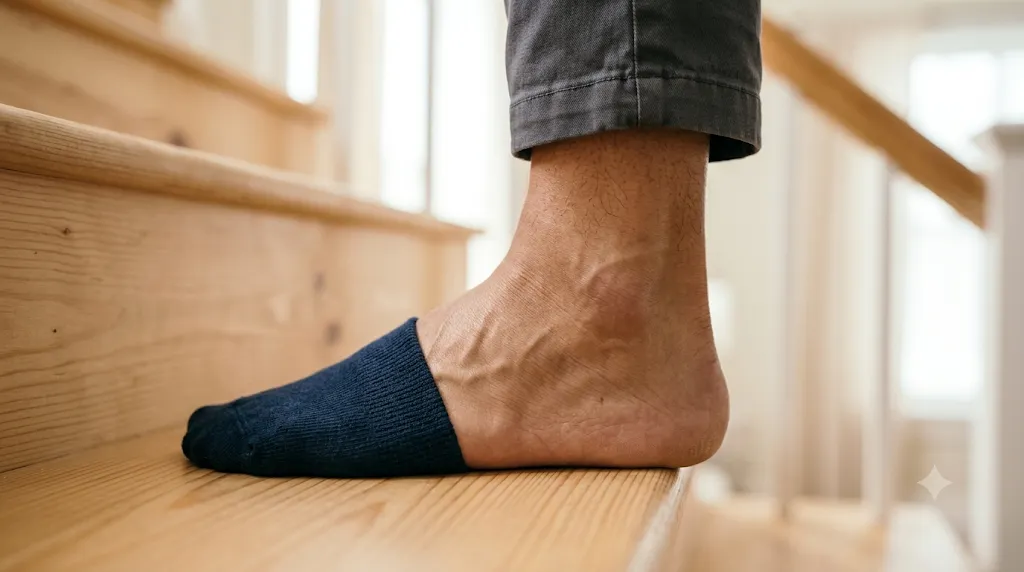
Most of us spend the day on flat surfaces—sidewalks, office floors, gym treadmills, and kitchen tiles. The ground rarely tilts under our feet. That predictability is convenient, yet it quietly removes a job that one of the smaller muscles of the lower leg evolved to perform repeatedly: the peroneus brevis (also called fibularis brevis). This muscle sits on the outer side of the lower leg, deep to its longer partner, and its main task is to evert the foot—tilt the sole outward—and help keep the ankle stable when the ground is not perfectly level.
When that demand disappears, the muscle does not vanish. It simply works less. Over time many people notice outer-ankle tightness, a sense that the ankle feels “weak” on uneven paths, or a tendency for the foot to roll inward more easily. None of this is dramatic for most healthy adults, but it is a clear example of a body system still calibrated for a world of varied terrain.
What the Peroneus Brevis Actually Does
The peroneus brevis originates on the lower two-thirds of the fibula and inserts on the base of the fifth metatarsal (the bone that sticks out on the outer edge of the mid-foot). Because it crosses behind the lateral malleolus, it can both plantarflex the ankle and, more importantly, evert the foot. Electromyography studies dating back to the work of John V. Basmajian and later researchers show that both peroneal muscles fire during the stance phase of walking, with activity rising when the surface challenges lateral stability.
A 2004 study by James C. Otis and colleagues found that the peroneus brevis is actually a more effective evertor than the longer peroneus longus under the same tendon load. Its shorter moment arm and insertion make it especially useful for fine control of the outer edge of the foot. On a trail or uneven sidewalk the muscle helps stop the ankle from inverting (rolling inward) when the lateral border of the foot strikes a bump or a soft edge.
In evolutionary terms the lateral compartment of the leg is part of the package that supports upright bipedalism. Ancestral humans walked on soil, grass, roots, and rocks. Sideways adjustments were constant. Modern shoes with rigid soles and padded collars, combined with almost perfectly flat urban surfaces, reduce the need for those micro-corrections. The muscle still expects them.
Why Modern Life Leaves It Underused
Supportive shoes and level floors are not harmful in themselves. They simply change the loading pattern. Research comparing barefoot walking with various athletic shoes has shown reduced peak electromyographic activity in the peroneus brevis during the propulsion phase when shoes are worn. On a medial incline (a surface that tips the foot inward) both peroneal muscles increase their activation substantially, as demonstrated by Bavdek and colleagues in 2018. Flat ground does not provide that stimulus.
Prolonged sitting and standing still further limit the natural gait variations that would otherwise recruit the muscle. Many people also walk with a relatively narrow step width on hard surfaces, reducing the sideways shear forces that once trained the evertors. The result is a muscle that remains strong enough for ordinary daily steps yet has less reserve when the surface becomes unpredictable—think a grassy park path, a cobblestone street, or a quick sidestep to avoid a puddle.
This is the same pattern seen in other lower-leg and foot muscles that still expect occasional barefoot balance or uneven steps. The peroneus longus shares the lateral compartment and faces a similar reduction in demand, while the abductor hallucis on the medial side continues to wait for the stabilizing work of barefoot balance.
Common Everyday Signs
Most people do not feel a specific “peroneus brevis problem.” Instead they notice secondary effects:
- Outer ankle or lower-leg tightness after a long day of standing on hard floors
- A sense that the ankle feels less secure when stepping off a curb or onto grass
- Mild fatigue along the outside of the lower leg after a hike on uneven ground
- A tendency for the foot to feel “floppy” or to roll slightly when tired
These sensations are usually benign. They simply reflect a muscle that has spent most of its recent history on predictable surfaces. Occasional lateral ankle pain that appears only after a sudden twist is more likely related to the ligaments or the peroneal tendons themselves, not the everyday under-use of the muscle belly.
When to Pay Closer Attention
Under-use itself is not dangerous. A few patterns, however, deserve medical evaluation:
- Sharp pain behind the outer ankle that worsens with toe walking or side-to-side movements
- A snapping or popping sensation on the outside of the ankle
- Swelling along the peroneal tendons that persists for more than a few days
- Repeated ankle sprains or a feeling that the ankle gives way even on flat ground
- Numbness or tingling that travels down the outer leg into the top of the foot
These can indicate tendon irritation, subluxation of the peroneal tendons, or nerve irritation—conditions that benefit from proper assessment rather than simple stretching.
How to Give the Muscle What It Still Expects
The goal is not to abandon shoes or modern floors. It is to restore occasional, low-risk challenges that match the muscle’s design. A few practical options:
- Walk barefoot or in minimal footwear for short periods on safe indoor surfaces or grass. The increased sensory feedback and slight instability raise peroneal activity naturally.
- Include deliberate sideways steps or lateral lunges a few times a week. Even small side-to-side movements while standing in place recruit the evertors.
- Practice single-leg balance on a slightly uneven surface (a folded towel or a soft mat) for 20–30 seconds per side. Keep the knee soft and the foot relaxed.
- When outdoors, choose paths that are not perfectly flat—park trails, gentle slopes, or even the edge of a sidewalk—for a few minutes of each walk.
- Strengthening can be simple: seated eversion with a light resistance band around the forefoot, or standing calf raises with a slight outward bias.
These strategies echo the broader idea that feet and ankles still expect occasional barefoot time and varied surfaces. The same principle appears in discussions of foot soles that still expect barefoot contact.
Myths Versus Facts
Myth: Outer-ankle tightness always means the muscle is “tight” and needs aggressive stretching.
Fact: The peroneus brevis is more often under-activated than shortened. Controlled eversion and balance work usually help more than passive stretching alone.
Myth: Supportive shoes permanently weaken the ankles.
Fact: Shoes reduce certain demands, but brief barefoot or minimal-shoe time, plus deliberate sideways loading, restores the stimulus without requiring a full lifestyle change.
Myth: Only athletes need strong evertors.
Fact: Everyday tasks—stepping off a curb, navigating a crowded sidewalk, or recovering from a slight stumble—rely on the same lateral stability system.
Frequently Asked Questions
Is it normal for the outer ankle to feel stiff after sitting all day?
Yes. Prolonged stillness reduces synovial fluid circulation and muscle activity. A few minutes of walking and gentle eversion usually restore comfort.
Can weak peroneals cause ankle sprains?
Reduced evertor strength and delayed activation are associated with higher risk of inversion sprains. Restoring occasional sideways challenge helps the muscle stay ready.
Should I do specific exercises every day?
Not necessary. Two or three short sessions a week of balance work or lateral steps, plus ordinary walking on varied surfaces, are usually enough for healthy adults.
Does the muscle work the same way in shoes and barefoot?
Electromyography shows lower peak activity in many shoes during propulsion. Barefoot or minimal footwear increases the demand, which is why short periods of safe barefoot time are useful.
What if I already have ankle pain?
Stop any provocative movements and have the area checked. Tendon or ligament issues need different care than simple under-use of the muscle belly.
Conclusion
The peroneus brevis is a small muscle with a clear job: keep the outer edge of the foot ready for ground that is not perfectly flat. Modern life has removed most of that ground. The muscle has not changed its expectations. Occasional sideways steps, short barefoot moments on safe surfaces, and simple balance challenges give it the work it still anticipates. Most people notice improved ankle security and less outer-leg tightness within a few weeks of restoring those small demands. The body continues to prefer the terrain it was shaped for; a little deliberate variety is usually all it takes to meet it halfway.


