
Your peroneus longus stabilizes the outer ankle and first ray on uneven ground. Modern flat floors and shoes leave this muscle under-stimulated, which can affect balance and arch support.
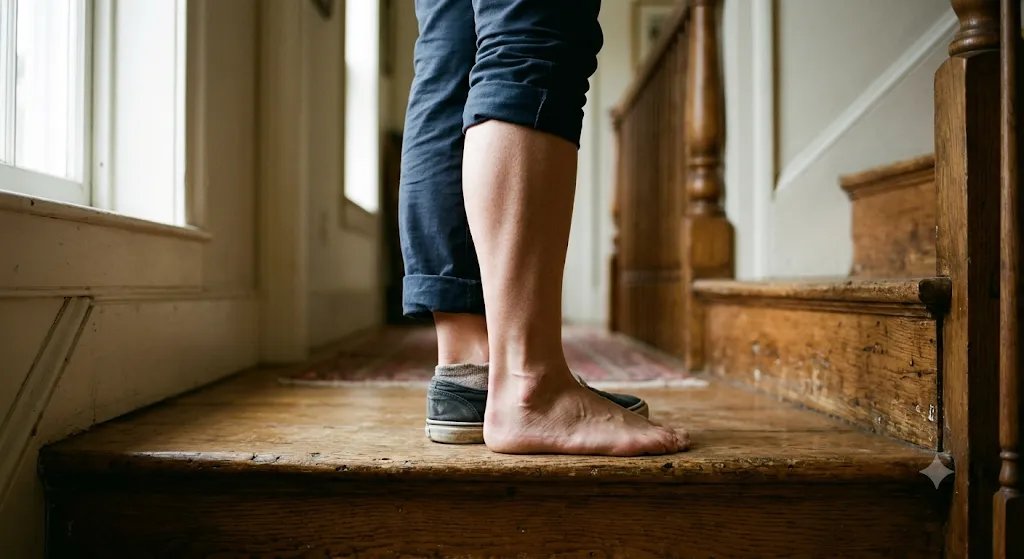
Most of us spend the day on flat surfaces—office floors, sidewalks, kitchen tile. Your outer lower leg does not fully agree with this arrangement. The peroneus longus, running along the outer calf and under the foot, still expects occasional sideways or uneven steps. When those demands disappear, the muscle and its tendon can quietly lose some of the work they evolved to do.
What the Peroneus Longus Actually Does
The peroneus longus (also called fibularis longus) starts on the upper outer fibula and travels down the outer leg. Its tendon wraps behind the outer ankle bone, crosses under the foot, and attaches near the base of the first metatarsal and medial cuneiform. This path lets it evert the foot—tilt the sole outward—and weakly plantarflex the ankle. More importantly, it helps lock the first ray and support the transverse arch when you put weight on the foot.
Electromyography studies, including classic work by Basmajian, show the muscle is active through much of stance, especially around mid-stance and heel-off. On uneven ground or during a side step, it fires more strongly to keep the ankle from rolling inward. Research by Johnson and Christensen demonstrated that tension in the peroneus longus creates an eversion “locking” effect on the medial column, stabilizing the foot under load. Without that, the first ray can feel less secure.
In short, this muscle is part of the team that keeps you upright when the ground is not perfectly level. Your ankles still expect uneven ground for the same reason; the peroneus longus is one of the main actors on the outer side.
Why Modern Life Leaves It Underused
Flat, hard surfaces and supportive shoes reduce the small lateral corrections the muscle normally makes. Studies comparing barefoot walking with various shoes have found lower peak activity in the peroneus longus and brevis during propulsion when footwear is worn. The shoe does some of the stabilizing work, so the muscle does less. Over months and years of mostly level walking, the muscle and its tendon simply receive fewer of the varied loads they are built for.
Sitting for long periods adds another layer. The lower leg stays quiet while the hips and knees are flexed, and the outer ankle muscles get almost no demand. When you finally stand and walk on a smooth floor, the pattern stays predictable and low-variety. The result is not usually dramatic weakness, but a quieter muscle that is less ready for the unexpected edge of a curb or a slight slope.
This is the same pattern seen with other lower-leg stabilizers. Your tibialis posterior still expects a springy arch on the inside; the peroneus longus does the complementary job on the outside. Both lose some of their daily practice when every step looks the same.
The Evolutionary Expectation
Human feet evolved for varied terrain—roots, rocks, soft sand, gentle slopes. The peroneus longus contributes to the stiffness of the transverse arch that helps the foot act as a rigid lever at push-off, a feature highlighted in work on foot stiffness and bipedal efficiency. On uneven ground the muscle also helps transfer load and prevent excessive inversion, which would have been useful when a misstep could mean injury far from help.
Modern environments remove most of that variability. The muscle still “expects” the occasional lateral challenge because that is the condition under which it developed its size and recruitment pattern. When the challenge is rare, the capacity remains but the readiness can fade. Side-stepping research shows the peroneus longus is facilitated early in stance precisely to stabilize the ankle against inversion—exactly the kind of demand a flat hallway rarely provides.
When the Quiet Muscle Becomes Noticeable
Many people never feel anything specific. Others notice a vague sense that the outer ankle feels less stable on grass or when they step off a curb, or that the first metatarsal area seems to work harder after a long day of level walking. Occasional mild soreness along the outer lower leg after a rare hike or after standing on a slight slope is common and usually settles once the muscle is given a little more variety.
True problems are less common. Persistent outer ankle pain, swelling behind the outer ankle bone, or a clear loss of balance that does not improve with rest can signal tendon irritation or, rarely, a tear. Sudden sharp pain with a pop after a roll of the ankle needs prompt attention. Most everyday underuse does not reach that level; it simply leaves the system a little less prepared.
Myths vs Facts
Myth: The outer ankle muscles only matter if you have sprained the ankle before.
Fact: They work on every step that is not perfectly straight and level. Everyday underuse affects people with no injury history.
Myth: Supportive shoes protect the peroneus longus.
Fact: Shoes can reduce the muscle’s peak activity. Some support is useful, but constant reliance means less practice for the muscle itself.
Myth: You need intense side-to-side sports to keep it strong.
Fact: Short periods of uneven ground, barefoot time on safe surfaces, or deliberate side steps are usually enough to remind the muscle of its job.
How to Give It the Occasional Challenge It Expects
You do not need a special program. A few simple changes restore some of the missing demand:
- Walk on grass, a gentle slope, or a slightly uneven path for a few minutes a few times a week. Let the feet make small adjustments.
- Practice slow side steps or a few controlled single-leg stands on a firm surface. Focus on keeping the outer ankle engaged without gripping the toes.
- Spend short periods barefoot on safe indoor floors or a soft mat. The extra sensory input and lack of shoe structure increase peroneal work.
- When rising from a chair, place the feet slightly wider than usual for the first few steps so the outer lower leg participates in the weight shift.
These are the same kinds of small lateral demands that also help the gluteus medius higher up. The goal is occasional variety, not constant challenge. Most people notice better readiness within a couple of weeks of adding even a little uneven or sideways work.
When to See a Doctor
See a clinician if you have persistent outer ankle or lower-leg pain that lasts more than a week or two, noticeable swelling, weakness when trying to evert the foot against light resistance, or repeated giving-way of the ankle. Sudden pain after a twist, or any neurological symptoms such as numbness or foot drop, need prompt evaluation. Everyday underuse is common and manageable; structural tendon problems are less so and benefit from early assessment.
FAQs
Does the peroneus longus get weaker just from walking on flat floors?
It usually loses some of its readiness rather than dramatic strength. The muscle still works, but the varied recruitment pattern it expects becomes less frequent, so it can feel less prepared for an unexpected uneven step.
Is barefoot walking good for this muscle?
On safe, clean surfaces for short periods, yes. Barefoot walking increases peroneal activity compared with most shoes, giving the muscle and the foot more of the sensory and mechanical input they are built for.
Can tight shoes affect the peroneus longus?
Yes. A narrow toe box or very rigid shoe can limit the small foot adjustments that normally accompany peroneal work, reducing the natural demand on the muscle during stance.
Why does the outer ankle sometimes feel tired after a long day of standing?
Standing still or shifting weight on a flat surface still requires low-level stabilization. If the muscle has had little varied practice, even that steady work can produce a sense of fatigue along the outer lower leg.
Will side steps help if I already have mild outer ankle discomfort?
Gentle, pain-free side steps or single-leg balance on a firm surface can help, provided they do not increase pain. If discomfort is sharp or persistent, get it checked before adding new loading.
Conclusion
Your peroneus longus still expects the occasional uneven or sideways step because that is the environment in which it developed its stabilizing role. Modern flat floors and supportive shoes quietly reduce that demand. Giving the outer lower leg a little variety—short walks on grass, a few side steps, or brief barefoot time—restores some of the work the muscle is ready to do. Most people find that small, consistent practice is enough to keep the system feeling more prepared for the moments when the ground is not perfectly level.


