
Your neck evolved for the small, constant motions of walking. Sitting still for hours leaves those tissues under-used and often stiff.
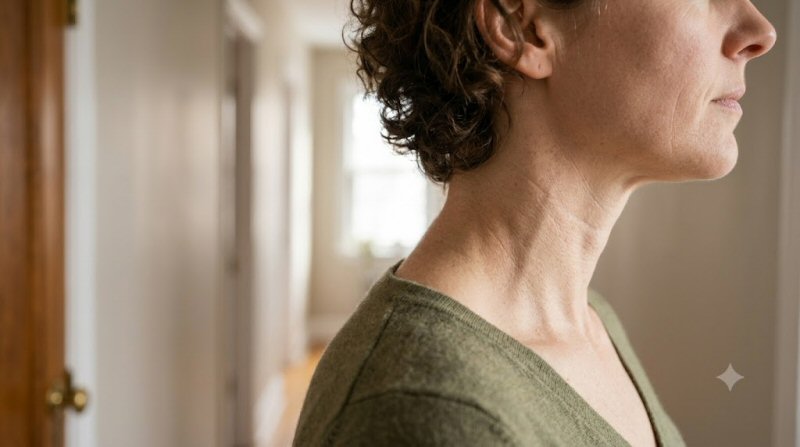
You finish a long desk day and your neck feels stiff, almost as if it has forgotten how to move. A short walk often loosens it more than any stretch. That is not a coincidence. Your cervical spine and the muscles around it spent most of human history receiving a steady stream of tiny motions every time you walked. Those motions still matter.
What This Sensation Feels Like
After hours of sitting, the neck often feels tight at the base of the skull or along the sides. Turning to check a blind spot in the car can feel restricted. Some people notice a dull ache between the shoulder blades that eases once they stand and walk. The stiffness is usually worse first thing in the morning or after a long meeting, and better after ordinary movement.
Common Causes
Prolonged still postures, especially with the head tipped forward toward a screen, are the most frequent trigger. Looking down for long stretches loads the upper neck and the muscles that hold the head. Cold drafts from air conditioning can add a surface tightness. Simple fatigue after a day of fixed gaze also plays a role. In most people the feeling is mechanical and temporary rather than a sign of damage.
Why This Happens: The Walking Motions Your Neck Expects
When you walk, the cervical spine is not locked in place. Dual-fluoroscopic imaging studies (Zhou, Li, Wang and colleagues, 2021) measured the motions in healthy adults and found small but consistent ranges: roughly 5 degrees of flexion-extension, about 3.4 degrees of lateral bending, and around 5.8 degrees of axial rotation across the whole C2–T1 region during a normal gait cycle. Vertical translation of the cervical spine occurs at twice the frequency of the steps, matching the impact of each footfall.
Earlier kinematic work (Cromwell et al., 2001) showed that the head and neck tend to move opposite the trunk, helping keep the eyes stable while the body rises and falls. The discs themselves deform a little with every step—axial compression and shear on the order of 16–24 percent of their resting height. Those repeated, low-level loads are the stimulus the tissues were built to receive.
Muscles such as the sternocleidomastoid, splenius, and deep suboccipitals fire in short, reciprocal bursts timed to heel strike. The pattern keeps the head level without large effort. When you sit still for hours, that entire rhythm stops. The same tissues that expect gentle, repeated motion instead experience static compression and reduced fluid exchange inside the discs and facet joints.
This is a classic evolutionary mismatch. Ancestral daily life included thousands of steps with natural head turns, glances, and the small vertical bob of bipedal gait. Modern work often replaces that with a fixed head position for most of the day. The neck does not “break”; it simply under-uses the loading pattern it still expects. Related articles on the site explore similar ideas: why your thoracic spine still expects frequent small rotations, why your ribs still expect a twist when you walk, and why your discs still expect walking and a night unload.
Less Common but Serious Causes
Sudden severe neck pain with arm weakness, numbness that spreads into the hand, or difficulty with balance and coordination needs prompt medical attention. Fever with neck stiffness, a history of trauma, or pain that wakes you repeatedly at night are also red flags. These situations are uncommon compared with ordinary postural stiffness, but they should not be ignored.
Hidden Triggers
Holding a phone between the ear and shoulder, sleeping with the head at an extreme angle, or driving with the seat too low can all add extra static load. Stress-related bracing—unconsciously tightening the upper trapezius—amplifies the feeling of tightness even when the spine itself is moving little. Poor lighting that forces you to lean closer to a screen has the same effect.
When to Worry
See a clinician if the stiffness is accompanied by radiating pain or numbness into the arm, if you develop weakness in grip or shoulder elevation, if symptoms follow a fall or accident, or if the pain is severe and unrelenting. Persistent night pain, unexplained weight loss, or neurological changes such as clumsiness in the legs are further reasons to seek evaluation. For the common tight, achy neck that improves with walking, self-care is usually sufficient.
Myths vs Facts
Myth: A stiff neck always means a pinched nerve or disc problem.
Fact: Most everyday stiffness comes from under-use of the small motions walking normally provides, not from structural damage.
Myth: You should keep the neck perfectly still to let it “heal.”
Fact: Gentle, varied motion—exactly what walking supplies—helps fluid exchange and reduces the sense of tightness.
Myth: Cracking the neck is required to free it.
Fact: The small rotations and translations of ordinary walking already move the joints; forceful cracking is unnecessary for typical postural stiffness.
How to Manage It
Break up long sitting periods with short walks. Even five to ten minutes of ordinary walking reintroduces the vertical and rotational cues the neck expects. While walking, let your arms swing naturally and allow your head to turn a little to look around rather than locking the gaze straight ahead. At the desk, raise the screen so you can keep a more level horizon and take micro-breaks to look into the distance and gently rotate the neck.
Simple range-of-motion movements—slow nods, side bends, and rotations performed while sitting tall—can be done several times a day. Strength is less important here than frequency of motion. If you work in a cold environment, a light scarf or warmer clothing around the neck can reduce surface muscle guarding. Most people notice improvement within a few days of adding more walking and fewer prolonged fixed postures.
When to See a Doctor
If the stiffness lasts more than a couple of weeks despite regular movement, if it is getting worse, or if any of the red-flag symptoms listed above appear, arrange a medical review. A clinician can check for less common contributors such as facet irritation, muscle imbalance, or, rarely, other conditions that need specific treatment. For the large majority of people the pattern is mechanical and responds to restoring the motions walking normally supplies.
FAQs
Is it normal for my neck to feel stiff only after sitting, not after walking?
Yes. Walking reintroduces the small, repeated motions and fluid shifts the cervical discs and muscles expect. Sitting removes those cues, so the stiffness is often posture- and inactivity-related.
Do I need special neck exercises, or is walking enough?
For most everyday stiffness, ordinary walking with natural arm swing and occasional head turns is the most relevant stimulus. Targeted mobility work can help, but it does not replace the loading pattern of gait.
Why does my neck feel better after a short walk than after stretching?
Walking supplies rhythmic, low-load motion in multiple planes plus the vertical oscillation timed to footfalls. Static stretches lengthen tissues but do not recreate that repeated, gait-linked stimulus.
Can looking at a phone while walking make the problem worse?
Yes. Studies of smartphone use during walking show substantially higher neck-extensor muscle activity and greater head tilt compared with upright walking. The extra static load offsets some of the benefit of the steps themselves.
Is a slightly forward head posture while walking harmful?
A modest forward lean is common and not automatically harmful. The larger issue is remaining in any single head position for many hours. Varied, frequent motion matters more than perfect alignment on every step.
Will the stiffness return if I go back to long sitting days?
It often does, because the mismatch remains. The practical solution is to keep interspersing walking and position changes rather than expecting one weekend of activity to permanently “fix” a weekday of stillness.
Conclusion
Your neck still expects the small, constant motions that come with walking—gentle flexion-extension, a few degrees of rotation and side-bend, and the vertical pulse of each step. Those cues keep discs and muscles nourished and the head stable without effort. Long hours of fixed posture simply withhold the stimulus the tissues were built to receive. Restoring ordinary walking, natural head turns, and frequent position changes usually returns the ease the neck is waiting for.


