
Why your mid-back still expects frequent small rotations from daily life, and how modern sitting and screens quietly limit the movement your thoracic spine was built for.
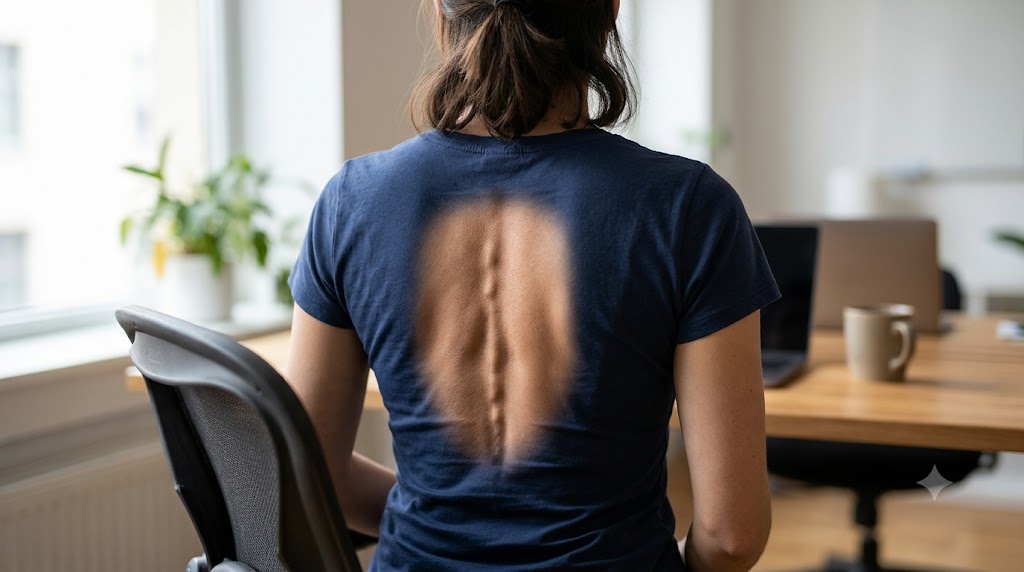
You sit at a desk for hours, turn your head to check a screen, and later notice a dull stiffness between your shoulder blades. Reaching into the back seat of the car feels tighter than it used to. Your mid-back was not designed for long stretches of stillness. It still expects the frequent, small rotations that come with looking around, reaching, carrying, and walking through a varied day.
This is not a dramatic injury story. It is a quiet mismatch between an old movement pattern and a modern environment that rarely asks the thoracic spine to rotate. Most people only notice it when the stiffness becomes familiar.
What This Feeling Actually Is
The thoracic spine is the middle section of your back, roughly from the base of the neck to the bottom of the rib cage. It is built to rotate more freely than the lower back. When you turn to look over your shoulder, reach behind you, or swing an arm while walking, much of that motion comes from the thoracic joints and the ribs attached to them.
In daily ancestral life, these small rotations happened dozens of times an hour. You turned to scan the horizon, reached for tools or food, adjusted a load on your back, or twisted slightly with each stride. The joints stayed lubricated, the surrounding muscles stayed coordinated, and the rib cage stayed mobile for breathing.
Today, many people spend large parts of the day with the trunk facing one direction. The thoracic spine receives far fewer rotation signals. Over time the tissues can feel stiffer, and larger movements start to feel restricted or mildly uncomfortable.
Why Your Thoracic Spine Still Expects Rotation
Human walking involves a subtle counter-rotation between the shoulders and pelvis. The arms swing, the rib cage rotates a little with each step, and the thoracic spine participates in that rhythm. Spine researcher Stuart McGill has described how the trunk is designed for repeated small movements and load transfers rather than prolonged static postures. When those small rotations disappear, the system loses one of its regular maintenance signals.
Nikolai Bogduk’s anatomical work on the thoracic joints shows they are oriented to allow rotation while still protecting the spinal cord and supporting the rib cage. The design assumes the joints will move. Synovial fluid circulation, ligament loading, and muscle coordination all improve with regular, varied motion. Without it, the same tissues can feel “stuck” even when no injury has occurred.
Modern life removes many of those cues. Driving keeps the trunk relatively fixed. Desk work orients the shoulders forward. Screen time reduces the need to turn the whole body to look at something. Even walking can become a straight-ahead, arms-at-sides activity if you are on a phone. The thoracic spine still expects the older pattern.
Common Everyday Triggers
Long periods of sitting with the chest facing forward are the most common trigger. The upper body stays in a narrow range while the lower body is also still. After a few hours, reaching across the body or turning the head can feel tighter.
Driving adds a similar constraint. The seat and steering wheel limit trunk rotation, and many people stay in that position for the entire commute. Later, a simple twist to check a blind spot can feel restricted.
Forward head and rounded shoulder postures reduce the available space for thoracic rotation. When the shoulders sit forward, the mid-back has less room to turn cleanly. The sensation is often described as a band of tightness rather than sharp pain.
Lack of arm swing while walking also reduces the small rotational input the thoracic spine normally receives. Holding a bag in one hand, keeping arms still while using a phone, or walking on a treadmill with fixed rails all reduce that natural counter-rotation.
When the Stiffness Is Usually Benign
Mild mid-back stiffness that eases with gentle movement, a short walk, or a few careful rotations is common and usually related to reduced motion rather than structural damage. It often feels worse after prolonged sitting and better after activity that includes turning or reaching.
Many people notice it more on one side if they habitually turn only in certain directions or carry a bag on one shoulder. The sensation is typically dull or achy rather than sharp, and it does not radiate into the arms or legs.
If the stiffness improves when you deliberately add small rotations throughout the day, that pattern fits the mismatch explanation. The tissues are responding to the return of the movement they still expect.
Less Common but Worth Attention
Persistent mid-back pain that does not change with movement, pain that wakes you at night, or stiffness accompanied by fever, unexplained weight loss, or neurological symptoms needs medical evaluation. Thoracic pain can occasionally relate to other structures, including the ribs, nerves, or referred pain from internal organs.
Sudden sharp pain after a specific movement, especially if breathing becomes painful, can indicate a muscle strain or rib joint irritation. These are usually self-limiting but can be uncomfortable for days.
If you have a history of osteoporosis, cancer, or significant trauma, new mid-back pain should be checked rather than assumed to be simple stiffness. The everyday rotational mismatch is common; it is not the explanation for every symptom in this area.
Myths Versus Facts
Myth: A stiff mid-back always means you need aggressive stretching or cracking.
Fact: Gentle, frequent small rotations are usually more useful than forceful end-range stretches. The joints respond well to regular motion within a comfortable range.
Myth: Sitting with perfect posture all day prevents thoracic stiffness.
Fact: Even an upright posture becomes stiff if it is held without variation. The thoracic spine expects movement more than it expects any single “correct” position.
Myth: Only the lower back matters for back health.
Fact: Limited thoracic rotation often forces the lumbar spine or neck to compensate during turning and reaching. Restoring mid-back motion can reduce strain elsewhere.
Simple Ways to Give It the Motion It Expects
Add small rotations during ordinary tasks. When you stand up from a chair, turn your shoulders slightly left and right before you walk. When you reach for something, let the rib cage rotate a little instead of keeping the trunk rigid.
Walk with a natural arm swing when it is safe to do so. The counter-rotation between arms and legs supplies the thoracic spine with low-level rotational input it recognizes. Even a few minutes of this pattern can reduce the stiff feeling.
A simple seated or standing rotation—turning the shoulders while the hips stay relatively still—performed a few times in each direction several times a day keeps the joints moving. Keep the motion comfortable; there is no need to force a large range.
Change positions regularly. Alternate between sitting, standing, and short walks. Each change usually includes a small rotation or reach that the mid-back can use. Related reading on how the upper back responds to reaching and pulling can be found in why your upper back still expects reaching and pulling.
If you spend long periods driving or at a desk, schedule brief movement breaks that include turning to look over each shoulder. These micro-movements are closer to the ancestral pattern than a single long stretching session at the end of the day.
When to See a Clinician
See a doctor or physical therapist if mid-back stiffness is severe, lasts more than a few weeks despite added movement, or is accompanied by arm numbness, chest pain, shortness of breath, or unexplained systemic symptoms. Most everyday rotational stiffness improves with consistent gentle motion, but persistent or unusual pain deserves a proper assessment.
A clinician can check whether the limitation is primarily joint, muscle, or postural, and can rule out less common causes. Early guidance often prevents the compensation patterns that develop when the thoracic spine stays restricted for long periods.
Frequently Asked Questions
Is it normal for my mid-back to feel stiff after a full day at a desk?
Yes. Prolonged forward-facing sitting reduces the small rotations the thoracic spine expects. Most people notice improvement once they add gentle turning and reaching throughout the day.
Will cracking my back help?
Occasional comfortable cracking is common and usually harmless, but it is not required. Regular small rotations often reduce the urge to crack by keeping the joints moving. More on back cracking appears in is it normal for your back to crack when you stretch.
Can limited thoracic rotation affect my neck or lower back?
Yes. When the mid-back does not rotate easily, the neck or lumbar spine may take extra motion during everyday turns. Restoring comfortable thoracic rotation often eases compensatory strain.
How much rotation does the thoracic spine actually need?
It does not need extreme ranges. Frequent small rotations—turning to look, reaching across the body, or the natural counter-rotation of walking—are usually enough to maintain the mobility it expects.
Is this the same as upper-back pain between the shoulder blades?
They overlap. Shoulder-blade pain after desk work is often related, and the same principle of adding varied reaching and rotation applies. See also why your fascia still expects twist and reach for the broader tissue context.
Conclusion
Your thoracic spine still expects the frequent small rotations that were part of ordinary movement for most of human history. Modern sitting, driving, and screen-focused days quietly remove those signals, and the mid-back can respond with stiffness. The mismatch is usually mild and reversible. Gentle, regular rotation woven into the day—turning to look, reaching with a little trunk motion, walking with arm swing—gives the joints and muscles the input they were built to receive. Most people feel the difference within days once the old pattern returns in small, consistent doses.


