
The rib cage still expects a small twist with every walking step. Hours of still sitting leave the ribs stiff, the breath shallow, and the mid-back sore.
You stand up after a long meeting and the first full breath feels stuck. The mid-back is dull, one side of the rib cage feels tighter than the other, and a deeper inhale stops short of the usual reach. Nothing popped. Nothing tore. The cage simply spent hours doing the one job it was never built to hold: staying still.
Ribs are not a fixed barrel around the lungs. They are a moving frame. Walking was the daily drill that kept that frame turning. A desk, a car seat, and a phone in the lap quietly cancel the drill.
What This Mismatch Feels Like
The usual report is a band of stiffness under the shoulder blades, or a catch along one side of the ribs when you twist to look behind you in the car. A yawn feels unfinished. Some people notice they can only fill the top of the chest, as if a belt were sitting too high even when it is not. Others get a sharp stitch on the first fast walk of the day, then feel looser after ten minutes.
It is often one-sided. The side you lean toward at the desk, or the side you carry a bag on, does less of the small rotation the other side still gets. The ache is mechanical more often than it is a lung problem. Breathing feels limited because the ribs will not travel, not because the air itself is short.
What the Ribs Were Built to Do
Each rib meets the spine at small joints, the costovertebral and costotransverse joints, and meets the breastbone or the rib above through flexible cartilage. Those joints are built to glide. Classic descriptions from respiratory mechanics, developed by researchers such as André De Troyer and Peter T. Macklem, split that glide into two familiar shapes. The upper ribs lift forward and up, like a pump handle. The lower ribs swing out to the side, like a bucket handle. Both shapes change the volume of the chest.
Walking adds a third motion the chair removes. In ordinary gait the pelvis and the rib cage rotate in opposite directions. Jacquelin Perry and the gait laboratory tradition that followed Verne T. Inman described this counter-rotation as part of normal walking, tied to arm swing. When the right leg swings forward, the rib cage tends to turn slightly the other way, and the left arm comes with it. The turn is small, often only several degrees each way, but it happens with every step.
Serge Gracovetsky later argued that this trunk motion is not a side effect of the legs but part of how the spine itself contributes to gait. That “spinal engine” idea is still debated, and it is not needed to make the simpler point. Measured walking includes a repeating twist through the thorax. Thomas White and Manohar Panjabi mapped how rotation in this region is coupled with other spinal motion. The ribs were not passengers. They were in the moving part of the stride.
Why Modern Hours Cancel the Twist
A chair fixes the pelvis. A screen fixes the eyes. Arm swing drops to a wrist on a mouse. The counter-rotation that Perry described has almost nothing left to attach to. Hours pass with the costovertebral joints in one quiet angle.
Soft tissue does not need a dramatic injury to complain about that. Capsule, cartilage, and the small muscles between the ribs prefer repeated glide. Hold them, and the next demand feels like a catch. Stuart McGill and Jack Callaghan have spent years showing that the spine tolerates load best when posture changes and worst when one flexed shape is held. The rib cage sits on that same column. A still thorax is a still set of joints.
Breathing changes with it. Seated life already favors a shorter, higher breath, a pattern covered in why the breath was never meant for seated life. If the lower ribs cannot swing out, the diaphragm has less room to descend. People then lift the shoulders to steal volume from the neck. The mid-back ache and the unfinished breath are often the same story.
There is a second, quieter job the twist used to share. A deeper occasional breath reopens small air spaces and spreads the film that keeps them from sticking. That reset is the subject of why the lungs still expect an occasional sigh. A rib cage that will not rotate makes those sighs harder to take, so the day loses both the walking twist and the breathing reset.
Less Common but Serious Causes
Rib stiffness after sitting is common. A few patterns are not the mismatch and should not be stretched through.
Chest pressure, squeezing pain, or breathlessness that arrives with effort, spreads to the jaw or arm, or comes with sweating and nausea needs emergency care. A sudden sharp chest pain with shortness of breath, especially after a long still period, can be a clot in the lung. Fever, a wet cough, and pain that worsens with every breath can be infection of the lung or of the lining around it. A band of burning pain on one side, sometimes followed by a rash, can be shingles along a rib nerve. A fall, a hard cough, or a direct blow can crack a rib. Pain that is focal, worsening, and worse at night deserves a clinical look even if the day was mostly a chair.
Hidden Triggers
Bag carry on one shoulder trains a permanent lean. A bra band or a tight layer that sits just under the lower ribs can block the bucket-handle swing even during a walk. Stomach sleeping with one arm overhead twists the cage for hours, then the morning feels “locked” on that side. Cold air makes the first breaths shallower, so a winter commute adds a stiff start. Stress bracing, the habit of holding the belly and the ribs still while concentrating, removes the small motions that would have happened even in the chair.
A long drive is a special case. The wheel fixes both arms, the seat fixes the pelvis, and the only rotation left is a quick check of the mirror. People often blame the seat cushion and miss the missing twist.
Myths vs Facts
Myth: Rib pain after sitting means the lungs are weak.
Fact: Most desk-day rib stiffness is joint and muscle glide, not lung capacity. The breath feels small because the frame will not move.
Myth: You should stretch the ribs hard until they pop.
Fact: A pop can be a harmless pressure change in a joint, but forcing end-range twist on a cold cage is how people strain an intercostal muscle. Walk and easy reach come first.
Myth: Good posture means a perfectly still, lifted chest.
Fact: The chest was built to turn. A tall freeze is not the same thing as a useful posture. Walking posture includes motion.
Myth: Only athletes need thoracic rotation.
Fact: The original dose was ordinary walking with arm swing, repeated all day. Gym rotation is optional. The missing daily twist is not.
How to Give the Ribs the Twist Back
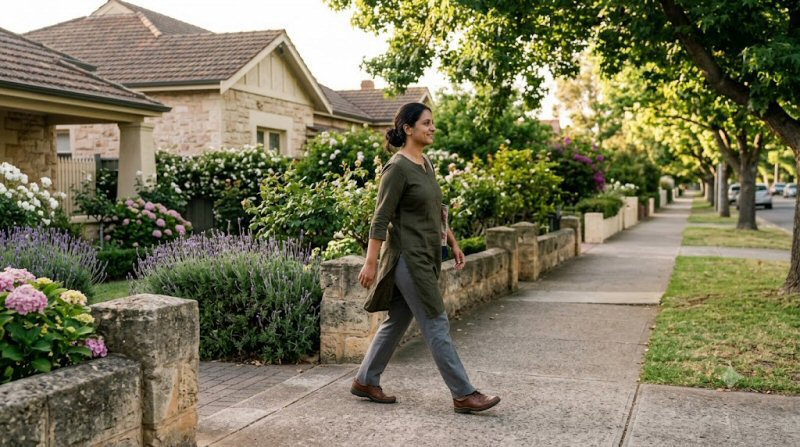
Start with the original drill. On a short walk, let the arms swing. Do not march them. A natural opposite swing is enough to bring the rib cage back into the stride. If one side feels glued, a slightly longer swing on that side for a minute or two is a reasonable cue, then return to easy walking. The spine’s case for this kind of day is laid out in why the spine still expects you to walk more than you sit. The ribs are the part of that walk you can feel under your hands.
Between desk blocks, try a standing reach. Feet quiet, one hand slides up the wall or toward the ceiling, and the rib cage turns a little as the arm goes. Five slow breaths there, then the other side. The point is glide, not a twist that takes the breath away. If a breath makes the pain sharper, stop and stay with walking only.
Unbuckle the lower ribs when you can. Loosen a tight waistband for the walk. Switch the bag side, or use two straps. At the desk, change the lean before the hour is up. A small turn of the chair to reach a shelf counts. The cage needs position change more than it needs a perfect upright freeze.
If mornings are the worst, a warm shower and a few easy side reaches before the commute are often enough. Save deep rotational stretches for after you have already walked. Cold cartilage does not like a sudden end-range demand.
When to See a Doctor
Get urgent care for chest pain with effort, fainting, blue lips, coughing blood, or sudden breathlessness. Book a visit if rib pain follows an injury, wakes you most nights, comes with fever or an unexplained rash, or keeps limiting a full breath after a week of ordinary walking. One-sided weakness, numbness around the chest, or pain that travels in a stripe is also worth a clinical check. A clinician can sort a strained muscle from a joint problem, a nerve, or something in the chest that should not be walked off.
FAQs
Is a stiff rib cage after sitting normal?
A dull, symmetric or slightly one-sided stiffness that eases once you walk and breathe more deeply is a common result of hours without trunk rotation. Sharp, worsening, or breathless pain is not something to file under normal.
Why does one side of my ribs feel tighter?
Most people lean, carry, or reach on a preferred side. That side, or the side that never moves, loses the small step-by-step twist. Sleeping twisted and a one-shoulder bag do the same thing overnight and through the day.
Can walking really move the ribs?
Yes. Ordinary gait includes a counter-rotation between the pelvis and the thorax, linked to arm swing. You will not feel a large twist. You should feel the cage become easier to fill after several minutes of real walking rather than a stiff shuffle.
Should I hear a click when I twist?
An occasional painless click can be a joint pressure change or a tendon flick and is often harmless. Repeated clicking with pain, a catch that stops the breath, or a new click after a fall should be checked.
Does a tight bra or waistband matter?
It can. Anything that pins the lower ribs blocks the outward swing those ribs use in a deeper breath and in walking. If the band leaves a mark and the breath feels taller the moment you loosen it, the clothing is part of the stiffness.
How is this different from a side stitch?
A side stitch is a brief, sharp pain during harder breathing or running, often on one side, that settles when you slow down. Desk-day rib stiffness is a dull limit on twist and on a full breath, present before you exercise. Both can involve the rib region. They are not the same event.
Conclusion
The rib cage still expects a small twist with the stride, a pump-handle lift, and a bucket-handle swing. Chairs, fixed arms, and one-sided bags cancel that expectation for most of the day. The result is a mid-back that feels banded and a breath that stops short. Give the joints their original dose, a walk with arm swing and a few easy reaches, and most of that stuck feeling loosens without a dramatic stretch. Pain that is sudden, breathless, or worsening is a different problem, and it should not be walked past.


