
The small muscles between your hand bones still expect the occasional full finger spread that ancestral gripping and tool use required.
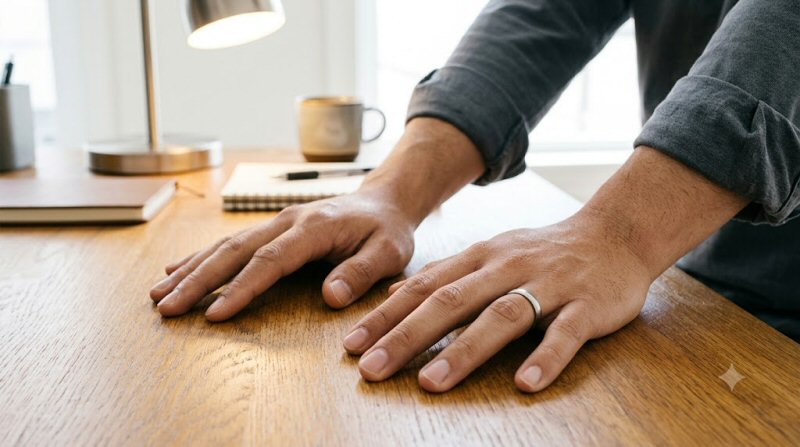
You can type for hours, hold a phone, or grip a steering wheel without ever fully opening your hand. The fingers stay close together, the spaces between them barely used. That constant closed or half-closed posture is new. For most of human history the hands did a lot more spreading, reaching, and side-to-side work.
The small muscles responsible for that spreading sit between the long bones of the hand. They are called the interossei—dorsal ones that move the fingers apart and palmar ones that bring them back together. They still expect occasional full use. When they rarely get it, the hands can feel stiff, the fingers can feel less precise, or a simple stretch can remind you how little those muscles have been asked to do.
What the Interossei Actually Do
There are four dorsal interossei and three palmar interossei. The dorsal ones abduct the index, middle, and ring fingers away from the midline of the hand; the palmar ones adduct them back toward that midline. Both groups also help flex the knuckles and extend the finger joints, giving the fingers the stable, slightly arched posture needed for precise work.
Hand biomechanics researchers such as I. A. Kapandji described how these intrinsic muscles stabilize the fingers during grip and fine manipulation. Electromyography studies by J. V. Basmajian and others showed that the interossei are active not only during deliberate spreading but also during many ordinary pinches and holds, keeping the fingers from collapsing sideways under load. Without them, the fingers lose lateral control and the classic “claw” posture appears when the ulnar nerve is damaged.
The first dorsal interosseous, the one you can feel between thumb and index finger, is especially strong and is recruited whenever you pinch or stabilize the index finger. The others work more quietly, yet they are what let you spread your hand wide to catch something, to stretch a sheet of paper, or simply to open the hand fully after a long period of closed gripping.
Why Ancestral Hands Needed Spreading
Human hands evolved under conditions that demanded a wide range of finger positions. Climbing, foraging, tool making, and carrying irregular objects all required the ability to open the hand fully and then close it with control. Comparative work on primate hands, including electromyographic studies by R. L. Susman and J. T. Stern on chimpanzees, shows that the interossei and related intrinsic muscles are recruited during both locomotion and manipulation. The same muscles that stabilize a knuckle-walking hand also fine-tune the fingers for object handling.
In everyday ancestral life the fingers moved through larger arcs. Reaching into a bush, gripping a branch, shaping a stone tool, or carrying a woven container all involved moments of full abduction followed by controlled adduction. The interossei were loaded repeatedly in both directions. That repeated use kept the muscles strong and the joints mobile in the plane of finger spreading.
Modern hands still contain the same muscle architecture. The dorsal interossei can still generate meaningful force for abduction, and the palmar ones still stabilize the fingers during power grip. What has changed is the frequency of those full-range demands.
How Modern Life Underuses Them
Most contemporary hand postures keep the fingers relatively adducted. Typing, smartphone use, driving, and many desk tasks involve a partially closed hand for long stretches. The fingers stay close enough that the dorsal interossei are rarely asked to produce a full, deliberate spread. Even when you open your hand to reach for a cup or a mouse, the movement is usually small and brief.
This is the opposite of the varied loading the muscles evolved for. Related articles on the site explore similar mismatches: the finger flexors still expect occasional curled grips, the finger extensors still expect full opening, and the thenar muscles still expect thumb opposition. The interossei sit in the same pattern—muscles built for occasional wide, controlled movements that modern tools rarely require.
Over time the lack of full abduction can leave the muscles feeling under-recruited. You may notice that spreading the fingers fully feels slightly stiff or that the hand feels less stable when you try to hold something with the fingers open. The sensation is usually mild and temporary; it is more a reminder of unused range than a sign of injury.
Common Everyday Sensations
Many people first notice the interossei when they deliberately stretch their hands. After hours of typing or gripping a phone, spreading the fingers wide can feel tight between the knuckles. The first dorsal interosseous may ache a little if you have been pinching or holding tools tightly. Some people feel a mild fatigue in the back of the hand after a long day of fine work, even though the larger forearm muscles have done most of the heavy lifting.
These sensations are usually benign. They reflect muscles that have been held in a relatively fixed position and are then asked to move through a range they have not used recently. The same pattern appears in other small hand muscles when modern tasks replace the varied grips of earlier life.
When to Worry
Occasional stiffness after a long closed-hand day is common and usually improves with movement. Seek attention if spreading the fingers becomes genuinely weak, if you cannot hold a piece of paper between two fingers, or if the weakness is accompanied by numbness or tingling in the ring and little fingers. Those signs can point to ulnar-nerve irritation, which supplies all the interossei.
Sudden inability to abduct the fingers, visible wasting in the spaces between the metacarpals, or clawing of the ring and little fingers are reasons to be evaluated promptly. Persistent pain that does not ease with simple movement, or pain that radiates up the arm, also deserves a closer look. Most everyday tightness does not fall into these categories.
Myths vs Facts
Myth: If your fingers feel stiff when you spread them, the interossei must be injured.
Fact: Mild stiffness after prolonged adducted postures is usually underuse, not damage. The muscles respond well to gentle, repeated full-range movement.
Myth: You need heavy resistance to keep these muscles healthy.
Fact: The interossei are small. Controlled spreading against light resistance, or simply moving through full abduction and adduction several times a day, is enough to remind them of their full range.
Myth: Modern keyboards and phones have made these muscles obsolete.
Fact: They remain essential for finger stability during any grip. They are simply used less often at the extremes of their range.
How to Give Them Occasional Work
The simplest cue is deliberate spreading. Several times a day, open the hand fully so the fingers move as far apart as is comfortable, hold for a few seconds, then bring them back together. Repeat the motion slowly ten to fifteen times. You can add a light rubber band around the fingers and spread against it, or place the hand flat on a table and lift each finger slightly while keeping the others down.
After long periods of typing or phone use, pause and spread the fingers wide for ten seconds. The movement takes almost no time and restores the abduction the dorsal interossei expect. If the first dorsal interosseous feels tired from pinching, a few slow pinches against the opposite thumb can reload it without heavy strain.
These small actions do not replace broader hand health habits, but they specifically address the range the interossei evolved to use. Most people notice the hands feel more open and the fingers more precise after a few days of consistent light spreading.
FAQs
Is it normal for my fingers to feel stiff when I try to spread them after typing?
Yes. Prolonged adducted postures leave the dorsal interossei under-recruited. A few deliberate spreads usually restore comfort.
Do I need special exercises, or is everyday use enough?
Everyday gripping keeps the muscles active for stability, but full spreading is rare in modern tasks. Brief intentional spreads close the gap.
Can weak interossei cause hand clumsiness?
Mild underuse can make fine control feel slightly less crisp. True weakness that affects holding objects between the fingers or causes visible wasting needs medical review.
Why does the space between my thumb and index finger sometimes ache?
That is often the first dorsal interosseous after prolonged pinching or tight gripping. Gentle rest and light movement usually settle it.
Are these muscles the same ones affected in ulnar-nerve problems?
Yes. All interossei are supplied by the deep branch of the ulnar nerve. Difficulty spreading the fingers or holding paper between them is a classic sign of ulnar-nerve involvement.
Will spreading my fingers regularly prevent stiffness?
For most people, yes. Occasional full-range abduction counters the constant closed posture of modern hand use and keeps the muscles and joints comfortable.
Conclusion
The interossei are small muscles with a clear job: move the fingers apart and bring them back together while stabilizing the hand during grip. They evolved under conditions that regularly asked for full spreads. Contemporary life rarely makes that request. The result is a quiet mismatch—hands that can feel stiff or less precise until the muscles are reminded of their full range.
A few deliberate finger spreads each day are usually enough to meet that expectation. The movement is simple, takes seconds, and restores the abduction the dorsal interossei still anticipate. Most of the time the stiffness is only a signal that the hands have been held closed for too long, not a sign that anything is wrong.


