
Your gracilis was built for occasional wide stance, dynamic adduction, and knee flexion during walking and ground-level living. Modern chair sitting keeps it in a mild shortened position without the varied loads it expects.
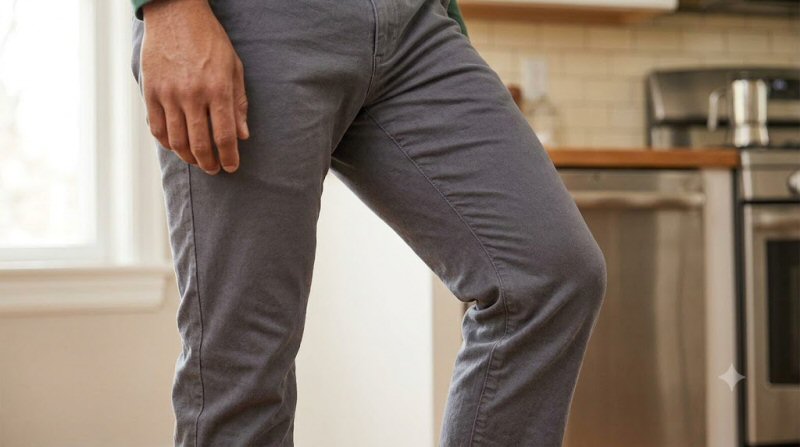
You stand up from your desk after a long stretch of sitting and feel a faint pull along the inside of one thigh. Or you step sideways to catch a bag and notice the inner thigh feels tighter than it used to. That thin muscle running from your pelvis down the medial thigh to the inside of the knee is the gracilis. It is one of the adductors, but it is also a two-joint muscle that flexes the knee. For most of human history it worked during wide stances, climbing, squatting, and the small side-to-side corrections of walking on uneven ground. Chair sitting rarely asks it to do any of that.
What This Muscle Actually Does
The gracilis originates from the lower pubic bone and runs down the inner thigh to insert on the medial surface of the tibia as part of the pes anserinus, alongside sartorius and semitendinosus. It is innervated by the obturator nerve. Its main jobs are hip adduction (pulling the thigh toward the midline), weak hip flexion, knee flexion, and internal rotation of the tibia when the knee is bent.
Because it crosses both the hip and the knee, its length changes with both joints. When you stand with your feet wider than shoulder width or take a lateral step, it lengthens and works. When you sit in a chair with your knees close together and slightly flexed, it stays relatively shortened and quiet. Electromyography studies of the hip adductors, including work by Gregory A. Lovell and colleagues, show that the gracilis activates most strongly during adduction tasks performed with the hip near neutral or modestly flexed, not during the narrow, static posture of typical chair sitting.
Richard L. Lieber and colleagues measured the passive mechanical properties of living human gracilis muscle during surgical procedures. They found it is relatively compliant, generating only modest passive tension even at longer lengths. That compliance is useful for the occasional stretch and load of a wide stance or a deep step; it is less useful when the muscle spends most of the day neither stretched nor loaded.
Why Modern Sitting Changes the Demand
For most of human evolutionary history, people spent non-walking time in postures such as squatting or sitting on the ground. Research on contemporary hunter-gatherer groups, including the Hadza, has shown that these “active rest” postures produce higher lower-limb muscle activity than chair sitting. David Raichlen, Herman Pontzer, and colleagues described this as an inactivity mismatch: total sedentary time can be similar, but the muscle activity within that time differs.
Chair sitting keeps the hips and knees in a mild flexed position with the thighs roughly parallel. The gracilis experiences little length change and little dynamic force. Over months and years the muscle can adapt by becoming shorter and less responsive to sudden lengthening. The same pattern affects the broader adductor group, which is why many people notice inner-thigh tightness after long desk days or car rides. Related patterns appear in other hip muscles that also expect occasional deep or wide ranges; the adductors as a group still expect a wide stance, and the psoas still expects occasional deep hip flexion.
Common Everyday Triggers
The mismatch shows up in ordinary situations:
- Long periods of chair sitting with knees close together
- Driving with a fixed seat position and little side-to-side movement
- Standing with feet parallel and close rather than occasionally stepping wide
- Sudden lateral movements after hours of stillness (reaching sideways, catching a falling object, changing direction while walking)
- Cycling or rowing that repeatedly flexes the knee without full-range adduction variety
None of these are harmful in isolation. They simply fail to provide the occasional length and load the muscle historically received.
When the Feeling Is Probably Benign
A mild sense of tightness or a brief pull along the inner thigh after sitting is common and usually resolves with a short walk or a gentle stretch. The muscle may feel “asleep” or slightly resistant at first, then loosen once it moves through a larger range. Occasional clicking or a soft sensation near the medial knee when you straighten the leg after sitting is often related to the pes anserinus tendons sliding and is not a sign of damage if it is painless.
Less Common but Worth Checking
Persistent inner-thigh or groin pain, especially with walking, climbing stairs, or squeezing the knees together, can indicate an adductor strain. These are more frequent in sports that involve sudden direction changes. Pain specifically at the medial knee that worsens with knee flexion or adduction can involve the pes anserinus area. True weakness, numbness along the inner thigh, or pain that radiates from the lower back may point to nerve irritation rather than a simple muscle adaptation. A sudden sharp tear with bruising is uncommon in everyday life but can occur with a forceful wide step or fall.
If tightness is accompanied by visible swelling, fever, or an inability to bear weight, seek medical evaluation rather than stretching through it.
Hidden Contributors
Several modern factors amplify the basic mismatch:
- Shoes with narrow toe boxes and stiff soles that limit natural foot splay and subtle pelvic shifts
- Seats that are too high or too low, forcing the thighs into a fixed angle
- Habitual leg-crossing that shortens one side more than the other
- Core and glute weakness that shifts extra stabilization work onto the adductors
- Dehydration or low overall daily movement, which can make any muscle feel tighter
These do not create the problem alone, but they reduce the small, frequent opportunities the gracilis would otherwise have to lengthen and shorten.
Myths Versus Facts
Myth: Inner-thigh tightness means you need aggressive stretching every day.
Fact: Occasional gentle lengthening is useful, but the muscle also needs occasional loaded shortening and dynamic use. Constant passive stretching without strength or varied movement can leave it weak.
Myth: Sitting with perfect posture completely protects the adductors.
Fact: Even good chair posture keeps the gracilis in a relatively static, mid-range position. The missing element is occasional wider stance and knee flexion under light load.
Myth: Only athletes get gracilis problems.
Fact: Everyday desk workers and drivers commonly report the same tightness because the modern environment removes the varied demands the muscle expects.
Simple Ways to Give It What It Expects
You do not need a special program. Small, frequent changes restore some of the missing variety:
- Stand and take two or three wider steps every hour. Place one foot slightly out to the side and shift your weight gently, then return.
- When you sit, occasionally open your knees a few inches rather than keeping them tightly together, or stand and squat partway for a few seconds.
- During a walk, include a short stretch of lateral steps or simply walk with a slightly wider base for a minute.
- Practice a gentle “sumo” stance: feet wider than hips, toes turned out modestly, and a soft knee bend held for 20–30 seconds while breathing normally.
- If you already exercise, add a light side-step or lateral lunge once or twice a week rather than only forward-and-back movements.
These movements use the gracilis through a larger range without requiring heavy loads. People who already notice hip tightness after sitting often find that the same simple changes help both the adductors and the deeper hip flexors. Related sitting-related hip stiffness is covered in hips that feel tight after sitting.
When to See a Doctor
See a clinician if you have persistent groin or inner-thigh pain that limits walking, sudden sharp pain with bruising, numbness or weakness in the thigh, or pain that radiates from the lower back. Also seek care if the tightness does not improve after a week or two of ordinary movement and gentle activity, or if you have a history of hip or knee injury that has recently worsened.
Frequently Asked Questions
Is it normal for the inside of my thigh to feel tight after a long day at a desk?
Yes. Chair sitting keeps the gracilis relatively shortened and unloaded. A mild tight sensation that eases with walking is common and usually reflects reduced daily range rather than injury.
Can a tight gracilis cause knee pain?
It can contribute to discomfort at the medial knee where it inserts with the other pes anserinus tendons. The pain is typically mild and activity-related. Persistent or swelling-related knee pain should be checked.
Should I stretch my gracilis every day?
Gentle lengthening a few times a week is reasonable, but daily aggressive stretching is unnecessary. Occasional wide-stance movements and light loaded knee flexion are more useful for restoring normal function.
Does crossing my legs make this worse?
Habitual one-sided crossing can create asymmetric tightness. Alternating sides or simply sitting with knees a little farther apart reduces the imbalance.
Will strengthening my glutes help?
Often yes. Stronger glutes and hip abductors share stabilization work so the gracilis and other adductors do not have to compensate as much during standing and walking.
Is this the same as a groin strain?
No. Everyday tightness from under-use is different from a strain, which involves a sudden pull, sharper pain, and sometimes bruising. Strains are more common in sports with rapid direction changes.
Conclusion
The gracilis is a slender, compliant muscle that evolved to handle occasional wide stances, dynamic adduction, and knee flexion during ordinary movement and ground-level postures. Modern chair sitting removes most of those demands, leaving the muscle shorter and less practiced. The resulting mild tightness is usually harmless and responds well to simple, frequent variety—wider steps, occasional partial squats, and light lateral movements. You do not need to abandon chairs; you only need to give the muscle a few of the ranges it still expects.


