
Your gluteus minimus keeps the pelvis level during single-leg stance. Modern sitting and flat walking leave it underused. Learn why it still expects occasional lateral balance and simple ways to meet that need.
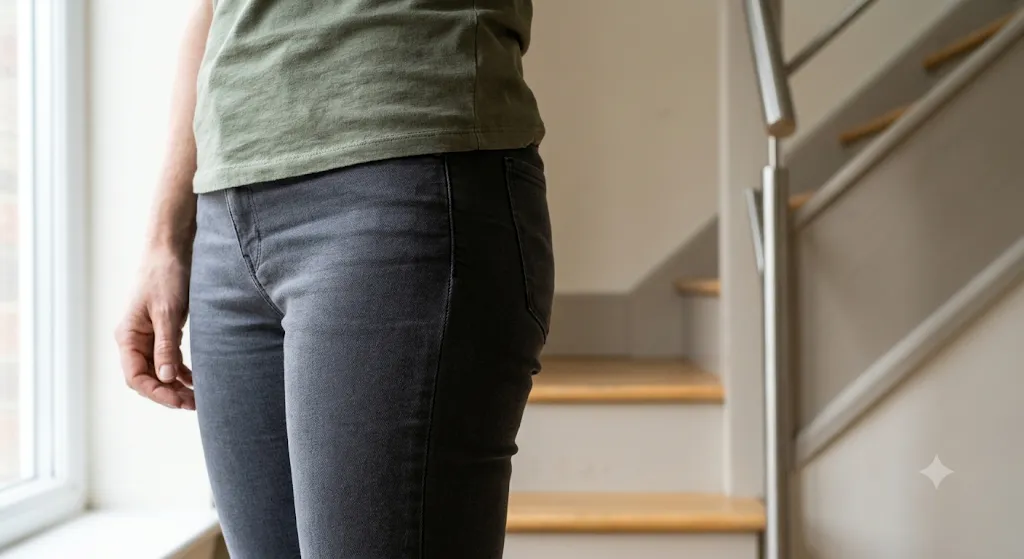
Every time you stand on one foot to put on a shoe or take a step, a small deep muscle on the side of your hip has to work. The gluteus minimus is the deepest of the three gluteal muscles. It helps keep your pelvis level so the opposite leg can swing forward without your whole trunk dipping. Most modern days give it far less of that single-leg work than it was built for.
What the Gluteus Minimus Actually Does
The gluteus minimus is a fan-shaped muscle that originates on the outer surface of the ilium, between the anterior and inferior gluteal lines, and inserts on the anterior aspect of the greater trochanter of the femur. It is innervated by the superior gluteal nerve. Its main jobs are hip abduction (moving the thigh away from the midline) and medial (internal) rotation of the thigh, plus continuous stabilization of the pelvis during single-leg stance.
When you stand on one leg, the gluteus minimus on that side, working with the gluteus medius, contracts to stop the opposite side of the pelvis from dropping. This is the classic role that prevents a Trendelenburg gait. Electromyography studies using fine-wire electrodes, including work by Semciw and colleagues, have shown that the anterior and posterior segments of the muscle activate at slightly different times during the gait cycle, giving fine control over pelvic position and femoral rotation. Research by Moore and others has further mapped which everyday and rehabilitation movements produce the highest activity in each segment.
In short, it is a stabilizer more than a power muscle. It keeps the hip joint compressed and the pelvis steady so larger muscles can do the bigger work of propulsion.
Why It Still Expects Occasional Lateral Balance
Human walking is a series of single-leg stances. Evolutionary anatomist Daniel Lieberman and others have described how the arrangement of the gluteus medius and minimus became essential for efficient upright bipedal gait. In ancestral environments the ground was uneven, paths required frequent side steps and balance corrections, and people spent most of their waking hours on their feet. The gluteus minimus therefore received repeated, varied loading: brief isometric holds while standing on one leg, small abduction forces on slopes or while reaching sideways, and internal rotation moments as the body adjusted direction.
Modern life replaces most of that with prolonged sitting (which places the hip in flexion and reduces the muscle’s abduction capacity) and walking on flat, predictable surfaces. The muscle is not asked to make those constant small corrections. Over months and years the deep fibers can become quieter, even while the larger gluteus maximus or the more superficial medius still fire. The expectation of occasional lateral balance work remains wired into the tissue’s architecture and neural control.
You can see a related pattern in articles on why the gluteus medius still expects a single-leg step and occasional sideways steps. The minimus sits just deep to the medius and shares the same stabilizing job, but it is easier to under-load because it is smaller and less visible.
What Underuse Feels Like in Daily Life
When the gluteus minimus is quiet for long periods, people often notice a few ordinary things:
- A sense that the hip “gives” or feels less steady when standing on one leg to dress or wash the other foot.
- Mild deep ache on the outer hip after a long day of sitting followed by a walk, or after climbing stairs.
- A tendency for the knee to drift inward during a single-leg squat or when stepping off a curb (the deeper stabilizer is not holding the femur as firmly).
- More reliance on the tensor fasciae latae or the lower back when the pelvis has to stay level.
None of these automatically mean injury. They are often just the result of the muscle receiving less of the brief, frequent loading it expects. Prolonged sitting can also leave the anterior fibers in a shortened position, so the first steps after a desk day feel stiff until the muscle warms up.
Simple Ways to Meet the Expectation
You do not need heavy equipment. The muscle responds to controlled single-leg positions and modest abduction or rotation loads. Useful patterns include:
- Standing on one leg while brushing your teeth or waiting for the kettle, with a light fingertip touch on a counter for safety. Hold 20–30 seconds per side.
- Slow side steps or “monster walks” with a light resistance band just above the knees, keeping the pelvis level. Ten to fifteen steps each direction is enough for most people.
- Single-leg bridge or single-leg squat to a chair, focusing on not letting the opposite hip drop. Moore’s EMG work showed these produce high activity in the posterior segment.
- Occasional lateral balance on a slightly uneven surface (a folded towel or soft mat) while keeping the standing knee softly bent and the pelvis square.
Short sessions spread through the day are more in keeping with the ancestral pattern than one long gym session. Pairing them with ordinary walking, as discussed in pieces on why the pelvis still expects the motion of walking, gives the whole hip-stabilizer system the varied input it was built for.
When to Pay Closer Attention
Most quietness in the gluteus minimus is harmless and improves with ordinary loading. See a clinician if you notice:
- A clear drop of the pelvis on the opposite side every time you stand on one leg (Trendelenburg sign) that does not improve with practice.
- Sharp or persistent deep hip pain that radiates or wakes you at night.
- Weakness that makes stairs or getting out of a car suddenly difficult, or any numbness or tingling in the leg.
- Pain after a fall or sudden twist that does not settle within a few days.
These can point to more than simple underuse—nerve irritation, tendinopathy, or joint issues that benefit from specific assessment. For the common “my hip feels less steady after sitting all day” pattern, gradual reintroduction of single-leg work is usually sufficient.
Frequently Asked Questions
Is the gluteus minimus the same as the gluteus medius?
No. They sit next to each other and share the job of keeping the pelvis level, but the minimus is smaller, deeper, and has slightly different fiber orientation. Both are underused by prolonged sitting, yet they can be trained with overlapping exercises.
Can sitting really weaken it that much?
Sitting places the hip in flexion, a position in which the minimus’s ability to abduct drops and internal rotation becomes more dominant. Hours of that position, day after day, reduce the brief isometric holds the muscle normally gets during walking and standing. The change is gradual and reversible for most people.
Do I need special equipment to wake it up?
No. Single-leg stands while you do ordinary tasks, slow side steps, and controlled single-leg bridges are enough for everyday maintenance. A light band can be added later if you want more challenge, but it is not required.
Why does one side often feel weaker?
Most people favor one leg when standing or when they shift weight. The less-used side simply receives fewer of those stabilizing contractions. Alternating which leg you stand on during daily tasks usually balances it over a few weeks.
Is pain on the outer hip always this muscle?
No. Outer-hip pain can come from the gluteus medius tendon, the trochanteric bursa, referred lumbar issues, or simple muscle fatigue. The minimus is deep, so its contribution is often part of a broader stability picture rather than the sole source of sharp pain.
How quickly should I notice a difference?
Many people feel steadier on one leg within one to two weeks of adding a few short single-leg holds each day. Strength and coordination continue to improve over several weeks if the loading stays consistent and pain-free.
Conclusion
The gluteus minimus is a small, deep stabilizer that evolved to keep the pelvis level during the repeated single-leg moments of walking and balance. Modern sitting and flat, predictable surfaces give it far fewer of those moments. Occasional deliberate lateral balance—standing on one leg, taking slow side steps, or holding a controlled single-leg position—simply returns a loading pattern the muscle still expects. For most people that is enough to restore the quiet steadiness the hip was built to provide.


