
Your pelvis was built for constant weight shifts and stride-driven motion. Modern sitting locks it still, leading to stiffness and lower-back tightness that a short walk often eases.
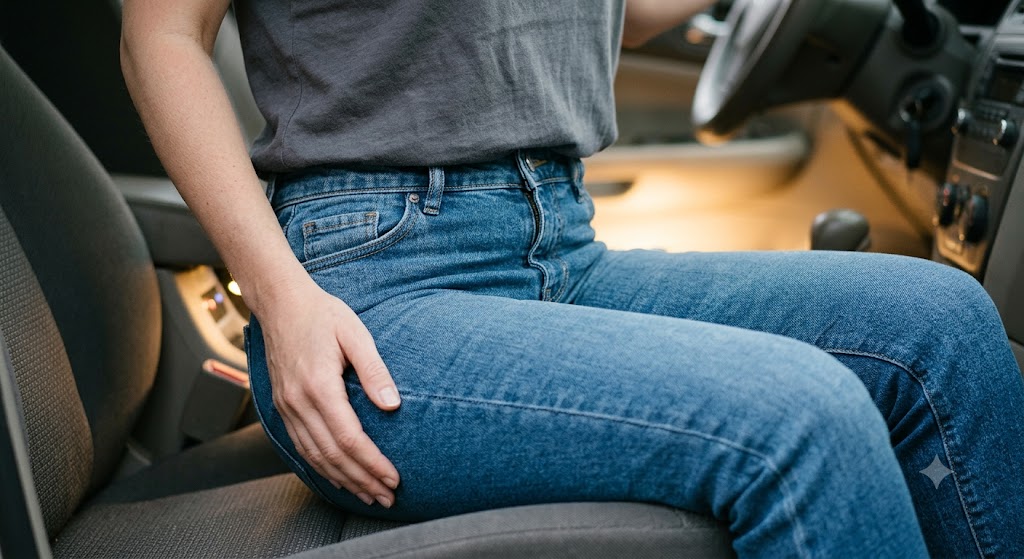
You stand up from the desk and the first few steps feel stiff through the hips and lower back. The pelvis seems glued in place until you walk a little and everything loosens. That sequence is common enough that most people barely notice it anymore.
Your pelvis was never designed for long stretches of fixed sitting. It evolved as a mobile platform that tilts, rotates, and shifts weight with every stride. When that motion disappears for hours, the joints and surrounding tissues stiffen in ways that feel surprisingly stubborn once you try to move again.
What This Stiffness Feels Like
The sensation is usually a deep, dull tightness across the low back, the front of the hips, or right at the center of the pelvis. Some people describe it as the hips “not wanting to swing,” or a sense that the lower spine is locked until a few dozen steps unlock it. The first steps out of the car or after a long meeting often feel the most restricted; after a short walk the same area moves more freely.
It is rarely sharp pain at the start. More often it is a reluctance to move, a sense of heaviness, or the need to stretch the hips before they feel usable. Many people also notice the stiffness returns quickly if they sit again.
Common Everyday Causes
Prolonged sitting is the main modern trigger. A chair holds the pelvis in a relatively fixed posterior tilt and reduces the small, repeated weight shifts that normally occur while standing or walking. Desk work, driving, and long meetings all do the same thing: they keep the pelvic ring still for far longer than ancestral daily life required.
Other common contributors include:
- Soft couches or car seats that encourage a slumped pelvic position
- Standing in one place without shifting weight
- Wearing shoes with thick, rigid soles that mute the ground feedback the pelvis uses for balance
- Core bracing that is held constantly rather than used briefly during lifting
None of these are inherently harmful in isolation. The problem appears when the pelvis receives almost no varied motion for most of the day.
Why This Happens: The Pelvis Was Built to Move With Every Step
Human bipedalism depends on a pelvis that can transfer force efficiently while remaining mobile. With each step the pelvis tilts slightly, rotates in the transverse plane, and shifts weight from one side to the other. These small movements allow the legs to swing freely and keep the spine from having to absorb every impact.
Andry Vleeming’s work on the sacroiliac joints showed how form closure (the shape of the bones) and force closure (the pull of muscles and ligaments) work together to stabilize the pelvis during walking while still permitting the tiny motions needed for efficient gait. Daniel Lieberman’s research on the evolution of the human pelvis highlights how our wide, bowl-shaped pelvis and the associated gluteal and hip muscles developed specifically for endurance walking and running on varied terrain.
When you sit for hours, those joints receive almost none of the loading and unloading cycles they expect. Synovial fluid circulation slows, the surrounding fascia and ligaments adapt to the fixed position, and the muscles that normally control pelvic tilt (gluteus maximus, deep hip rotators, and the pelvic floor) become less responsive. The first steps after sitting feel stiff because the system has to re-establish the motion it lost.
A related article on why your hips still expect a natural pelvic tilt explores the same sitting-related change from the hip-joint angle. The pelvic floor and glute articles below cover the muscle side of the same problem.
Less Common but More Serious Possibilities
Most pelvic stiffness after sitting is mechanical and resolves with movement. Occasionally the same sensation can signal something that needs medical attention:
- Sacroiliac joint dysfunction that produces one-sided pain radiating into the buttock or thigh
- Early hip osteoarthritis that limits internal rotation and causes stiffness after rest
- Inflammatory conditions such as ankylosing spondylitis (more common in younger men and often worse in the morning)
- Pelvic floor hypertonicity that creates a deep, central ache and sometimes urinary or bowel symptoms
These are less common than simple inactivity-related stiffness, but they share the feature of not improving (or even worsening) once you start walking.
Hidden Triggers People Often Miss
Several everyday habits amplify the mismatch:
- Crossing the same leg for long periods, which twists the pelvis into a fixed position
- Sitting on a wallet or thick phone case that tilts one side of the pelvis
- Holding the breath while concentrating, which reduces the gentle pelvic motion that accompanies normal breathing
- Going from long sitting straight into intense exercise without a few minutes of easy walking
The combination of stillness plus sudden demand is particularly hard on the SI joints and the deep hip rotators.
When to Worry
Seek an evaluation if you notice any of the following:
- Pain that is sharply one-sided and radiates into the groin or down the leg
- Stiffness that lasts more than an hour after you start walking
- Night pain that wakes you or morning stiffness lasting longer than 30–45 minutes
- Numbness, weakness, or changes in bowel or bladder control
- A recent fall or impact followed by persistent pelvic pain
Occasional stiffness that eases within a few minutes of walking is almost always the expected response of a mobile structure that has been held still.
Myths vs Facts
Myth: A stiff pelvis after sitting means your core is weak.
Fact: The pelvis needs motion more than constant bracing. Many people with strong cores still stiffen when they sit for hours without shifting.
Myth: You should keep the pelvis perfectly neutral and still while sitting.
Fact: Small, frequent weight shifts and occasional standing are healthier for the SI joints and surrounding tissues than prolonged stillness, even in a “good” posture.
Myth: Stretching the hips once a day is enough.
Fact: The pelvis responds better to frequent, low-level motion throughout the day than to a single long stretch session.
How to Give Your Pelvis the Motion It Expects
You do not need long workouts. The goal is to restore the frequent, small movements the pelvis was built for.
- Stand and shift your weight from side to side or take a short walk every 30–40 minutes of sitting.
- Practice a few gentle pelvic tilts or figure-eight hip circles while standing or on all fours.
- Walk on slightly uneven surfaces (grass, packed dirt, or a low curb) when you can; the changing ground forces the pelvis to adjust.
- When you sit, change positions often and avoid keeping a wallet or phone under one hip.
- Include a short walk before and after longer drives or meetings so the transition is less abrupt.
These habits reintroduce the loading cycles that keep the SI joints and surrounding muscles responsive. Related guidance appears in the articles on why your pelvic floor still expects a daily squat and walk and why your glutes still expect hills and deep extension.
When to See a Doctor
Most desk-related pelvic stiffness improves with more frequent movement and does not require treatment. See a clinician if the stiffness is accompanied by radiating pain, lasts well into your walk, or is joined by neurological symptoms. A physical therapist familiar with SI joint and hip mechanics can often identify whether the restriction is primarily joint, muscle, or movement-pattern related.
FAQs
Why does my pelvis feel fine while I am sitting but stiff the moment I stand?
Sitting reduces the normal weight-shift and rotational motion. When you stand, the joints and soft tissues that have been held still need a few steps to resume their usual glide and force-closure pattern.
Is it better to sit with a lumbar support or to keep changing position?
Changing position and standing periodically helps more than any single “perfect” seated posture. A support can reduce slouching, but it does not replace the motion the pelvis expects.
Can walking on a treadmill replace outdoor walking for pelvic health?
A treadmill provides some stride motion, but flat, predictable surfaces give the pelvis less varied demand than uneven ground. Even a few minutes on grass or a sidewalk with slight camber adds useful variety.
Does strengthening the core fix pelvic stiffness from sitting?
Core strength is useful for lifting and stability, but the primary issue after long sitting is lack of motion, not lack of strength. Frequent light movement usually helps more than extra bracing exercises alone.
Why do some people feel the stiffness more on one side?
Habitual leg crossing, carrying a bag on one shoulder, or sitting with a wallet on one side can tilt the pelvis asymmetrically. The side that stays relatively fixed often feels tighter when you finally move.
Conclusion
Your pelvis still expects the small, repeated weight shifts and rotational motions of walking because that is the pattern it evolved to handle. Long periods of fixed sitting remove those cycles and leave the joints and soft tissues temporarily stiff. The stiffness is usually a straightforward response to modern stillness rather than a sign of damage. Restoring frequent, low-level motion—short walks, weight shifts, and position changes—gives the pelvis the loading it was built for and keeps the first steps of the day from feeling so locked. Most people notice a clear difference within a few days of simply standing and moving more often.


