
Gluteus medius still expects to hold the pelvis level on one leg with every step. Chairs never ask for that job, then a walk or stair aches the outer hip.
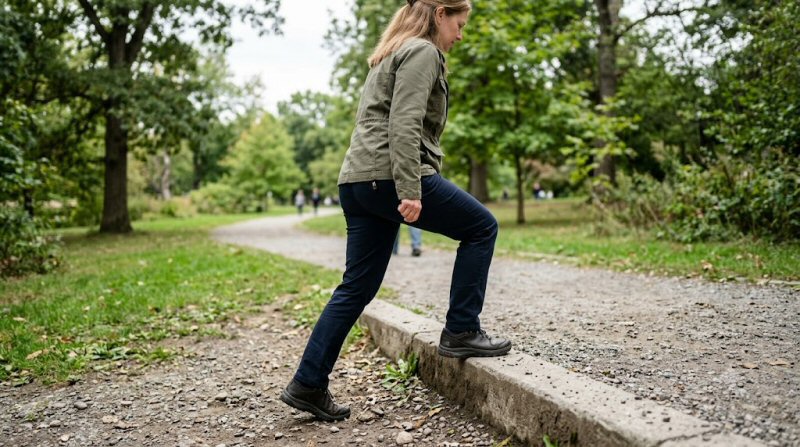
The ache sits on the outside of the hip, just behind the bony point you can feel when you stand with a hand on your pocket. It shows up on a long walk, on the second flight of stairs, or when you stand on one leg to pull on a shoe. Sitting in a deep chair feels fine. Crossing that leg makes the spot tender again. By evening the same hip complains if you lie on it.
That spot is where gluteus medius meets the greater trochanter. The muscle still expects a single-leg step, many times an hour, with the pelvis held level. A chair never asks for that. Both feet are on the floor, or neither is carrying you. The abductor that was rebuilt for bipedal walking spends the day quiet, then gets the whole job at once.
What This Ache Feels Like
The usual complaint is a dull burn or deep pinch over the outer hip, sometimes traveling a few inches down the side of the thigh. It is worse after walking, standing on one leg, or climbing stairs, and easier when you sit with the knees apart. Some people notice the opposite side of the pelvis dipping when they watch themselves in a shop window. A heavy bag on one shoulder makes the other hip work harder and ache sooner.
A short stiffness after a new hill that fades the next day is common. Pain that wakes you when you lie on that side, a limp that lasts more than a week, or a hip that gives way on stairs is a different story. Groin pain deep in the front of the joint, catching, or pain that started with a twist and a pop belongs to the joint or a tendon in front, not to this side stabilizer.
What the Muscle Was Rebuilt to Do
In apes, the gluteus medius is more of a propeller. It helps extend the hip as the animal climbs or knuckle-walks. When hominins stood up, the blade of the ilium flared out to the side. The same muscle swung around to the lateral hip and became the main abductor. C. Owen Lovejoy and later gait anatomists argued that this rearrangement is part of what made a level pelvis possible on one leg. Without it, each step would drop the swing-side hip and waste energy.
Jack Stern, Randall Susman, and the comparative work that followed them made the same point from fossils and living apes: human gluteus medius is a pelvic stay, not a leftover climbing engine. Daniel Lieberman has described the energetic bargain of human walking. A level pelvis keeps the center of mass from lurching side to side. The price of that bargain is a muscle that must fire on every single-leg stance, for as many steps as the day contains.
Verne Inman estimated the demand in plain numbers. The body-weight lever from the center of the pelvis out to the hip is long. The gluteus medius lever from the joint out to the trochanter is short. To keep the pelvis level, the abductors often produce a force around twice body weight on the stance leg. Jacquelin Perry’s gait work put single-limb support at most of each stride. Double support, when both feet share the load, is brief. The muscle’s ancestral job is not a gym set. It is the ordinary step.
Donald Neumann later mapped the segments. The posterior fibers help steady rotation. The middle fibers hold the pelvis in the frontal plane. Anterior fibers assist flexion. Adam Semciw’s electromyography showed those regions do not switch on as one blob. A slow level walk uses them differently from a side step or a stair. Variety was the original program.
Why Chairs Leave It Late
Sitting loads the hip in flexion, often with the thigh rolled inward and the knees together. That position shortens or compresses the tendon against the trochanter, depending on how you sit, and it never reproduces the single-leg torque. Hours of that, then a commute walk, is a familiar pattern: quiet tissue, then a sudden demand near the top of its force range.
Alison Grimaldi and colleagues have argued that gluteal tendinopathy is often a compression-and-load problem, not simple weakness. Lying on the sore side, crossing the legs, and standing with the hip dropped all press the tendon into the bony trochanter. Add a long walk before the tendon has been prepared, and the outer hip lights up. The muscle can be strong in a clinic test and still irritable if the day’s postures keep compressing it.
The glute article on hills and the floor covers gluteus maximus, the climber and the get-up muscle. Medius is the neighbor with a different job. Maximus can feel fine while medius complains on level pavement. The IT band piece sits on the same outer hip. A tight-feeling band is often the fascia taking load the abductor did not share, especially on cambered roads.
Hidden Triggers
A few patterns show up more often than one unlucky step.
Long sitting with knees crossed or ankles stacked. The top hip rests in adduction. The tendon stays compressed for the length of a meeting.
A bag always on the same shoulder. The pelvis shifts, one medius holds a longer moment, and the other side never gets the job.
Side sleeping on the sore hip, or on the other hip with the top knee fallen forward and no pillow between the legs. Both positions load the tendon at night, which is why the ache can be worse at dawn than at noon.
Sudden hills, stairs, or a first run after a seated season. Collagen keeps the strength it has been given. It does not store a reserve for a weekend it never trained.
Very cushioned shoes on flat pavement. The foot rolls in, the knee drifts, and the hip abductor’s timing slips. The sideways-step article describes the ankle half of that chain. If the foot cannot steer, the hip pays next.
Standing still with weight on one leg, hip cocked. It looks relaxed. It is a sustained hold at end range, which the muscle was not built to do for twenty minutes in a queue.
When to Worry
Most outer-hip fatigue after a new walk settles in a few days of easier steps and fewer crossed-leg hours. Get it checked sooner if you cannot stand on that leg without the other side of the pelvis dropping hard, if night pain continues even when you sleep on your back with a pillow between the knees, or if the limp is getting worse over two weeks.
Groin pain, locking, or a hip that will not rotate inward after a twist needs an exam. A hot swollen joint, fever, or pain with weight that followed a fall can be joint, bursitis with infection, or a fracture, especially after a minor stumble in older adults. Numbness down the side of the shin, or pain that shoots past the knee with a cough, points more toward the back or a nerve than toward gluteus medius. True weakness that appeared overnight, with a foot drop or trouble rising from a chair, is not a simple tendon story.
Greater trochanteric pain is common and usually mechanical. It is not the same as hip osteoarthritis, a stress fracture, or a tear that has stopped the muscle from holding the pelvis. Those are the reasons a persistent limp deserves a clinician rather than another week of stretching the sore spot.
Myths vs Facts
Myth: Outer-hip pain means the bursa is inflamed and needs rest alone.
Fact: A bursa can be irritated, but Grimaldi and others have shown the gluteal tendons are often the main tissue. Complete rest removes the signal the tendon needs to tolerate load again.
Myth: If the muscle is weak, aggressive side-lying leg lifts will fix it.
Fact: A leg lift done with the pelvis rolling backward mostly works other muscles and can compress the tendon. Slow stance work with a level belt line is closer to the original job.
Myth: The IT band is tight and should be foam-rolled until the pain stops.
Fact: The band is a strap, not a muscle that shortens like a hamstring. Rolling may change sensation. It does not replace single-leg control.
Myth: This only happens to runners.
Fact: Walkers, people who stand at work, and people who sit all week and hike on Saturday are typical. The mismatch is missing single-leg hours, not missing a sport.
How to Give It the Step Back
You do not need a new gait. You need the stance the muscle already knows, in amounts it can recover from.
Break long sitting. Stand up every half hour and shift weight fully onto one leg for a few slow breaths, then the other, with the belt line level. A hand on a table is fine at first. The point is the pelvic stay, not a balance trick.
On walks, let the arms swing and avoid hiking the hip. If a cambered road always bothers one side, switch sides of the street. Hills and stairs are useful once level walking is comfortable. Take them slowly enough that the pelvis does not drop.
At night, sleep on your back, or on the non-sore side with a pillow between the knees so the top hip does not fall into adduction. Skip leg crossing as a default sitting posture for a few weeks.
For strength, a side-lying lift only helps if the pelvis stays stacked and the movement is small. A standing hip hike on a step, or a slow single-leg stand while the opposite foot taps forward and back, matches Inman’s demand more closely. Start with short holds. Add time before you add speed. Pain that fades within a day is acceptable. Pain that climbs each morning is a signal to cut the volume.
Shoes with a stable heel and a sole you can feel help the hip time its work. You do not need a minimal shoe on day one. You need a shoe that is not worn flat on the outer heel.
When to See a Doctor
See someone if the outer hip is hot and swollen, if you cannot bear weight, if pain followed a fall, or if groin pain and stiffness are the main story. Also go if a week of easier walking and night-position changes does nothing, or if you notice a new Trendelenburg limp that a partner can see from behind. Imaging is rarely the first step for a clear mechanical outer-hip ache. It matters when the story includes trauma, night pain that ignores position, or weakness that does not match a tendon irritation.
FAQs
Why does the outside of my hip hurt after walking but not after sitting?
Sitting never asks gluteus medius to hold body weight on one short lever. Walking does, on almost every step. The ache is the tendon meeting a job it has not practiced, often after hours of compression from a chair.
Is a dropping hip when I stand on one leg serious?
A small dip is common when the muscle is deconditioned. A hard drop, a limp, or a drop that appeared suddenly is worth an exam. Trendelenburg described the sign as a clue to abductor failure, not as a normal quirk to ignore for months.
Does side sleeping cause this?
It can feed it. Direct pressure on the trochanter, or the top knee falling forward, compresses the gluteal tendons for hours. A pillow between the knees or sleeping on your back often calms night pain faster than stretching.
Should I stop walking until it goes away?
Total rest usually backfires. Shorter, flatter walks with a level pelvis keep the load the muscle expects, without the long compressed sits and the sudden weekend hill. Stop only if each walk clearly worsens the next morning.
Can this become a tear?
Ongoing overload and compression can irritate the tendon and, less often, lead to a partial tear. Most outer-hip aches stay mechanical and settle with load changes. A pop, clear weakness, or a limp that worsens is the point to get it examined rather than to push through.
Conclusion
Gluteus medius was rearranged for one human problem: staying level while the other foot is in the air. Chairs, crossed knees, and same-side bags never rehearse that problem. The outer hip complains when the rehearsal finally comes, all at once, on a stair or a long pavement. Give the muscle single-leg minutes it can recover from, take the night compression off the tendon, and the step it still expects becomes ordinary again.


