
The gastrocnemius is built for hills, stairs, and short bursts of power, yet most modern days keep it on flat floors. Here’s why the calf muscle still expects that work and how to give it a little without strain.
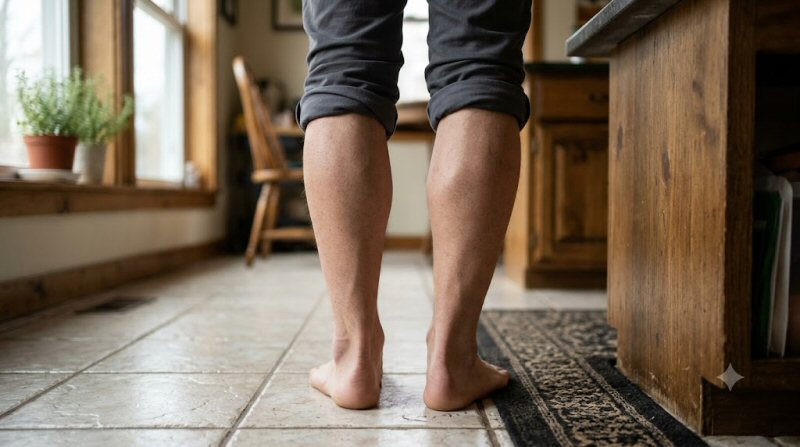
You step off a curb and the back of your lower leg suddenly feels tight, or you climb a short flight of stairs after a week of flat walking and the calves burn more than the effort seems to deserve. That sensation is common. The gastrocnemius—the more visible, two-headed muscle that forms the upper part of the calf—still carries an expectation shaped by ground that was rarely level and by short bursts of speed or lift that modern sidewalks and elevators rarely demand.
What This Muscle Actually Does
The gastrocnemius crosses both the knee and the ankle. When it contracts with the knee relatively straight, it plantarflexes the foot (points the toes downward) and helps generate the push-off force that propels you forward. Because it also flexes the knee, its length and tension change with every bend of the leg. Researchers using electromyography, including classic work by John Basmajian and later studies of incline walking, have shown that the gastrocnemius becomes more active when the grade steepens or when walking speed rises, while its partner the soleus handles more of the steady postural load on level ground.
Glen Lichtwark and colleagues have documented how the gastrocnemius fascicles and the Achilles tendon interact during uphill and downhill steps: the muscle often works nearly isometrically on moderate grades while the tendon stores and returns elastic energy. That spring-like arrangement, long noted by R. McNeill Alexander in studies of animal and human locomotion, lets the muscle produce force efficiently rather than constantly shortening and lengthening under load. On flat, predictable pavement the demand drops. On a hill, a stair, or a sudden acceleration, it returns.
Why Modern Days Leave It Under-Used
Ancestral landscapes were rarely flat. Even modest slopes, uneven trails, and occasional short sprints or climbs recruited the biarticular calf repeatedly. Daniel Lieberman’s work on human locomotor evolution emphasizes how features such as a long Achilles tendon and a robust plantarflexor complex supported efficient endurance walking and occasional faster gaits. Today most indoor and urban surfaces are engineered to be level; elevators and escalators remove the need to lift the body against gravity for more than a few steps at a time. The gastrocnemius therefore spends long stretches either quiet (while sitting) or performing only low-level, repetitive work (while walking on the flat).
Sitting itself alters the muscle’s resting length. With the knee bent, the gastrocnemius is slackened at the knee while the ankle is often held in a mildly plantarflexed position by shoes or by the simple habit of resting the feet. Over weeks and months this can contribute to the isolated gastrocnemius tightness that clinicians commonly measure: ankle dorsiflexion is limited when the knee is straight but improves when the knee is bent. Prolonged unloading also favors earlier atrophy in the gastrocnemius than in some other lower-leg muscles; bed-rest and immobilization studies repeatedly show faster volume loss in the medial gastrocnemius. The muscle does not disappear, but its capacity for rapid force and its tolerance for stretch both decline when the hills and power steps never arrive.
Common Sensations and Hidden Triggers
Many people notice the mismatch as a sudden “pull” when they point the toes hard, rise onto the balls of the feet, or take stairs two at a time after days of desk work. Others feel a low-grade stiffness at the back of the knee or upper calf after long sitting, then a burn once they start walking uphill. Hidden contributors include:
- Shoes with elevated heels that keep the ankle slightly plantarflexed all day, further shortening the resting length of the gastrocnemius.
- Long uninterrupted sitting that both unloads the muscle and reduces the natural fluid pumping action of the calf (related to the venous return discussed in other work on the calf pump).
- Sudden return to hills, trail running, or even vigorous gardening after weeks of flat walking—exactly the pattern that can produce delayed calf soreness.
- Inadequate recovery between sessions that already load the muscle heavily (for example, repeated jump training without gradual progression).
These triggers are mechanical and reversible for most people; they are not signs that the muscle is “broken.”
When the Sensation Deserves Attention
A brief tightness that eases within a day or two of ordinary walking or a gentle stretch is the expected response of a muscle that has not been asked to do its ancestral job. Seek evaluation if you experience:
- A sudden sharp pain or a popping sensation in the calf followed by swelling or bruising (possible muscle or tendon tear).
- Persistent night cramps that wake you repeatedly and are not relieved by simple position changes or hydration.
- Swelling, redness, or warmth in one calf only, especially if accompanied by shortness of breath or chest discomfort (possible clot—urgent).
- Weakness that makes it hard to rise onto the toes on one side, or numbness and tingling that travels into the foot.
Most everyday calf stiffness does not fall into these categories.
Myths Versus Everyday Reality
Myth: “If your calves are tight you must stretch them aggressively every day.”
Reality: Aggressive stretching of an already shortened gastrocnemius can irritate the muscle–tendon junction. Short, frequent movement through a comfortable range—walking, gentle heel drops off a low step, or simply standing and rising onto the toes a few times—usually restores tolerance more safely than long static holds.
Myth: “Calf raises are only for athletes.”
Reality: Simple double-leg or single-leg heel raises performed a few times a day give the gastrocnemius the lengthening and shortening cycles it expects, without requiring a gym. The soleus, which works more during quiet standing, benefits from the same movements but is less sensitive to knee position; both respond to regular use.
Myth: “Flat shoes solve everything.”
Reality: Transitioning abruptly from elevated heels to completely flat shoes can overload the Achilles and the plantar fascia before the gastrocnemius has lengthened. A gradual shift, combined with the short power steps described below, is kinder.
Simple Ways to Give the Muscle What It Still Expects
You do not need hills every day. A few deliberate exposures are enough for most people:
- Take the stairs instead of the elevator for one or two floors, keeping the pace comfortable. The extra grade recruits the gastrocnemius more than level walking, as incline EMG studies have shown.
- Once or twice a day, stand near a wall or counter, rise slowly onto the balls of both feet, hold for a second, and lower. Progress to single-leg versions only when both sides feel even.
- If you have access to a gentle slope or a low step, perform a few controlled heel drops with the knee straight (to bias the gastrocnemius) and the knee slightly bent (to bias the soleus). Stop if you feel sharp pain.
- Break up long sitting with a short walk that includes at least one small curb or ramp. The change in grade is a miniature version of the ancestral terrain.
- When you do walk on the flat, occasionally take a few quicker steps or a short burst of speed; the gastrocnemius contribution rises with velocity.
Pair these with ordinary hydration and a comfortable sleeping position that does not keep the feet pointed hard all night. Most people notice less “surprise” tightness within a couple of weeks of consistent, low-dose loading.
For related context on the deeper calf muscle that handles quiet standing, see Why Your Soleus Still Expects You on Your Feet. The spring-like behavior of the shared Achilles tendon is covered in Why Your Achilles Still Expects a Springy Step. And the fluid-pumping role of the whole calf complex appears in Why Your Veins Still Expect the Calf Muscle Pump.
Frequently Asked Questions
Why do my calves feel tighter after sitting all day even though I did not exercise?
With the knee bent the gastrocnemius is slack, and the ankle is often held in a shortened position. When you stand and straighten the knee, the muscle is suddenly asked to lengthen under body weight. That sudden demand feels like tightness.
Is it normal for one calf to feel tighter than the other?
Mild asymmetry is common and often reflects habitual posture or a slightly stronger push-off on one side. Large differences in strength, swelling, or pain that appear suddenly are worth checking.
Do I need to stretch before every walk?
A few slow ankle circles or gentle heel raises are usually sufficient. Long static stretches immediately before activity are less important than regular use of the muscle across the day.
Can high-heeled shoes permanently shorten the gastrocnemius?
They can maintain a shortened resting length and make the muscle less tolerant of flat shoes or barefoot walking, but the change is usually reversible with gradual loading and reduced heel height over weeks rather than permanent.
Will walking on a treadmill set at an incline help?
Yes. Even a modest incline increases gastrocnemius activity relative to level walking, giving the muscle a controlled version of the hill work it expects. Start low and increase gradually.
When should I stop and rest instead of pushing through?
Sharp, localized pain, swelling, or a sensation of tearing means stop and reassess. Ordinary stiffness that eases with gentle movement is the signal the muscle is adapting, not the signal to quit.
Conclusion
The gastrocnemius is not asking for heroic training. It is simply still organized for occasional hills, stairs, and short bursts of power that most modern surfaces have removed. A few deliberate rises onto the toes, a flight of stairs, or a short stretch of gentle slope each day restores the length and force cycles the muscle evolved to handle. For the great majority of people that small, regular exposure is enough to keep the “surprise” tightness from appearing and to keep the calf ready for the next uneven step the world still occasionally offers.


