
The flexor pollicis longus still expects occasional loaded thumb flexion from ancestral tool use and climbing, yet modern keyboards and light phone grips rarely provide it.
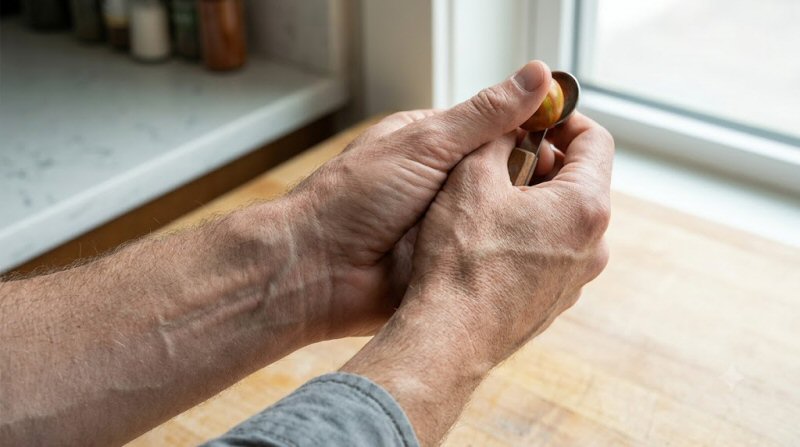
Your thumb can open a jar, hold a tool, or steady a pen for hours, yet the deep forearm muscle that powers its strongest flexion often goes under-used in daily desk life. The flexor pollicis longus (FPL) is the long muscle that flexes the tip of the thumb. It still seems calibrated for the frequent, loaded pinches and grips of climbing, carrying, and tool work. Modern keyboards, mouse clicks, and phone scrolling mostly ask for light, repeated contacts instead.
What This Muscle Actually Does
The flexor pollicis longus originates on the anterior surface of the radius and the interosseous membrane, then travels through the carpal tunnel to insert on the base of the distal phalanx of the thumb. Its main job is to flex the interphalangeal joint of the thumb—the joint nearest the thumbnail—while also contributing to overall thumb flexion and opposition strength.
Hand anatomist Adriaan Kapandji emphasized how this muscle, working with the short thenar muscles, allows the precise yet powerful opposition that distinguishes human grip. Electromyographic work by John Basmajian and others showed the FPL becomes highly active during firm pinches and power grips, far more than during light contact or resting postures. In evolutionary terms, John Napier’s studies of the human hand highlighted the thumb’s role in both precision and power, patterns that would have been used daily for foraging, stone-tool making, and climbing.
Why Modern Life Leaves It Under-Loaded
Ancestral environments demanded repeated loaded thumb flexion: pulling vines, gripping branches, carrying loads, fashioning tools, and processing food. The FPL and its tendon were built for those intermittent high-effort demands interspersed with rest. Today, most people spend hours with the hand in a relatively static or lightly loaded position. Typing keeps the thumb near the space bar with minimal flexion force. Phone use often involves the thumb in a shallow, high-frequency tap rather than a sustained pinch. Even many gym routines emphasize larger muscle groups and neglect specific loaded thumb work.
The result is not usually dramatic weakness, but a subtle mismatch. The muscle and its tendon may spend less time under meaningful load, while the extensors and short thenar muscles continue to receive frequent light activation. Over years this can contribute to the common feeling that a firm pinch feels effortful or that the thumb fatigues quickly during tasks that used to feel ordinary. Related articles explore nearby muscles: why the abductor pollicis longus still expects occasional thumb spreading, why the extensor pollicis longus still expects occasional thumb extension, and why the thenar muscles still expect occasional thumb opposition.
Common Everyday Signs
People often notice the mismatch only when a task suddenly requires real pinch strength—opening a tight jar, holding a heavy grocery bag by its handles, or using hand tools for more than a few minutes. The thumb may feel less stable at the tip, or the forearm may fatigue sooner than expected. Mild stiffness in the thenar area or a sense that the thumb “doesn’t want to curl fully” under load can appear after long periods of light desk work. These sensations are usually benign and improve with varied use.
When to Pay Closer Attention
Most under-use is harmless. Seek assessment if you develop true weakness (inability to flex the thumb tip against even light resistance), numbness or tingling in the thumb and index finger that persists, or sudden loss of function after an injury. The FPL is innervated by the median nerve, so carpal tunnel compression can affect it. A locked or catching thumb (trigger thumb) involves the flexor tendons and pulley system and is distinct from simple under-use. Persistent pain at the wrist with thumb movement also warrants a check, as the FPL tendon can be involved in overuse conditions.
Practical Ways to Give It What It Expects
The goal is occasional loaded flexion, not endless gripping. Simple options include:
- Pinch a soft ball or folded towel for 5–10 seconds, several times a day, focusing on the thumb tip.
- Use a clothespin or spring-loaded clip for short sets of opening and closing.
- Carry a light grocery bag or water bottle by pinching the handle between thumb and fingers for short distances.
- During breaks, practice slow full thumb flexion and extension, adding a little resistance with the other hand.
Vary the load and avoid prolonged maximal effort. Combining these with the spreading and extension patterns described in related articles helps keep the thumb’s muscle balance closer to the varied demands it evolved for. Most people notice improved comfort and endurance within a couple of weeks of adding a few brief loaded pinches each day.
Frequently Asked Questions
Is the flexor pollicis longus the same as the thenar muscles?
No. The thenar muscles (abductor pollicis brevis, opponens pollicis, and flexor pollicis brevis) are the short muscles in the palm that move the thumb base. The flexor pollicis longus is a longer muscle originating in the forearm that specifically flexes the tip of the thumb. Both contribute to pinch, but they are anatomically and functionally distinct.
Can typing weaken this muscle?
Typing does not typically weaken it in a clinical sense, but the low-force, high-repetition pattern provides little of the loaded flexion the muscle is well suited for. Over time this relative under-loading can make stronger pinches feel more effortful until the muscle is given occasional higher-demand work.
Will pinching exercises help carpal tunnel symptoms?
Loaded pinching is not a treatment for carpal tunnel syndrome. If you have numbness, tingling, or true weakness, address the nerve compression first. Once symptoms are controlled, gentle progressive loading can be useful, but only under guidance if nerve symptoms are present.
How much loaded pinch work is enough?
A few short sets of 5–10 second holds or 8–12 light repetitions, two or three times a day, is usually sufficient to restore the occasional loaded demand. More is not necessarily better; the ancestral pattern was intermittent, not constant.
Why does my thumb tip feel unstable sometimes?
The FPL helps stabilize the interphalangeal joint during pinch. When it has been under-used relative to other thumb muscles, the tip can feel less steady under load. Brief, progressive loaded flexion usually improves this without special equipment.
Conclusion
The flexor pollicis longus remains a specialist in loaded thumb flexion—an ability that served climbing, carrying, and tool use for most of human history. Modern light grips and keyboards rarely ask for that capacity. A few deliberate, brief pinches each day are usually enough to keep the muscle and tendon closer to the intermittent loading pattern they still expect, reducing the sense that a firm grip has become unexpectedly tiring.


