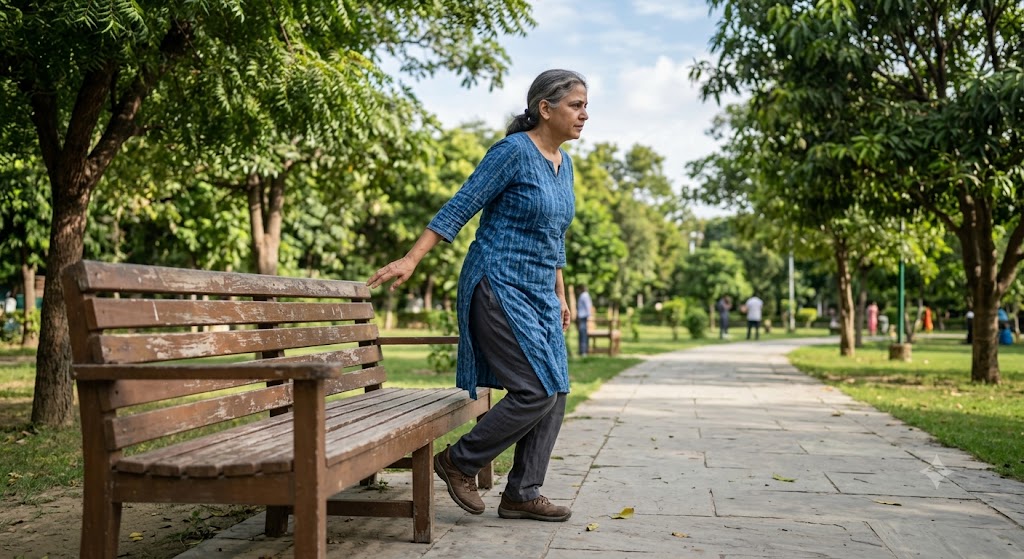
Arterial lining still reads the shear stress of walking as a daily maintenance cue. Sitting leaves nitric oxide quiet and the vessel wall stiffer — a mismatch Robert Furchgott and later exercise physiologists mapped.
An artery is not a garden hose. It is a living tube whose inner surface, the endothelium, tastes the blood that slides across it. When that slide is brisk and pulsatile — the pattern of walking, carrying, climbing — the cells release nitric oxide, quiet platelets, and keep muscle in the wall from clamping down. When the slide is sluggish for hours, the same cells grow quieter, stickier, and more willing to let cholesterol lodge. The chemistry is modern. The expectation is old.
Robert Furchgott showed in 1980 that a healthy endothelium makes a relaxing factor when acetylcholine arrives. Salvador Moncada’s group identified that factor as nitric oxide. Louis Ignarro worked out how it activates the muscle underneath. Together they turned a forgotten lining into a daily organ. M. Harold Laughlin, Daniel Green, Michael Joyner and others then showed that the most reliable way to keep that organ talking is not a supplement. It is the shear stress of moving blood during ordinary locomotion.
Humans walked for hours. They did not sit through a morning, a commute, and an evening of screens and then hope a twenty-minute gym session would reset eight hours of stagnant flow. The vessel wall still votes with the hours, not the calendar.
What Shear Stress Actually Is
Shear stress is the frictional drag of blood on endothelial cells, measured in dynes per square centimeter. At rest in a large artery it is modest. During walking it rises in waves with each step, especially in the femoral and tibial trees and, through cardiac output, in the aorta and coronaries. The cells sense that drag through the glycocalyx — a sugar-rich coat — and through ion channels, integrins and caveolae. Downstream, endothelial nitric oxide synthase (eNOS) makes NO from L-arginine. NO diffuses into smooth muscle, raises cyclic GMP, and the vessel widens.
That is only the first sentence. Laminar shear also suppresses adhesion molecules that recruit white cells, keeps endothelin and angiotensin tone in check, and maintains a surface that platelets find uninteresting. Disturbed, low, or oscillatory shear — the pattern at branch points and in a sitting femoral artery — does the opposite. Peter Libby and Russell Ross’s “response-to-injury” framing of atherosclerosis sits on top of this flow map. Plaque prefers inner curves and bifurcations not because those spots are morally weak, but because the lining there rarely gets a clean, forward slide.
Ultrasound studies of flow-mediated dilation, popularized in human work by John Deanfield’s group and later standardized by Green and others, make the lining visible without a catheter. A cuff releases, the artery widens if the endothelium can still make NO, and the percentage change becomes a rough fitness report for the inner wall. Untrained, sitting-heavy adults often post a quieter number. A few weeks of regular walking can lift it — not because the gym “cleans arteries,” but because repeated shear keeps eNOS phosphorylated and the glycocalyx intact.
The Evolutionary Job
Bipedal walking is a human specialty. For most of the species’ history it was not a hobby. It was how distance, water, food and social life were reached. Cardiac output rose. Muscle pumped venous blood back, as described in why veins still expect the calf pump. Arterial flow became pulsatile and directional for long stretches of the day. The endothelium evolved under that schedule.
Hunter-gatherer and traditional farming days mixed walking with carrying, squatting and rest, not with uninterrupted chair time. Björn Folkow’s work on structural vascular adaptation showed that vessels remodel to the loads they see. High, regular shear favors a slightly larger, more compliant conduit. Low shear and high pressure favor a thicker, stiffer wall. Ancestral arteries saw both movement and, often, a leaner blood lipid pattern. They did not see eight sitting hours plus a refined-carbohydrate lunch that leaves glucose and insulin high while the legs stay still — the pairing discussed in why blood sugar still expects a walk after meals.
Atherosclerosis is not new in the fossil record, but the combination of sitting, energy-dense food, evening light, and long life is. That is the core of why heart disease is an evolutionary mismatch disease. The lining is still waiting for the day’s push. The chair does not send it.
What Sitting Does to a Living Tube
Within an hour of sitting, blood flow in the legs falls. After a few hours, some studies show a measurable dip in subsequent flow-mediated dilation in the popliteal artery. Standing breaks help. Walking breaks help more. The point is not that one afternoon of sitting “clogs” anything. The point is that the lining is a use-it-or-quiet-it tissue, and quiet hours add up.
Stiffening is the other half. Arteries lose elastin with age; that is unavoidable. They lose nitric-oxide buffering faster when shear is rare and when glucose, smoke, and inflammation batter the same cells. Pulse-wave velocity — the speed of the pressure wave from the heart to the periphery — rises when the tube is stiff. A faster wave means the reflected pressure comes back while the heart is still ejecting. Afterload climbs. The left ventricle works harder for the same output. Walking does not reverse aging. It keeps the chemical half of stiffness from arriving early.
Exercise training studies from Rainer Hambrecht, Stephan Gielen and Josef Niebauer in people with coronary disease showed that regular aerobic work can restore endothelial function even when plaque is already present. The plaque does not vanish. The lining over it starts talking again. That is a more honest promise than “cardio melts blockage.”
Hidden Triggers in Ordinary Days
A commute that follows a desk that follows a sofa. Crossing the legs until a foot buzzes. A standing desk that becomes a still desk. Heat without movement, which dilates skin vessels but does not recreate locomotor shear in the legs. Air travel. A full weekend of sitting after a week of the same. Smoking, which poisons eNOS. Very high post-meal glucose, which makes the lining temporarily clumsy. Sleep loss. Air pollution on a walk that is still, on balance, better than no walk. Compression of the femoral region in a deep chair. Dehydration that thickens blood a little and makes the same cardiac output less elegant.
Strength training matters for muscle and bone. It is not a full substitute for the long, rhythmic shear of locomotion. Short, intense intervals help. They still leave the remaining twenty-three hours to write most of the story.
When to Worry
Exertional chest pressure, jaw or arm pain that arrives with effort and eases with rest, new breathlessness on a familiar hill, a calf that always hurts after the same block of walking and eases with stopping — those are vascular sentences, not fitness complaints. So is a cold, pale foot with a weak pulse, or a sudden neurologic deficit. High blood pressure that is ignored, diabetes that is untreated, and a smoking habit that is bargained with all accelerate the same lining failure. Age alone does not make every stiff artery an emergency. Age plus those accelerants does.
Raynaud-style white fingers in the cold, covered elsewhere on this site, are a different circuit — digital arteries over-reacting to chill. They are not proof that walking has failed the large vessels. They also do not excuse skipping movement.
Myths vs Facts
Myth: If cholesterol is “fine,” sitting cannot matter.
Fact: Lipids load the wall. Flow decides where and how angrily the lining accepts the load. Plenty of first events happen at ordinary lab numbers in people who never walk.
Myth: A hard gym hour cancels a sitting day.
Fact: Training helps. Hours of low shear still register. Breaking sitting with brief walks is not a lesser cousin of exercise. It is a different signal.
Myth: Nitric-oxide supplements replace a walk.
Fact: Beetroot and arginine products can nudge pathways in some studies. They do not rebuild the glycocalyx or the daily phosphorylation pattern that locomotion writes.
Myth: Stiff arteries are only an old-age problem.
Fact: Pulse-wave velocity can rise in sedentary young adults. The calendar is not the only clock.
Myth: You must sweat for the endothelium to notice.
Fact: Moderate walking that you can talk through already raises leg shear. Sweat is a heat story, not the shear story.
How to Give Arteries the Push They Expect
Walk after meals when you can. Ten minutes is not a consolation prize; it is a shear and glucose double cue. Stand and stroll once an hour during desk work — a corridor, a kettle, a flight of stairs. Keep one daily bout that lasts long enough for cardiac output to stay up: thirty to forty minutes of easy walking still does work the lining understands.
Hills and stairs add pulse pressure and calf work without needing a machine. Carrying a bag on a walk adds a little afterload and a little arm shear. If joints complain, a bicycle or an elliptical still moves blood; they are not evolutionary replicas, but they are honest shear. If you already have known coronary or peripheral disease, get a clinician’s map before you add intensity. The Hambrecht-style lesson is that supervised aerobic work can be medicine. Unsupervised heroics after years of stillness can be a trigger.
Do not smoke. Treat blood pressure and glucose as lining hygiene, not only as numbers for a chart. Sleep. The vessel wall is not separate from the night the pineal and the cortisol axis still expect.
When to See a Doctor
See someone promptly for chest, jaw or arm pain with effort, sudden breathlessness, a cold painful limb, or neurologic symptoms. See someone soon for a walking-limited calf, rising blood pressure, a family history of early events, or diabetes that has not been mapped. Endothelial function tests are research-adjacent; they are not required to justify a walking habit. They are also not a substitute for standard risk care.
FAQs
Does walking really change the inside of an artery?
Yes, in a measurable way. Repeated shear up-regulates eNOS, improves flow-mediated dilation in many training studies, and can slow some age-related stiffening. It does not dissolve established plaque on a timetable you can feel week to week.
Is standing as good as walking?
Standing is better than sitting for reducing the worst pooling. Walking is better than standing for shear, calf-pump return, and post-meal glucose. Use both.
How soon does sitting start to matter?
Leg flow drops quickly. Some endothelial measures sag after a few uninterrupted hours. The clinical risk is the pattern across years, not one movie night.
Can I walk if I already have heart disease?
Often yes, and often it is part of treatment — after a clinician has ruled out unstable symptoms and set a pace. Cardiac rehabilitation exists because the lining and the muscle still respond.
Do compression socks replace walking?
They can help venous return on flights and in some swelling. They do not recreate arterial shear from muscle work. Wear them if you need them. Still walk.
Is a short walk after dinner worth doing?
Yes. It is one of the few habits that serves glucose, triglycerides, venous return and endothelial shear in the same twenty minutes.
Conclusion
Your arteries still expect the push of walking because that is the signal their lining was trained on: forward, pulsatile, repeated shear, hour after hour of a moving day. Furchgott’s relaxing factor, Moncada and Ignarro’s nitric oxide, and the exercise physiologists who took those molecules into living legs all describe the same organ. It is not asking for heroics. It is asking not to be left still while the rest of modern life stays loud. Give it a corridor, a hill, a walk after the plate. The tube remembers what to do with that.