
Your little-finger spreader evolved for wide grips and tool use. Modern closed hands leave it under-used, leading to stiffness and reduced hand stability.
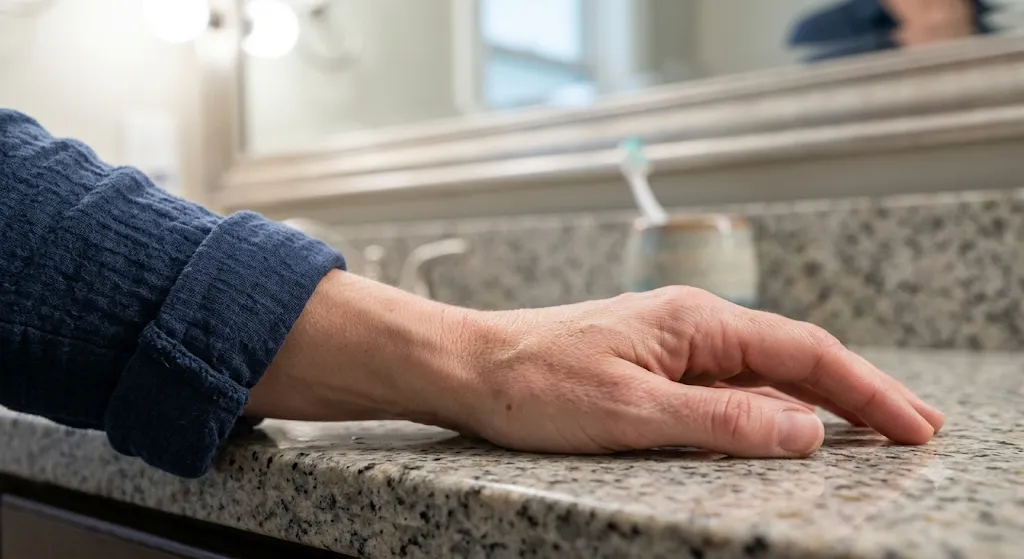
Your little finger has its own dedicated spreader. The abductor digiti minimi sits along the outer edge of your hand, in the fleshy hypothenar area just below the pinky. It pulls the little finger away from the ring finger and helps steady the knuckle when you grip something wide. Most days it barely moves. Keyboards, phones, steering wheels, and tool handles keep the fingers packed close together. The muscle that once spent part of every day holding a wider stance now mostly rests in a narrow, closed position.
What This Muscle Actually Does
The abductor digiti minimi (ADM) is one of the intrinsic muscles of the hand. It originates near the pisiform bone and the flexor retinaculum and inserts into the base of the little-finger proximal phalanx and the extensor expansion. Its main action is abduction of the fifth digit—spreading the pinky outward. It also contributes a little to flexion at the metacarpophalangeal joint and helps stabilize that joint during power grips.
Hand anatomists such as Kapandji have long noted that the ulnar-side muscles, including the ADM, give the hand its ability to adapt to objects of different widths. Electromyography work by Basmajian and others showed that these muscles fire not only for pure spreading but also whenever the hand needs to resist forces that would collapse the little-finger side inward. In short, the ADM is both a mover and a stabilizer.
Why It Still Expects Occasional Spreading
For most of human evolutionary history the hand was used for climbing, carrying irregular loads, shaping tools, and manipulating food or plant material. Those tasks repeatedly required the fingers to open to different widths. A wider stance at the ulnar side improved stability on branches or rough surfaces and allowed a better purchase on thick handles or bundles. The ADM and its neighboring hypothenar muscles were loaded in those positions many times a day.
That loading pattern left a residual expectation. The muscle and its associated connective tissues developed under conditions of intermittent abduction and variable grip width. When those demands disappear, the tissue does not simply “forget”; it becomes less tolerant of the positions and loads it once handled routinely. This is the same mismatch pattern seen in other under-used hand muscles, such as the interossei that also expect occasional spreading.
What Changes When Spreading Disappears
Modern life supplies almost continuous narrow grips. Typing keeps the fingers close and slightly flexed. Phone use and mouse work do the same. Even many power tools and kitchen utensils have handles sized for a closed hand. Over weeks and months the ADM spends most of its time in a shortened, unloaded state.
People often notice a vague stiffness along the outer hand, a feeling that the little finger does not open as freely as it used to, or a mild ache after a long day of gripping. The muscle itself does not usually become dramatically weak, but its ability to contribute to hand stability declines. Some individuals also report that the little-finger side feels “tight” when they try to spread the fingers wide. These sensations are usually benign and reverse with modest practice, but they illustrate the mismatch.
Related articles on the site explore similar patterns: the interossei that still expect finger spreading, the broader hypothenar group that expects pinky grip, and the general hands that still expect varied everyday grips.
Hidden Triggers in Everyday Life
Several common habits quietly reduce ADM use:
- Keyboard and trackpad work that keeps the hand in a narrow, slightly ulnar-deviated posture for hours.
- Phone grips that pin the little finger against the ring finger or the palm edge.
- Steering-wheel holds that favor a closed fist rather than an open, adaptive grip.
- Cold environments that encourage fists and further reduce finger excursion.
- Repetitive tool use with small-diameter handles.
None of these are harmful in isolation, yet together they remove the occasional wide-hand demand the muscle still expects.
How to Give It the Work It Expects
The remedy is simple and brief. A few deliberate spreading actions restore the loading pattern without requiring special equipment.
- Several times a day, place the hand flat on a table and slowly spread the little finger as far from the ring finger as is comfortable. Hold for two to three seconds, then relax. Repeat eight to ten times.
- While seated, open the hand wide (as if signaling “five”) and gently emphasize the pinky outward. Hold briefly, then close.
- When carrying a grocery bag or water bottle, consciously allow the little finger to participate rather than tucking it under.
- During short breaks from typing, interlace the fingers of both hands and gently press the little fingers outward against each other for a few seconds.
These movements take less than a minute and can be done at a desk, in a car, or while waiting. Consistency matters more than intensity. Most people notice improved ease of spreading within a week or two.
When to Worry
Occasional outer-hand stiffness that improves with movement is common and usually harmless. Seek medical advice if you notice:
- Persistent weakness that makes it hard to spread the little finger or to grip objects securely.
- Numbness or tingling that travels into the little finger and the ulnar half of the ring finger (possible ulnar-nerve involvement).
- Visible wasting of the hypothenar bulk that develops over weeks.
- Pain that is sharp, night-dominant, or accompanied by neck or elbow symptoms.
These features are uncommon with simple under-use and point toward other conditions that deserve evaluation.
Myths vs Facts
Myth: The little-finger muscles only matter for musicians or climbers.
Fact: They contribute to everyday grip stability for anyone who carries, opens, or steadies objects of different widths.
Myth: If the hand does not hurt, the muscles are fine.
Fact: Reduced range and subtle stiffness can appear before pain. Restoring occasional spreading often prevents later discomfort.
Myth: Stretching the fingers aggressively will fix under-use.
Fact: Gentle, repeated abduction is more useful than forceful stretching. The muscle responds to the positions it is asked to hold, not to passive over-extension.
FAQs
Does the abductor digiti minimi get used when I just make a fist?
Only modestly. A closed fist shortens rather than lengthens or loads the ADM in its primary direction. Spreading or stabilizing a wider grip recruits it more effectively.
Can under-use of this muscle contribute to ulnar-sided hand pain?
It can contribute to a feeling of tightness or reduced stability, but true ulnar-sided pain more often involves the triangular fibrocartilage complex, the ulnar nerve, or joint issues. Simple spreading practice is still a reasonable first step while those possibilities are considered.
How long does it take to notice a difference?
Most people feel easier spreading within several days of daily practice. Full comfort with wider grips may take two to three weeks of consistent, low-dose work.
Is it normal for the little finger to feel weaker than the others?
Yes. The little finger has less independent strength than the index or middle finger by design. The ADM’s job is more about positioning and stability than raw power.
Should I do resistance exercises for it?
Light resistance (for example, pressing the little finger outward against the other hand) can be added once plain spreading feels easy. Heavy loading is unnecessary for restoring the everyday pattern.
Can cold weather make the stiffness worse?
Yes. Cold reduces tissue compliance and encourages closed-hand postures, so the mismatch becomes more noticeable. Warming the hands and adding a few spreads helps.
Conclusion
The abductor digiti minimi is a small muscle with a clear ancestral job: helping the little finger occupy a wider stance when the hand needed stability on varied surfaces and tools. Modern closed grips remove that demand for most of the day. The resulting stiffness is usually mild and reversible. A few deliberate pinky spreads each day restore the loading the muscle still expects, keep the outer hand comfortable, and support the broader stability the hand was built to provide. Small, regular movements are enough; the muscle does not need dramatic exercise, only the occasional reminder of the positions it evolved to handle.


