
Your little-finger muscles were shaped by tools, climbing, and strong grips. Modern keyboards and flat hands leave them underused, which can show up as stiffness, reduced grip, or ulnar-side discomfort.
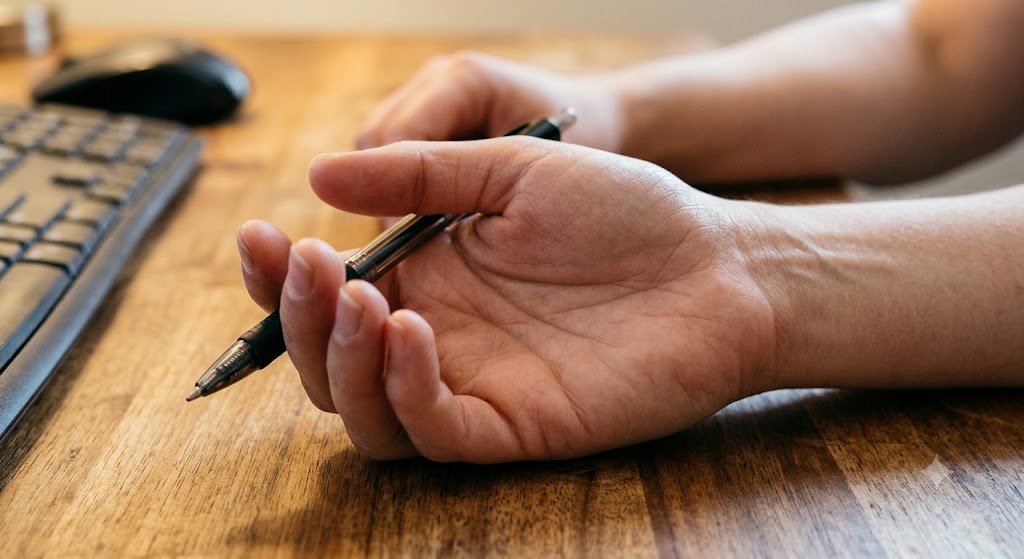
If you type for hours, swipe on a phone, or carry bags by the handles, you may notice that the outer edge of your hand feels a bit flat or stiff by the end of the day. The muscles on the pinky side of your palm—the hypothenar group—were built for more than occasional keystrokes. They expect short bursts of strong pinky opposition, abduction, and grip that once came from tools, climbing, and everyday carrying.
What This Expectation Feels Like Today
Most people do not think about the hypothenar muscles until something feels off. You might notice that your pinky does not spread as easily, that a jar lid feels harder on the ulnar side of the grip, or that the outer palm aches after a long keyboard session. The thenar (thumb) side often gets more attention; the pinky side is quieter until it is underused or overloaded in a narrow pattern.
These sensations are usually mild and reverse with a change in hand use. They are different from sharp nerve pain or sudden weakness, which need a different evaluation.
Why Your Hypothenar Muscles Still Expect Occasional Pinky Grip
The hypothenar muscles—abductor digiti minimi, flexor digiti minimi brevis, and opponens digiti minimi—move the little finger away from the ring finger, flex it, and rotate it toward the thumb. Together with the other intrinsic muscles of the hand, they create a stable, adaptable grip that can handle irregular shapes and changing loads.
In ancestral environments, hands regularly gripped branches, rough tools, and carried loads with the little finger contributing meaningfully to the power grip. Anthropologists such as Mary Marzke have described how human hand proportions and intrinsic muscle function support precision and power grips that other primates use less often. The pinky side helps close the hand around an object and resists forces that try to pry the fingers open. Modern life replaces much of that varied loading with a relatively fixed posture: fingers hovering over keys or resting on a flat screen. The muscles still “expect” occasional strong, short-duration work.
This is a classic evolutionary mismatch. The anatomy is the same; the daily demand is not. Similar patterns appear in other under-loaded hand muscles, such as the thenar group that still expects thumb opposition and the broader palm that expects textured, varied grips.
Common Reasons the Pinky Side Feels Underused
Several everyday habits keep the hypothenar muscles in a low-demand state:
- Prolonged keyboard and mouse work with the little finger mostly stabilizing rather than actively gripping.
- Phone use that relies on the thumb and index finger while the pinky rests or drifts outward.
- Carrying shopping bags by the handles so the load sits mainly on the fingers rather than a full closed grip.
- Avoiding tools or sports that require a firm ulnar-side contribution (certain racket grips, climbing, or gardening tools).
None of these are harmful by themselves. The issue is the lack of occasional higher-load, more varied use that the muscles are structured to handle.
Hidden Triggers That Can Amplify the Feeling
Even when the muscles themselves are simply under-challenged, other factors can make the outer hand feel stiffer or more fatigued:
- Sustained wrist extension or ulnar deviation at a desk, which changes the resting length of the intrinsic muscles.
- Cold hands, which reduce muscle efficiency and make fine control feel clumsier.
- Previous minor sprains or overuse that leave the ulnar side slightly guarded.
- Low overall hand activity outside of work, so the only loading the hypothenar muscles receive is the light, repetitive kind.
These factors do not create a new problem; they simply make the mismatch more noticeable.
When to Worry
Most stiffness or mild fatigue on the pinky side of the palm is benign and improves with a few days of varied hand use and rest from the narrow pattern. Seek medical advice if you notice:
- True weakness that makes you drop objects or prevents you from spreading the little finger.
- Numbness or tingling that travels into the pinky and ring finger and does not resolve with position changes (this can involve the ulnar nerve).
- Sudden swelling, redness, or pain after a specific injury.
- Symptoms that steadily worsen over weeks despite simple changes in activity.
These patterns are uncommon with simple underuse and deserve a proper check.
Myths vs Facts
Myth: The little finger is unimportant for grip strength.
Fact: Studies of grip biomechanics show that the ulnar digits contribute substantially to power grip force. Losing or weakening the little finger reduces overall grip more than many people expect.
Myth: If your hands do not hurt, the muscles are fine.
Fact: Muscle capacity declines quietly with disuse. You may only notice the change when you need a stronger or more precise grip later.
Myth: Stretching alone restores the function these muscles expect.
Fact: Stretching can ease the feeling of stiffness, but the muscles also need occasional active loading in the directions they were built for—spreading, opposing, and gripping.
How to Give Your Hypothenar Muscles What They Expect
You do not need a special program. Short, deliberate uses of the pinky side a few times a day are enough for most people:
- Once or twice a day, actively spread your fingers wide, hold for a few seconds, then gently oppose the little finger toward the thumb as if making a loose “O.” Repeat 5–8 times.
- When you pick up a mug, water bottle, or tool, consciously include the little finger in the grip for a moment instead of letting it float.
- If you type a lot, take a 20-second break every hour to open and close the hand fully and shake it out.
- Occasional tasks that involve a firm, varied grip—gardening, cooking with a knife, carrying a backpack by the shoulder strap with a closed hand, or light climbing if that is already part of your life—supply the loading the muscles still expect.
These small additions restore the variety without adding much time. Pair them with the same attention you might already give the thenar muscles or the overall palm.
When to See a Doctor or Therapist
If the outer hand feels weak, numb, or painful in a way that interferes with daily tasks, or if simple changes do not help within a couple of weeks, a clinician can check nerve function, joint mobility, and muscle strength. Hand therapists are particularly skilled at restoring balanced intrinsic muscle use when needed. Early attention is usually straightforward; waiting until grip has clearly declined makes the process longer.
FAQs
Is it normal for the pinky side of my hand to feel stiffer than the thumb side?
Yes, for many people who spend long hours at a keyboard or phone. The thenar muscles often receive more varied use through thumb opposition, while the hypothenar group can stay relatively quiet. The difference usually shrinks once you add a few deliberate pinky grips and spreads.
Can underused hypothenar muscles contribute to ulnar nerve symptoms?
Not directly in most cases. Ulnar nerve irritation is more often related to elbow or wrist position, prolonged pressure, or other factors. However, a hand that is chronically held in a narrow posture can make any underlying sensitivity more noticeable. If you have true numbness in the little and ring fingers, get it checked rather than assuming it is only muscle underuse.
Do I need special exercises or equipment?
No. Everyday actions that briefly load the little finger in opposition and abduction are sufficient for most people. If you already do strength training, simply making sure your grip includes the pinky (for example, on a dumbbell or pull-up bar) covers the need.
How quickly should I expect the stiffness to improve?
Many people notice a difference within a few days of adding short active spreads and fuller grips. If the feeling has been present for months, it may take a couple of weeks of consistent variety before the hand feels more even.
Is this the same as the advice for thenar muscles or overall palm grip?
It is related but specific. The thenar muscles still expect occasional thumb opposition, and the broader palm expects textured, varied surfaces. The hypothenar group has its own job on the ulnar side. Addressing all three keeps the hand balanced rather than favoring one side.
Conclusion
Your hypothenar muscles are small, but they were shaped by the same demands that shaped the rest of the hand: tools, climbing, carrying, and grips that changed from moment to moment. Modern keyboards and screens ask far less of the pinky side. The mismatch is usually quiet—mild stiffness, a slightly flatter grip, or an outer palm that tires first—rather than dramatic. Giving those muscles the occasional strong pinky opposition and spread they still expect is a small, practical way to keep the hand feeling capable. If the change is more than mild stiffness, or if weakness or numbness appears, a professional assessment is the next sensible step.


