A yawn that arrives with a full-body stretch is usually pandiculation — a brainstem-and-hypothalamus motor program that Walusinski, Provine and Deputte mapped as a sleep-wake reset, not a sign you need more oxygen.
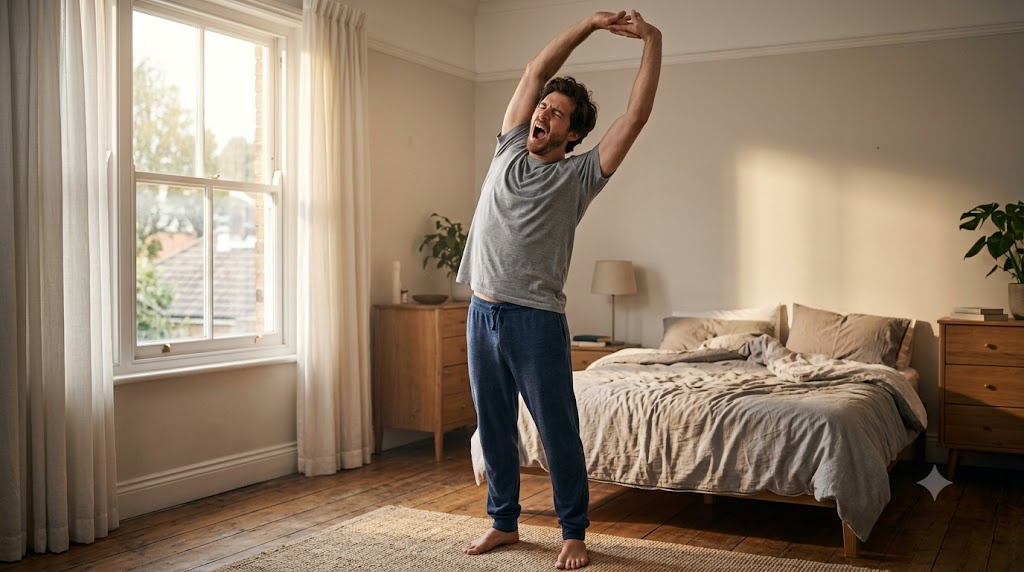
You sit up. Before a single useful thought arrives, the body writes its own first sentence: arms overhead, spine long, jaw opening past the point of manners, a slow inhale that seems to fill more than the lungs. The stretch and the yawn do not feel like two separate decisions. They feel like one program with two visible parts.
That program has a name. When a yawn and a coordinated whole-body stretch arrive together, the combination is called pandiculation. Ethologists also call the paired act the stretch-yawning syndrome. It is one of the most conserved motor patterns vertebrates still run — present in fetuses, cats, horses, and people who insist they “never yawn.” It is also one of the most misunderstood. The popular story is that you yawn because the room is low on oxygen. Direct tests of that story failed decades ago. What remains is more interesting: a hypothalamic switch that resets posture, breathing, and arousal at the borders of sleep, boredom, and action.
What This Sensation Feels Like
A stretch-yawn is not a polite covered mouth. The classic morning version is a long inhale through a widely opened jaw, a brief pause at the peak, a slower exhale, and a simultaneous reach that loads the arms, the thoracic spine, and often the hips and calves. The eyes narrow or close. The neck extends. Many people hear a small pop in the jaw or upper back. The aftertaste is a brief sense of being more here than you were ten seconds earlier.
The pairing is uneven. Robert Provine, who spent decades treating yawning as a proper behavioral science problem rather than a joke, noted that people usually yawn when they stretch, but they do not always stretch when they yawn. Bedtime yawns can be small and local. Morning yawns often recruit the whole trunk. Desk-hour yawns sit in the middle: the jaw runs the program even when the chair will not let the spine join in.
A stifled version exists too. You clamp the jaw, keep the arms down, and the urge still rises in the throat and behind the eyes. The motor program is trying to finish. Feedback from a fully opened mouth and a deep oral inhale appears to be part of how the sequence knows it has run. Block the parts, and the urge often repeats.
Common Causes
A conserved motor program, not a random habit. Bertrand Deputte’s comparative work showed that the form of a yawn is remarkably similar across vertebrates. Olivier Walusinski later argued that pandiculation itself — stretch plus yawn at biological-rhythm borders — is older than the social, contagious yawn that humans and some other primates added later. Fetuses already run yawn-and-stretch sequences by the end of the first trimester, as Johanna de Vries, Gerard Visser, and Heinz Prechtl documented with ultrasound in the early 1980s. A behavior that appears before air, conversation, or boredom is not a polite response to a stuffy room.
A hypothalamic conductor with a brainstem orchestra. Pharmacological and stimulation work by Antonio Argiolas and Maria Rosaria Melis, and later by Ichiyo Sato-Suzuki and colleagues, points to oxytocinergic neurons in the paraventricular nucleus of the hypothalamus as a key trigger zone. From there the program fans out. Walusinski summarized at least five output channels: a deep inspiratory act, a brief cardiovascular dip, facial motor nuclei that open the jaw, spinal motor patterns that extend the trunk and limbs, and an arousal bump. The putative pattern generator sits near other brainstem rhythm machines for breathing and circulation — a neighborhood A.P. Heusner already suspected in 1946 from infants who could yawn despite missing much of the forebrain.
State change, not low oxygen. The oxygen-and-carbon-dioxide story is culturally sticky and experimentally weak. In 1987 Provine, with Heidi Tate and David Geldmacher, had people breathe air enriched with carbon dioxide or with extra oxygen. Breathing rate changed as expected. Yawn rate did not. You can hyperventilate or sit in a poorly ventilated meeting and still find that yawns cluster at the edges of states — waking, settling toward sleep, shifting out of boredom — not at the moments when blood gases are most disturbed.
A myofascial reset after stillness. After hours of one posture, muscle spindles and the gamma loop that sets resting length have been listening to a very narrow story. A pandiculation is not a passive stretch. It is a co-contraction: you load the muscle while you lengthen it, then release. Luigi Bertolini and Gian Luigi Gessa, and later clinicians influenced by Thomas Hanna’s somatic work, treated that contract-and-release as a way of sending the spinal cord a fresh length report. The pleasant “unlock” after a morning reach is that report arriving.
If the same pairing also shows up when you have been sitting still, staring at a screen, or coming out of a long car ride, the common ingredient is not fatigue alone. It is a long period without a full-range, self-generated reset.
Why This Happens
Think of sleep and quiet sitting as two ways of putting the motor system on hold. Muscle tone drops. Joints spend hours near the middle of their range. The brain’s default-mode chatter can drift. Something has to mark the border when the system is asked to become a moving animal again.
Pandiculation is a plausible border marker. Walusinski has framed yawning as a way of increasing the salience of the body schema — making the map of “this is me, in this posture, now” briefly louder — while also nudging noradrenergic and orexin/hypocretin arousal systems. Andrew Gallup and colleagues have argued for a complementary cranial effect: the gaping jaw and the accompanying facial and scalp muscle play as a localized stretch that changes blood flow around the skull, with possible cooling of brain tissue as a side benefit. Those ideas are still being tested. They are more consistent with the timing of yawns than the old air-quality story.
Cerebrospinal-fluid flow has entered the conversation as well. Small imaging studies have found that a yawn is not simply a deep breath wearing a different face. The maneuver can reorient CSF movement in ways quiet breathing does not. The sample sizes are modest and the finding is not universal, so it should not be sold as the one true purpose. It does fit a broader picture: a stereotyped act that stirs several fluids and several motor maps at once, right when the brain is changing jobs.
The pleasure is not an accident. Homeostatic acts that protect readiness — a full breath, a stretch after stillness, a swallow, a shiver — tend to feel good enough that animals keep doing them. Cats look theatrical because they still live in a body that treats the reset as a daily craft. Humans look slightly embarrassed because we have offices.
The social layer sits on top of this older machine. Contagious yawning, which Provine showed can be triggered even by reading the word, is a later, more cortical addition. You can read about that social reflex in our article on why someone else’s yawn becomes yours. The stretch-yawn when you get out of bed does not need an audience. It needs a state change.
Less Common but Serious Causes
Most stretch-yawns are ordinary. A few patterns are not.
Excessive yawning as a drug or withdrawal effect. Selective serotonin reuptake inhibitors, some dopamine agonists, and opioid withdrawal can increase yawn frequency out of proportion to sleepiness. The same PVN chemistry that runs the normal program is pharmacologically noisy.
Yawning with brainstem or hypothalamic disease. Rarely, clusters of yawns accompany multiple sclerosis plaques, stroke near the brainstem pattern generators, or tumors affecting the hypothalamus. The clue is not a morning stretch. It is yawning that is new, frequent, dissociated from sleep-wake borders, or paired with double vision, weakness, headache that is new and severe, or a sudden change in alertness.
The hemiplegic associated response. Sir Francis Walshe described in 1923 that some people with a paralyzed arm after stroke see that arm flex and rise during a yawn. The old motor synergy is still wired. It is startling. It is also a reminder that the yawn program talks to the spinal cord through pathways that can survive damage to the usual voluntary routes. New or one-sided involuntary movement always deserves a neurological look; a known associated response during an otherwise typical yawn in someone with a documented stroke is a different conversation.
Sleep disorders hiding as “I just stretch a lot.” If the morning pandiculation is followed by an unrefreshing day, loud snoring, witnessed apneas, or an overwhelming urge to sleep at the wheel, the yawn is not the disease. It is a flag on poor sleep quality. That is a sleep-medicine problem, not a stretching problem.
Hidden Triggers
The chair that never lets the program finish. A yawn at a desk often dies at the jaw because the spine cannot extend and the arms cannot reach. The program repeats. People then decide they are “exhausted,” when part of what they are missing is a completed motor sequence.
Social jet lag and weekend lie-ins. A shifted wake time moves the border the program is trying to mark. The stretch-yawn can feel stickier and less satisfying after a late morning, the same way the whole first hour can feel slightly mis-timed. Our piece on why you feel off after sleeping in covers that clock mismatch in more detail.
Caffeine timing. A delayed first coffee does not create pandiculation, but the combination of overnight adenosine and a still-quiet motor system makes the morning sequence more likely to run hard. That is physiology, not a character flaw.
Very still hobbies. Long drives, gaming sessions, and flights stack hours of limited range onto the same joints that a cat would have reset several times. The first standing stretch in the airport concourse is the program collecting its debt.
Watching other people do it. Even if your own stretch started the sequence, seeing a co-worker complete a yawn can add a second wave. The social reflex and the homeostatic reflex can stack.
When to Worry
See a clinician promptly if yawning is:
- Sudden, frequent, and no longer tied to waking, bedtime, or long stillness
- Paired with new headache, neck stiffness, vision change, facial weakness, or trouble speaking
- Accompanied by fainting, chest pain, or breathlessness
- Part of a new medication start or a withdrawal state you did not expect
- Associated with excessive daytime sleepiness that is new or dangerous
A single luxurious morning reach that includes a yawn is not a neurological emergency. A change in the pattern is the thing to notice.
Myths vs Facts
Myth: You yawn when you stretch because you need oxygen. Fact: Provine’s gas-mixture experiments did not increase yawns with extra carbon dioxide or suppress them with extra oxygen. Timing tracks state change, not room air.
Myth: Only tired people stretch-yawn. Fact: The program runs at several borders — waking, settling toward sleep, leaving a long still period, even shifting out of a dull task. Sleepiness is one context, not the whole map.
Myth: Stifling a yawn is healthier or more polite in a way that matters to the body. Fact: Blocking the jaw and the inhale often leaves the program unfinished, so it repeats. Social manners are real. They do not rewrite the brainstem sequence.
Myth: If you yawn while stretching, your lungs or heart are struggling. Fact: The cardiovascular dip during a yawn is brief and ordinary in healthy people. Persistent breathlessness, chest pain, or fainting is a different problem and should not be blamed on the stretch.
Myth: Contagious yawning and morning pandiculation are the same thing. Fact: One is a social, often visual trigger layered onto an old motor act. The other is a homeostatic reset that fetuses and solitary animals already perform.
How to Manage It
You do not need to stop a healthy stretch-yawn. You can make it less nagging and more useful.
Let the sequence finish once. Stand if you can. Reach overhead. Open the jaw instead of clamping it. One complete cycle is often quieter than five half-yawns into a sleeve.
Give the morning a real border. Light, a few minutes of walking, and a change of posture do the job the program is hinting at. People who go from dark bedroom to dark commute to dark office keep asking the same circuit to mark a transition that never quite arrives.
Do not confuse this with static stretching. Holding a long passive stretch is a different stimulus. Pandiculation is load-then-release. A few slow reach-and-yawn cycles after sitting usually feel more like what the body asked for than a minute-long hamstring hold.
If you wake stiff, treat stillness as the input. Overnight joint quiet is normal; the first movement of the day is supposed to be a little rusty. Our article on why you wake up stiff every morning explains that overnight viscosity without turning it into a diagnosis.
Watch medications if the rate changes. A new daily yawn storm after starting or stopping a drug is worth a call to the prescriber, not a new stretching routine.
When to See a Doctor
Book routine care if frequent yawning is new, if sleep is unrefreshing, or if a partner reports snoring and pauses in breathing. Seek urgent care for yawning plus neurological signs, chest pain, or fainting. Bring a simple timeline: when the yawns cluster, what you were doing, which medicines changed, and whether the stretch still feels like a satisfying reset or like an unfinished loop.
FAQs
Is it normal to yawn every time I stretch in the morning? Yes for many people. Morning is the most reliable border between a long still period and a moving day, so the stretch-yawning program is biased to run then.
Why do I yawn when I stretch but not when I am actually exhausted at night? Night yawns can be smaller and less coupled to a full-body reach. Provine noted the asymmetry: stretching often brings a yawn; a yawn does not always bring a stretch. Different borders, same family of acts.
Does a stretch-yawn mean I slept badly? Not by itself. It can follow ordinary sleep. It becomes a clue only when the rest of the day is unrefreshing or when other sleep-disorder signs are present.
Can I train myself not to do it? You can suppress the visible parts. The urge usually returns until the state change actually happens — standing, walking, light, a finished motor sequence. Suppression is a social tool, not a cure.
Why does a yawn sometimes make my eyes water? The same orbicularis squeeze and brief change in tear drainage that shows up in a large yawn can overflow a little fluid. That overflow is usually mechanical, not sadness.
Is it the same as contagious yawning? No. Contagious yawning uses social and visual cues. A solo morning pandiculation does not require another face. Both can happen in the same hour.
Conclusion
A yawn that arrives with a stretch is not your lungs filing a complaint about the bedroom air. It is an old, stereotyped reset — hypothalamic trigger, brainstem pattern, spinal reach — that vertebrates have used at the edges of sleep and stillness for a very long time. The oxygen story failed when someone finally measured it. The remaining picture is a body marking a change of job: from stored to ready, from quiet map to moving map.
Let it finish. Then go do the day the program was warming up for.