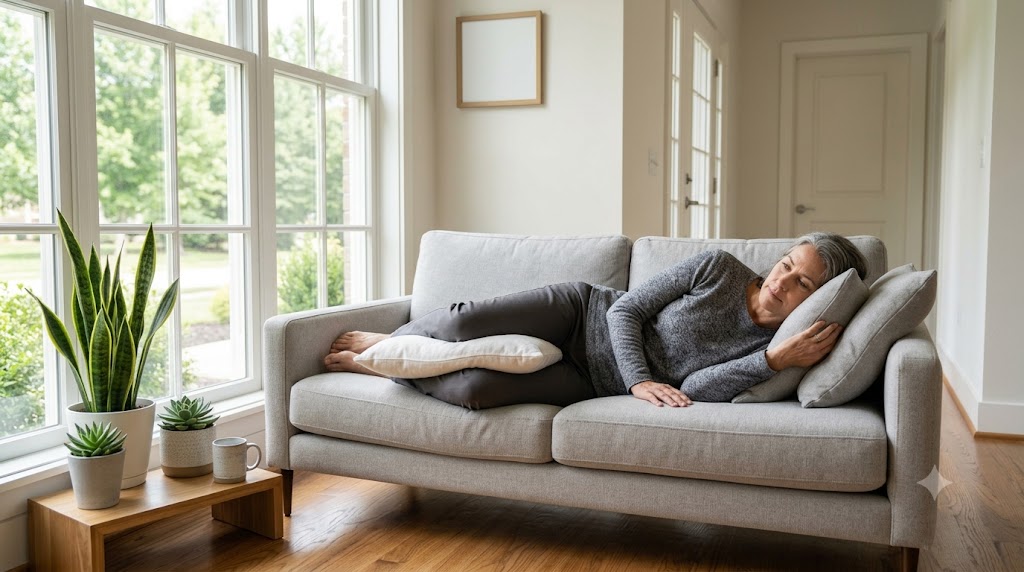
A morning-sore jaw that eases after breakfast is often overnight clenching or grinding plus a dry, still joint — not automatically a broken bite or a doomed TMJ.

You wake up and the first thing you notice is not the light. It is the hinge. The jaw feels tired, tight, or vaguely bruised. Chewing toast is work. Yawning is a negotiation. By mid-morning the ache has usually faded, which is why a lot of people never mention it until a dentist asks, or until a partner mentions the nighttime grinding soundtrack.
A jaw that is sore on waking and better after you start using it is a very common pattern. It is often the leftover of overnight muscle work — clenching, grinding, or simply holding the teeth together for hours — plus a joint that spent the night still and a little dry. It is not automatically a sign that your bite is “off,” that the joint is ruined, or that you need an urgent procedure.
What This Sensation Feels Like
Morning jaw soreness is usually dull rather than sharp. People describe:
- A tired, heavy, or “worked-out” feeling in the masseter muscles at the angles of the jaw
- Tightness in the temples, as if you have been frowning in your sleep
- Tenderness when you press just in front of the ear
- A first yawn that feels limited, then gradually opens
- Teeth that feel slightly sensitive or “pressed”
- A click or pop that is more noticeable before breakfast and quieter after you chew
The pattern that most often stays benign is bilateral, worse on waking, and better with gentle use. One-sided swelling, locking so you cannot open, or pain that climbs through the day instead of settling deserves a closer look.
If the same nights also leave a grinding soundtrack, that overlap is unpacked in why many people grind their teeth in light sleep.
Why a Jaw Can Wake Up Sore
The jaw is a pair of joints — the temporomandibular joints, or TMJs — driven by some of the strongest muscles in the head. The masseter, temporalis, and pterygoid muscles can generate bite forces far beyond what breakfast requires. During the day most people keep a small freeway space between the teeth. At night that rule is easier to break.
Sleep bruxism, mapped in detail by Gilles Lavigne and colleagues, is rhythmic masticatory muscle activity that clusters in light sleep and around brief arousals. It is not usually a response to a “bad bite.” Frank Lobbezoo, Daniele Manfredini and others have argued that sleep bruxism is better understood as a centrally driven motor pattern — a brainstem and arousal phenomenon — than as a dental alignment problem that a night guard is supposed to correct at the source.
That activity does two things by morning. First, the muscles have done isometric and eccentric work they did not train for. Second, the joint surfaces have been loaded without the usual daytime lubrication cycle. Synovial fluid in a still joint thickens slightly overnight; the first few chews and yawns redistribute it. Work by researchers in joint lubrication and TMJ loading, including classic clinical observations from Jeffrey Okeson, helps explain why the first opening of the day can feel sticky even when the joint itself is structurally fine.
Mouth breathing, a dry bedroom, and a late evening of clenched concentration can stack on top. A dry mouth reduces the cushioning of saliva around the teeth. A high pillow or stomach-sleeping twist can park the jaw off-center for hours. None of that requires a dramatic diagnosis.
Common Everyday Causes
The most ordinary morning-sore-jaw list is short:
- Overnight clenching or grinding in light sleep
- Daytime jaw bracing that never fully switched off — desk focus, driving, screens
- Chewing gum, tough meat, or a long concert of talking the day before
- Sleeping face-down or with the jaw pushed into a pillow
- A dry, heated room and mouth breathing
- Caffeine late in the day, which can raise arousal scraps that bruxism likes to ride
- Alcohol in the evening, which fragments sleep and can increase next-morning muscle reports in some people
- A new night guard that the jaw is still arguing with
A click that appears while you chew later in the day is a related but separate story — often the disc reducing as the jaw opens, which we cover in whether a clicking jaw is usually a problem.
Hidden Triggers
Some morning jaw pain is not “the joint” so much as the neighborhood:
- Temple and masseter tightness from all-day screen frowning
- A tight ponytail or glasses arms that already loaded scalp and temple nerves
- Nasal congestion that forced mouth breathing
- Reflux that left the throat and jaw girdle slightly guarded
- A hard workout that included heavy gripping or breath-holding
- Stress that never made it into words, only into teeth
Takafumi Kato’s work on sleep micro-arousals and masticatory bursts is a useful reminder: the jaw often moves because the sleeping brain briefly checked the environment, not because a tooth was in the wrong place.
When It Is Usually Harmless
Reassurance is reasonable when all of the following are true:
- The ache is worse on waking and eases over the first hour
- You can open wide enough to yawn, even if the first try is stiff
- There is no progressive lock, fever, or facial swelling
- Chewing ordinary food is possible, just unenthusiastic
- The pattern tracks with stress, poor sleep, gum, or a dry room
- A dentist has not found cracked teeth or unexplained wear that is rapidly worsening
Many people have some tooth wear and some morning tightness for years without a collapsing joint. Imaging every sore morning is not the default.
When to Worry
Get prompt in-person care if you notice:
- Sudden inability to open or close the jaw
- A jaw that locks open
- One-sided swelling, redness, or fever
- Pain after a blow, fall, or dental procedure that is getting worse
- Numbness, facial droop, or vision change
- Ear pain with hearing loss or discharge
- Morning headaches that are new, severe, or unlike your usual pattern
- Teeth that chip, loosen, or become suddenly very sensitive
- Weight loss because chewing has become too painful
A primary care clinician, dentist familiar with temporomandibular disorders, or orofacial pain clinic can sort muscle pain from joint inflammation, disc lock, infection, or, rarely, a different source that only feels like the jaw.
Myths vs Facts
Myth: Morning jaw pain means your bite needs to be permanently reshaped.
Fact: Most sleep bruxism is centrally generated. Irreversible bite changes are not first-line care for a sore morning muscle.
Myth: A night guard cures the cause.
Fact: A well-made guard can protect teeth and sometimes reduce morning soreness. It does not always stop the brain from sending the motor command. Lavigne and Lobbezoo have both emphasized management over “cure.”
Myth: If it clicks, the disc is destroyed.
Fact: Painless clicking with reduction is common. Pain, lock, and loss of function matter more than the sound.
Myth: Stress is just an excuse.
Fact: Stress and fragmented sleep raise the odds of clenching. That is physiology, not a character judgment.
Myth: You should stretch the jaw hard first thing.
Fact: Gentle range is useful. Forcing a wide opening into a cold, guarded joint often makes the next hour worse.
How to Make Mornings Kinder
You do not need a perfect protocol. Small changes compound.
Give the joint a warm start. A warm cloth along the masseters for a few minutes before breakfast is often more useful than a heroic stretch.
Find the freeway space. Teeth should rest apart, tongue on the palate, lips closed. Practice that while you work. Many people clench only when they concentrate.
Shorten the evening load. Less gum, fewer very hard snacks late, and a caffeine cutoff that respects your own sleep.
Sleep position. Side or back is usually kinder than a face planted in a dense pillow. A pillow that keeps the neck from twisting hard also keeps the jaw from parking off-center.
Air and nose. Humidify a dry room. Treat obvious congestion so the mouth can stay closed. A morning dry mouth and a morning sore jaw often travel together.
Do not train through pain. If you lift, skip maximal jaw bracing and breath-holding for a few sessions when the hinge is already tired.
Protect teeth if wear is real. A dentist can decide whether a guard is worth it. The goal is tooth protection and comfort, not a promise to erase bruxism.
Unload the day jaw. Soft-food evenings after a sore morning are a rest day for muscle, not a life sentence.
Screen days that already tighten the neck and temples can feed the same morning hinge — a pattern that also shows up in stiff necks after phone flexion.
When to See a Doctor or Dentist
See someone if soreness lasts beyond two or three weeks, if chewing is limited, if a lock appears, or if teeth are being damaged. Bring a simple diary: which side, time of day, sleep quality, gum, caffeine, and whether a partner hears grinding. That history is often more useful than an early MRI.
A dentist can check wear, cracks, and whether a guard fits your mouth rather than a generic drugstore shape that pushes the jaw into a new argument. An orofacial pain clinician is the right next step when muscle care and a guard are not enough, or when the story does not match simple morning tightness.
FAQs
Is a sore jaw in the morning the same as TMJ disorder?
Not automatically. Temporomandibular disorders are a family of muscle and joint problems. Isolated morning tightness that eases with use is often myofascial — muscle — rather than a damaged joint.
Should I stop chewing on that side?
A day or two of softer food is fine. Long-term one-sided chewing can create its own imbalance. Return to ordinary meals as pain allows.
Will a night guard make grinding worse?
Some people clench on a bulky guard. A custom device that feels low and even is less likely to become a chew toy. Follow-up with the clinician who made it.
Can kids wake up with a sore jaw too?
Yes. Childhood sleep bruxism is common and often fades. Persistent pain, lock, or daytime limitation still deserves a pediatric dental look.
Why is it worse after a stressful week?
Arousal scraps in light sleep rise when the day never fully ended. The jaw is an easy outlet for a motor system that did not get to finish its script.
Does cracking or stretching the jaw help?
Gentle mobility helps. Forcing a pop does not lubricate the joint better and can irritate an already loaded disc.
Conclusion
Waking up with a sore jaw is, for many people, the receipt for overnight muscle work in a joint that spent hours still. The usual course is stiff at dawn, friendlier after breakfast, and louder in weeks when sleep and stress are messy. Protect the teeth if they need it, warm the muscles, keep a little space between the teeth during the day, and treat the room and the nose so the mouth can rest closed. Save urgency for lock, swelling, trauma, or pain that refuses to follow the morning-then-better script. The hinge is strong. It mostly wants a quieter night and a gentler first hour.