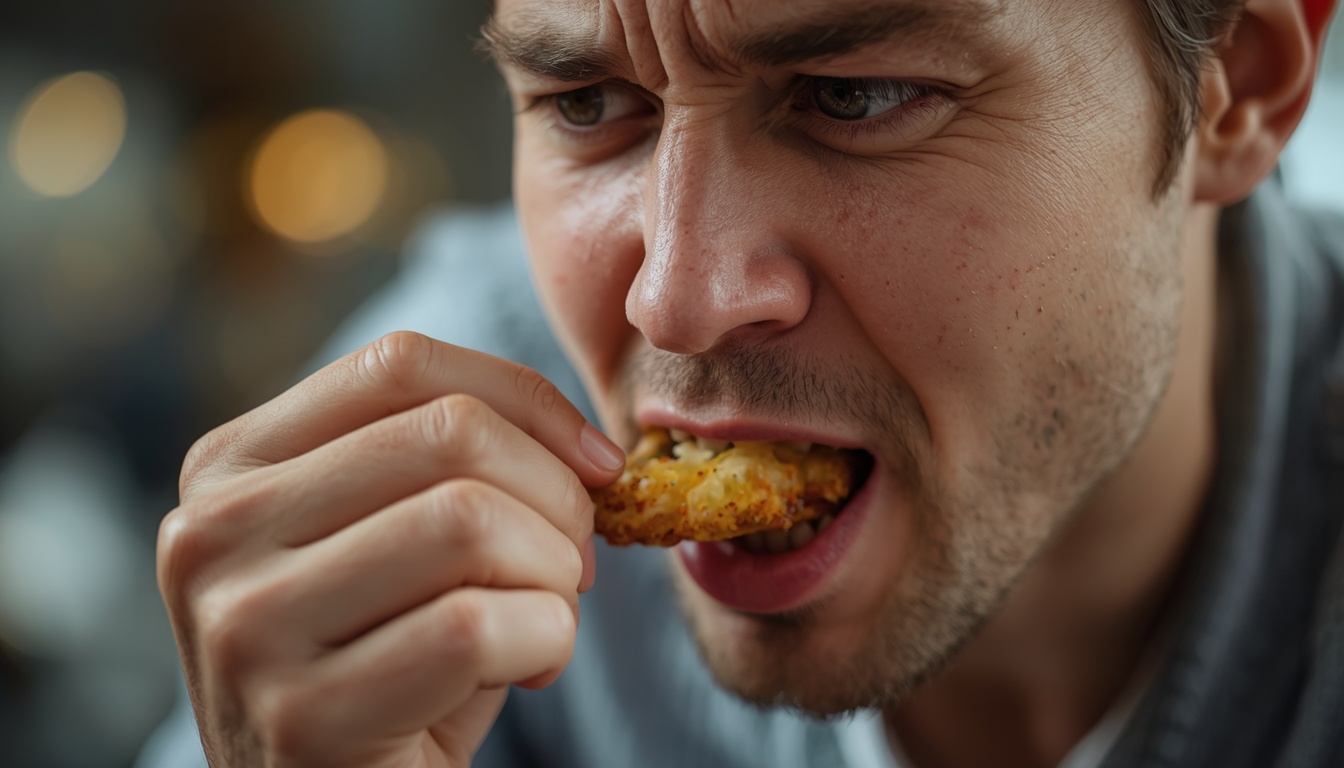

You wake with a tight jaw. Your temples feel used. A partner mentions a faint grinding sound from your side of the room. The dentist points to flattened edges on the molars and asks if you clench at night.
Yes — many people do. Sleep bruxism is rhythmic jaw-muscle activity during sleep. It is not the same as daytime clenching at a keyboard, and it is not usually proof that your bite is “wrong.” For most adults it is an exaggerated version of a motor pattern the sleeping brain already runs.
What Night Grinding Feels Like
You rarely feel the grind while it is happening. What you notice is the morning after:
- Sore masseter or temple muscles, as if you chewed all night
- Teeth that look a little shorter, chipped at the edges, or more sensitive to cold
- A partner who hears scraping or tapping
- A dull headache that sits in the temples and eases after breakfast
- A jaw that clicks or feels stiff for the first hour, similar to the painless click some people notice when they chew
- Indentations on the sides of the tongue or a scalloped cheek line
Some nights are quiet. Stressful weeks, alcohol, or a short sleep often make the next morning worse. That uneven pattern is typical, not a sign the habit is “getting out of control” by itself.
Why the Sleeping Jaw Fires
During wake, you can stop a clench. During sleep, the jaw is run by brainstem circuits that also handle chewing, swallowing, and breathing. Work by Dr. Gilles Lavigne and colleagues at the Université de Montréal showed that most sleep-bruxism bursts sit in light non-REM sleep, often riding a brief micro-arousal: a few seconds of faster brain activity, a small rise in heart rate, then a burst of masseter and temporalis activity. The sequence is usually autonomic first, muscle second.
Dr. Takafumi Kato’s group in Japan mapped the same cascade. A sleep-bruxism episode is not a dream of chewing. It is closer to a startle of the jaw during the cyclic alternating pattern that naturally punctuates light sleep.
Dr. Frank Lobbezoo’s team in Amsterdam helped shift the field away from “the bite caused it.” Occlusal interferences — high spots, a slightly uneven contact — do not reliably start sleep bruxism in controlled studies. The generator is central: brainstem pattern generators plus a brief sympathetic bump. The teeth are the surface that takes the load, not the switch that turns the load on.
Rhythmic masticatory muscle activity itself is common. Polysomnography finds small bursts in many people who never wear their enamel down. Sleep bruxism is that activity turned up in frequency and force — often several episodes an hour instead of one or two.
Common Reasons It Gets Louoser
Light, broken, or irregular sleep. Anything that multiplies micro-arousals multiplies chances for a jaw burst. That includes late screens, sleeping in on weekends, and a partner’s snoring.
Alcohol and some medications. Evening alcohol fragments sleep and is a well-known amplifier. Certain antidepressants (especially some SSRIs) can increase both wake clenching and sleep grinding in a subset of people.
Daytime load on the same muscles. A day of clenched concentration does not “cause” the night event in a simple one-to-one way, but tired jaw muscles complain more in the morning. The two habits often travel together.
Stress physiology, not just “stress thoughts.” Population work led by Dr. Maurice Ohayon linked sleep bruxism reports with anxiety and sleep disruption. That does not mean you grind because you are “bad at relaxing.” It means an aroused autonomic system makes micro-arousals cheaper — the same system described in how modern stress keeps an old alarm running.
Breathing effort at night. Sleep-disordered breathing and sleep bruxism can coexist. A jaw burst sometimes follows a brief airway effort. Treating the airway does not automatically erase grinding, but loud snoring plus morning jaw pain is a reason to look at both.
Age and life stage. Grinding is very common in children and often fades. In adults it tends to wax and wane across years rather than march in a straight line.
What It Does — and What It Usually Does Not
Enamel does not grow back. Years of heavy grinding can flatten cusps, open tiny chips, and make teeth more temperature-sensitive. The jaw joint can feel tired. That is real wear.
It does not, by itself, mean you are heading for arthritis of the jaw, a “collapsed bite,” or a personality problem. Many people grind for decades with only cosmetic flattening and morning stiffness. A night guard does not stop the brain event; it spreads the force so the enamel takes less of a beating.
Sleep bruxism is also not the same as a hypnic jerk at the edge of sleep. One is a whole-body startle as you drop off. The other is a jaw-specific burst later in the night.
Hidden Triggers
- A high late caffeine load that fragments the second half of the night
- Nicotine in the evening
- A very hard pre-sleep workout that leaves the nervous system “up”
- Chewing gum for hours, which trains the same muscles to stay busy
- A dry mouth from mouth breathing, which can make grinding noise louder and enamel more brittle by morning
- A new SSRI or stimulant, or a dose change
- Sleeping on the stomach with the jaw pressed into the pillow
- A cold that forces mouth breathing and lighter sleep
None of these invent a new brainstem circuit. They raise the odds that an existing circuit fires more often.
Myths vs Facts
Myth: A bad bite is the main cause.
Fact: Controlled work does not support occlusion as the generator. Adjusting the bite to “cure” grinding has a weak evidence base.
Myth: Only anxious people grind.
Fact: Anxiety raises the odds. Plenty of calm sleepers still show rhythmic jaw activity on a sleep study.
Myth: A mouth guard stops bruxism.
Fact: A well-made guard protects teeth. The muscle bursts usually continue underneath it.
Myth: You would know if you ground your teeth.
Fact: Most people learn from a partner, a dentist, or morning muscle fatigue — not from a memory of the night.
Myth: Grinding means you are hungry or dreaming of food.
Fact: The bursts cluster with micro-arousals, not with dream content about meals.
How to Make Nights Kinder to the Jaw
You cannot switch off a brainstem pattern with willpower at 2 a.m. You can lower the fuel and protect the surface.
- Keep a regular sleep window so light-sleep fragmentation is not a nightly sport.
- Leave a gap after alcohol, and notice whether weekend drinks predict Monday jaw pain.
- Give the jaw a job that is not clenching: a few slow nasal breaths before lights-out, tongue resting on the palate, teeth slightly apart. That is a daytime rehearsal, not a sleep command.
- If a dentist recommends a guard, use it. Hard or dual-laminate designs prescribed after a proper exam beat a generic boil-and-bite that shifts around.
- Treat loud snoring or gasping as its own problem, not as “just grinding.”
- Ease daytime clenching with the same rest position — teeth apart, lips together — during focused work.
- If an antidepressant coincided with new grinding, ask the prescriber before you change anything. Dose timing and medication choice sometimes matter.
Gentle jaw stretches in the morning — slow opening, light side-to-side, heat on the masseter — help the muscle recover. Aggressive cracking or forced stretching is not required.
When to See a Dentist or Sleep Clinician
Book a check if:
- Teeth are chipping, cracking, or suddenly very cold-sensitive
- Morning pain lasts into the afternoon or chewing becomes limited
- The jaw locks open or closed
- A partner hears grinding plus choking, gasping, or long pauses in breathing
- Headaches are new, one-sided, and building
- You started a new medication and the grind arrived with it
- A child has heavy grinding plus snoring, daytime sleepiness, or worn baby teeth worth documenting
A dentist can document wear, check the joint, and discuss a guard. A sleep evaluation is more useful when breathing effort, insomnia, or unusual movements share the night.
Frequently Asked Questions
Is night grinding dangerous?
For most people it is a wear-and-comfort problem, not a medical emergency. The risk is cumulative enamel loss and sore muscles, not a sudden systemic event.
Can children grow out of it?
Often yes. Childhood sleep bruxism is common and frequently fades. Persistent heavy grinding with snoring still deserves a look at the airway and the teeth.
Will relaxing more stop it?
Lowering evening arousal can reduce how often bursts happen. It rarely deletes the pattern. Protection plus sleep regularity beats “trying to be less stressed” as the only plan.
Do I need a sleep study?
Not for typical two-sided morning tightness and known wear. A study is more helpful when snoring, gasping, kicking, or unusual night behaviors are in the mix.
Can I train myself to stop mid-grind?
Not reliably. The event sits in light sleep, outside ordinary voluntary control. Daytime rest-position practice still helps the same muscles recover.
Is a custom guard better than a pharmacy one?
Usually. A custom appliance stays put and spreads force. A loose boil-and-bite can create new sore spots or be clenched into a worse shape.
Conclusion
Night grinding is a common sleep-motor pattern, not a moral failure and not proof that your bite designed the problem. The sleeping brainstem already runs brief jaw bursts; in sleep bruxism those bursts are louder and more frequent, especially when light sleep is choppy. Protect the enamel, steady the night, treat the airway if it is struggling, and let a dentist track wear. The jaw you wake up with is doing an old job a little too enthusiastically — and most of the time, that is manageable.