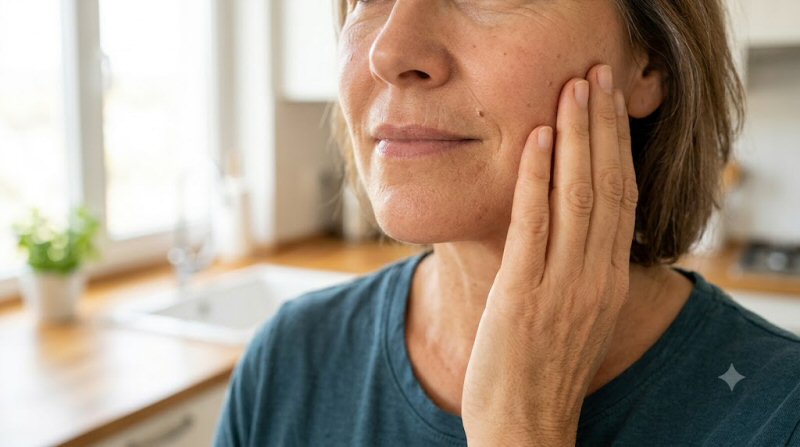
A short headache when you bend to pick something up is often sinus pressure, a migraine trigger, or neck load. Here is when that lean-forward ache is ordinary and when it is not.

You lean down to tie a shoe, grab a bag from the floor, or look under the sink, and a dull weight settles behind the eyes or across the forehead. It eases when you stand up. The next time you bend, it comes back. That pattern is common enough that people Google it between errands. Most of the time it is pressure, a migraine being nudged by posture, or a neck that has been flexed all day. A smaller share is a signal worth a proper look.
What This Symptom Feels Like
The usual version is a pressure or throb that arrives within a few seconds of bending forward and fades within a minute or two of standing straight. It may sit behind the eyes, across the brow, at the temples, or at the base of the skull. Some people describe a full feeling in the face, as if the cheeks have filled. Others feel a pulse that was quiet until the head went down.
It is often worse on days with a cold, allergies, a skipped meal, or a long stretch at a screen. Bending to pick up a child can set it off when a slow lean to the dishwasher does not, because the faster drop adds a brief strain, the same family of pressure change that can spark a cough headache.
A different pattern matters more than the bend itself. A headache that explodes at peak intensity in seconds, pain that is clearly worse when you lie flat, new pain with vomiting or double vision, or a bend-over ache that is brand new after age fifty deserves faster attention than a familiar pressure that leaves when you stand up.
Common Causes
Congested sinuses and a blocked nose. The sinus cavities are air spaces lined with mucosa and drained by narrow openings. When those linings swell from a cold, allergies, or dry indoor air, bending forward shifts pressure and blood volume in the face. Walter Messerklinger mapped how the ostiomeatal complex ventilates these spaces, and later clinicians noted that facial pressure often tracks nasal blockage more than a true bacterial sinus infection. Many people who call this a sinus headache are actually having migraine. David Dodick and colleagues, including work by Eric Eross, found that a large share of self-diagnosed sinus headaches meet migraine criteria once the history is taken carefully.
Migraine nudged by posture. Migraine is a sensory-threshold disorder, not only a bad head pain. Bending, straining, bright light, and skipped meals can all lower the threshold on a susceptible day. The International Classification of Headache Disorders, shaped by researchers including Jes Olesen, lists posture and physical activity among common aggravating factors. The pain may be one-sided, pulsing, and joined by nausea or light sensitivity, even if the bend was the obvious trigger.
Neck load after a flexed day. Looking down at a phone or laptop holds the cervical joints and upper trapezius in a long isometric. Nikolai Bogduk described how upper cervical structures can refer pain into the head. When you then bend at the waist, the neck often flexes further and the already tired muscles brace. The ache can feel frontal even though the driver is the neck. A related pattern is covered in stiff neck from looking at your phone.
Dehydration and a missed meal. Lower fluid volume and a falling blood sugar make cranial vessels and pain pathways more reactive. A bend that would have been silent after lunch can throb after a long meeting with only coffee. Joseph Blau and later headache researchers have linked fluid deficit and fasting to ordinary headache days. More on the meal side sits in the dehydration headache article.
A brief pressure surge. Bending, lifting, and holding your breath raise pressure in the chest, veins, and briefly in the head. Charles Symonds described cough and exertional headaches as short-lived events tied to that surge. If the pain is only a few seconds and only with the strain of the lift, it often belongs with that family rather than with a sinus story.
Why This Happens
Your head is a closed box of brain, blood, and cerebrospinal fluid. When you hinge at the hips, gravity shifts blood toward the head and face for a moment. Veins in the scalp and sinuses fill a little. If the lining is already swollen, or if migraine pathways are already irritable, that small shift is enough to register as pain.
The neck adds a second route. Flexion loads the upper cervical joints and can irritate the greater occipital region, which shares sensory traffic with the forehead through the trigeminal system. That is why a “sinus” pressure and a neck-driven ache can feel similar until you notice which days they appear.
Standing up reverses the blood shift and unloads the neck. That is why the ordinary version fades quickly. Pain that ignores posture, or that prefers lying down, is using a different mechanism.
Less Common but Serious
Most bend-over headaches are not dangerous. A few patterns are.
Raised pressure inside the skull can worsen with bending, coughing, and lying flat. Idiopathic intracranial hypertension, studied by Deborah Friedman and Michael Wall, often brings headache plus visual change, pulsatile whooshing in the ears, and worse pain when the head is down. It is more often seen in younger adults with recent weight gain, but it is not limited to that group.
The opposite timing is a clue too. Spontaneous low cerebrospinal fluid pressure, described in detail by Bahram Mokri and Wouter Schievink, typically hurts more upright and eases when you lie down. Bending can still aggravate it, but the dominant story is a headache that builds the longer you are vertical.
A sudden severe peak — the so-called thunderclap — during a bend or strain needs emergency care to exclude bleeding. New headache with fever, a stiff neck, confusion, weakness, or a drooping face is not a posture story. After fifty, a new one-sided temple pain with scalp tenderness or jaw pain on chewing needs prompt assessment for temporal arteritis.
True bacterial sinusitis is less common than viral congestion. Fever, thick one-sided nasal discharge, and facial pain lasting beyond the usual cold window are reasons to be checked, not a reason to assume every lean-forward ache is an infection.
Hidden Triggers
A few quiet habits make the bend more likely to hurt.
Holding your breath as you pick up a bag turns a simple lean into a small Valsalva. Dry heated rooms thicken nasal mucus, so the same forward lean that was fine in summer bothers you in January. Contact lenses and long screen sessions leave the eyes strained, and frontal ache gets blamed on the bend. Caffeine withdrawal, a late night, and alcohol the evening before all lower the threshold. Tight glasses, a ponytail, or a hat band can add an external-compression ache that only becomes obvious when you lean down. Allergy season and a habit of mouth breathing overnight leave the morning face more pressure-sensitive.
When to Worry
Get urgent care if the pain is explosive and maximal within seconds, if you faint, if vision doubles or blacks out, if you vomit repeatedly, or if you have fever with neck stiffness, new weakness, trouble speaking, or a seizure.
Book a timely visit if the headache is new after age fifty, wakes you from sleep, is clearly worse lying flat, comes with pulsatile tinnitus or visual blurring, follows a head injury, or is steadily worsening over days. Also get checked if bending pain is joined by one-sided weakness, numbness, or a new persistent ring in one ear.
A familiar, brief, bilateral pressure that leaves when you stand, tracks a cold or a screen day, and has no neurological extras is the pattern most people can watch and manage.
Myths vs Facts
Myth: Pain when you bend always means a sinus infection.
Fact: Viral swelling and migraine are more common. Infection is suggested by fever and persistent one-sided discharge, not by the bend alone.
Myth: If it fades when you stand up, it cannot be important.
Fact: Fading is reassuring, but a new pattern with visual change or a whooshing ear still needs a clinician.
Myth: You should never bend if you get headaches.
Fact: Avoiding every lean weakens the habit of normal movement. Fix the trigger day — fluid, neck position, nasal airflow — rather than treating bending as the disease.
Myth: A daily decongestant spray is the fix.
Fact: Short use can help a blocked nose. Daily use for more than a few days can rebound and worsen congestion, a pattern described in rhinitis research by Peter Howarth and others.
How to Manage
Stand up slowly if the pressure has already started, and breathe out rather than holding the breath on the next lift. Hinge from the hips with a long spine when you pick things up, so the neck is not stacked into end-range flexion.
On congested days, a saline rinse, a warm shower, and slightly moister indoor air often do more than another pain tablet. If allergies are the driver, treating the nose reduces the bend-over days.
Drink water through the afternoon, and do not let the only calories before a bending-heavy chore be coffee. A short walk and a screen break unload the neck before the headache arrives. If phone posture is the obvious setup, raise the screen and reset every half hour.
For a known migraine pattern, the plan you already use — early treatment, regular meals, steady sleep — applies here. Bending is a trigger, not a separate disease.
Skip daily decongestant sprays. Skip pressing hard on the eyes. If glasses are tight, loosen them. If a ponytail or headband sits on the sore spot, change it.
When to See a Doctor
See a clinician if bend-over pain is new, frequent, or changing, especially with visual symptoms, a whoosh in the ears, fever, or neurological signs. Primary care can sort migraine, neck referral, and nasal disease, and can decide whether eye pressure, imaging, or an ENT visit is useful. Do not wait out a thunderclap or a headache with fever and confusion.
FAQs
Is a headache only when I bend over normal?
A brief pressure that fades when you stand is common with congestion, migraine threshold, neck load, or a short pressure surge. New, severe, or neurologically accompanied pain is not something to file as normal.
Why does it sit behind my eyes?
The forehead and eye region share trigeminal sensory pathways with the sinuses and the upper neck. Pressure in any of those places can be felt behind the eyes.
Can allergies do this without a fever?
Yes. Swollen nasal lining alone can make a forward lean uncomfortable. Fever is more a clue to infection than to allergy.
Should I exercise if bending starts a headache?
Gentle walking is usually fine. Skip breath-holding lifts on a day the head is already irritable, and get checked if exertion itself brings severe sudden pain.
Will it damage my brain to keep bending?
Ordinary pressure shifts do not injure the brain. The goal is to reduce swollen linings and neck load, not to fear the movement.
How is this different from a cough headache?
Both can use a brief pressure surge. Cough headache is tied to the cough or strain itself. Bend-over ache more often tracks sinuses, migraine, or neck flexion, and lasts while the head stays down.
Conclusion
A headache that shows up when you bend and leaves when you stand is usually a small pressure story: swollen nasal lining, a migraine day, a neck fresh from a screen, or a breath held during the lift. Ease the setup — airflow, fluid, meals, and a less flexed neck — and the lean often goes quiet. Keep the red flags in view: explosive onset, visual change, pain worse when flat, fever with a stiff neck, or a new pattern later in life. Those are reasons to be seen, not reasons to blame the dishwasher.