A dull ache after a short rest is often sleep inertia, neck position, or a caffeine gap—not a sign that napping itself is harmful.
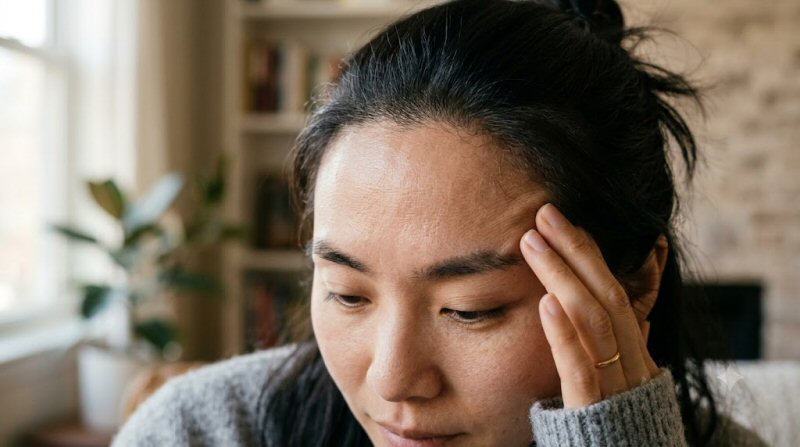
You closed your eyes for twenty minutes hoping to feel sharper. Instead you open them to a heavy head, a dull press behind the eyes, and the sense that the nap made things worse. The room looks ordinary. Your neck feels a little stiff. The headache is real, and it is common enough that many people simply stop napping.
Most of the time the pain is not a warning that your brain objects to rest. It is the predictable result of waking from the wrong stage of sleep, holding an awkward neck position, or running a small gap in fluids or caffeine. Short, well-timed naps still help many people. The ones that leave a headache usually share a few mechanical details that are easy to adjust.
What This Symptom Feels Like
A typical post-nap headache is dull rather than stabbing. It may sit across the forehead, at the temples, or at the base of the skull. Some people describe a heavy, cotton-wool quality that arrives with the grogginess and fades within half an hour to an hour. Others notice a tight band that lingers longer if the neck was twisted. Light and noise are usually tolerable; the main complaint is the sense of unfinished sleep rather than severe pain.
The ache often appears right as you sit up. It can be one-sided if you slept with your head tilted. Jaw soreness or temple tightness sometimes travels with it, especially if you clench during the nap. Most people can still function; the headache is an annoyance layered on top of sleep inertia rather than a reason to stay down.
Common Causes
The most frequent driver is sleep inertia. Sleep researchers Patricia Tassi and Alain Muzet described this as the temporary impairment that follows waking from deeper stages. In the first 15–20 minutes of a nap you usually stay in light sleep. After roughly 30 minutes the brain begins slow-wave sleep. Waking abruptly from that stage leaves arousal systems lagging. The mismatch can produce both grogginess and a dull headache. Studies by Amber Tietzel and Leon Lack showed that 10-minute naps produce little inertia, while 30- to 60-minute naps produce more.
Neck position is the second ordinary culprit. Many naps happen on a couch, in a chair, or with the head resting on folded arms. The upper cervical joints and suboccipital muscles stay in one strained angle. When those structures are irritated they refer pain upward—the same mechanism that produces cervicogenic headache after a full night of awkward pillow height. A desk nap with the chin on the chest is a classic setup.
Mild dehydration and a caffeine gap complete the usual list. If you have gone several hours without water, the nap simply makes the thirst more noticeable on waking. If you normally drink coffee mid-morning and then nap through the usual time, the adenosine rebound that Laura Juliano and Roland Griffiths documented in caffeine-withdrawal research can appear as a headache. Blood-sugar dips from a skipped meal act the same way.
Less often the nap unmasks teeth clenching (sleep bruxism) or mild airway narrowing. Both can produce a morning-style headache even after a short rest.
Why This Happens
Sleep cycles are roughly 90 minutes. A nap that ends in the middle of slow-wave sleep forces the brain to restart arousal systems that had just been dialed down. The transition is chemically messy; residual adenosine and incomplete clearance of sleep-promoting signals leave a temporary pressure sensation many people feel as headache. Neck muscles that have been held isometrically for twenty or thirty minutes accumulate local metabolites and mechanical strain. On sitting up, that strain is interpreted as head pain because the nerves serving the upper neck share pathways with those serving the scalp.
Caffeine withdrawal follows a different timetable. Regular users develop an upregulation of adenosine receptors. When the usual dose is delayed, the unblocked receptors produce the classic withdrawal headache that the International Classification of Headache Disorders lists as emerging within 24 hours of the last dose. A nap simply moves the moment of noticing it.
None of these mechanisms require disease. They require timing, posture, and ordinary daily gaps.
Less Common but Serious Causes
Occasional post-nap headaches that settle with water, a short walk, and better neck support are almost always benign. A few patterns deserve more attention.
Obstructive sleep apnea can produce headaches after both night sleep and naps because of repeated oxygen dips and arousals. Loud snoring, witnessed pauses, or daytime sleepiness that does not improve with better nap habits are the usual clues. Migraine can be triggered or worsened by the sleep-wake transition in susceptible people; the pain is typically more severe, often one-sided, and accompanied by light sensitivity or nausea. Rarely, a new severe headache with neck stiffness, fever, or neurological symptoms points to other problems that need prompt evaluation.
The key distinction is frequency and accompanying features. One or two post-nap headaches after long or poorly positioned rests are ordinary. Headaches that follow every nap, arrive with other warning signs, or fail to respond to simple changes are not.
Hidden Triggers
Several everyday details amplify the ordinary causes:
- Napping later than mid-afternoon, which collides with the circadian rise toward evening alertness and can fragment the following night.
- Sleeping in a warm, poorly ventilated room that raises skin temperature and makes dehydration more likely.
- Going straight from bright screens into a dark nap without a short transition, which can leave the visual system and neck muscles tense.
- Alcohol earlier in the day, which fragments sleep architecture even in a short nap and increases the chance of waking from deeper stages.
- Medications or supplements that alter sleep depth or fluid balance.
These are not exotic. They are the ordinary background of a modern afternoon.
When to Worry
Most post-nap headaches need no medical visit. See a clinician if:
- The headache is sudden and severe (“worst of my life”) or arrives with neck stiffness, fever, confusion, or weakness.
- You have repeated headaches after every nap despite keeping them under 25 minutes and supporting the neck.
- Loud snoring, gasping, or unrefreshing sleep accompany the pattern, especially with high blood pressure or morning headaches after full nights.
- The pain is progressively worse, wakes you from the nap, or is accompanied by vomiting, visual change, or one-sided neurological symptoms.
- You have a known headache disorder and the naps are clearly triggering more frequent attacks.
Urgent care is appropriate for the sudden severe pattern or any neurological deficit. Routine primary care is enough for the recurring but milder pattern once simple adjustments have been tried.
Myths vs Facts
Myth: Any headache after a nap means you should stop napping forever.
Fact: Short naps (10–20 minutes) timed for the early afternoon still improve alertness for many people. The headache usually tracks nap length and position, not the decision to rest.
Myth: Post-nap headaches are always caffeine withdrawal.
Fact: Caffeine gap is one common contributor, especially in regular users, but neck strain and sleep inertia are equally frequent and occur in people who drink no caffeine at all.
Myth: The headache means you have sleep apnea.
Fact: Apnea can cause waking headaches, but the typical post-nap version that settles quickly after a poorly positioned rest does not require that diagnosis. Snoring plus daytime sleepiness is the stronger signal.
Myth: Lying perfectly still for an hour is the healthiest nap.
Fact: Longer naps increase the chance of entering slow-wave sleep and waking with inertia. The evidence favors brief naps for most people who want to feel better afterward.
How to Manage
Practical steps usually resolve the ordinary pattern:
- Keep the nap to 10–25 minutes. Set an alarm. If you consistently need longer, look at nighttime sleep duration first.
- Nap earlier in the afternoon (roughly 1–3 p.m. for most schedules) so the rest aligns with the natural circadian dip.
- Support the neck. Lie down with a small pillow under the head rather than resting the chin on the chest or the head sideways on an arm. A travel neck pillow works if you must nap upright.
- Drink water before and after. A small snack if you have gone several hours without food prevents the blood-sugar contribution.
- If you are a regular caffeine user, either keep the usual timing or accept that a gap may produce a short headache; tapering rather than abrupt stops reduces withdrawal intensity.
- After waking, sit up slowly, roll the shoulders, and take a short walk or step into daylight. The combination helps clear residual inertia.
- If jaw tightness is part of the picture, a simple awareness check (lips together, teeth slightly apart) before the nap can reduce clenching.
These changes address the mechanical causes directly. Most people notice the difference within a few adjusted naps.
When to See a Doctor
Book a non-urgent visit if the headaches continue after you have shortened the naps, supported the neck, and corrected obvious fluid or meal gaps. Mention snoring, daytime sleepiness, blood-pressure readings, and any migraine history. A clinician can decide whether a sleep study, headache diary, or simple medication review is useful.
Seek prompt care for sudden severe headache, neurological symptoms, fever with neck stiffness, or headaches that are clearly worsening. Those patterns are uncommon after ordinary naps but should not be watched at home.
FAQs
Is a 10-minute nap less likely to cause a headache than a 40-minute one?
Yes. Brief naps usually stay in light sleep and produce little inertia. Longer naps raise the chance of waking from slow-wave sleep, which is when the dull headache and grogginess are most common.
Can neck position alone cause the headache even if I only nap for 15 minutes?
Yes. Fifteen minutes of an extreme head angle is enough to irritate upper cervical joints and muscles. Supporting the neck removes that contribution even when nap length is already short.
Does this mean I should avoid caffeine entirely?
No. Regular moderate caffeine is compatible with good sleep for many people. The issue is the abrupt gap. Keeping a consistent intake, or tapering if you want to reduce it, prevents the withdrawal headache that can appear after a nap.
Will better nighttime sleep stop the post-nap headaches?
Often, yes. Chronic short sleep increases sleep pressure, so even a short nap can drop you into deeper stages faster. Extending nighttime sleep by 30–60 minutes frequently reduces both the need for long naps and the inertia that follows them.
Is it normal for the headache to be only on one side?
It can be, especially if you slept with the head tilted to that side. One-sided pain that is severe, throbbing, or accompanied by nausea is more suggestive of migraine and worth mentioning to a clinician if it recurs.
Conclusion
A headache after a nap is usually the ordinary price of waking from deeper sleep, holding the neck in an awkward angle, or noticing a small gap in water or caffeine. It is not evidence that rest itself is harmful. Shortening the nap, supporting the head, and covering the simple daily gaps remove the most common triggers for most people. When those adjustments do not help, or when snoring and other symptoms travel with the pattern, a medical review is the sensible next step. The goal is not to abandon napping; it is to make the rest match the way the sleep system actually works.
Related reading: Is It Normal to Feel Worse After a Nap?, Is It Normal to Wake Up With a Headache?, and Is It Normal to Get a Headache When You Skip Coffee?.