A black toenail after a long hike or run is usually a small bruise under the nail from the toe box, not fungus. Roomier shoes and a straight trim let it grow out.
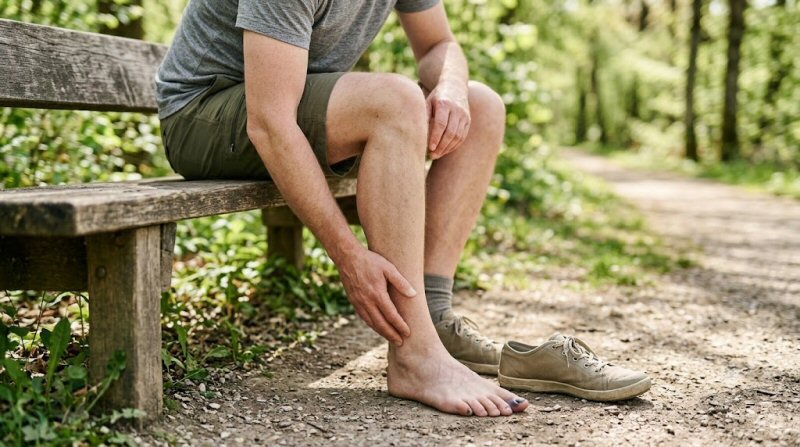
You take the boots off at the trailhead and the big toenail is the wrong color. Yesterday it was pale pink. Today a red-black patch sits under the free edge, or the whole nail looks bruised. It may throb in the shoe and feel fine once the boot is off. That finding has a trail name: jogger’s toe, or runner’s toe. In most weekend hikers it is a small bleed under the nail, not an infection and not a nail disease that appeared overnight.
What This Looks Like
The color is blood trapped between the nail plate and the nail bed. Fresh blood looks red or purple. After a day or two it turns brown-black as the hemoglobin breaks down. The patch often starts at the far end of the nail, where the toe met the toe box on every downhill step. Sometimes only a corner is dark. Sometimes the whole plate looks painted.
The nail may feel tender if you press it, especially in the first day. A loose click at the tip can show up a week later as the plate starts to separate. Many people have no pain at all and only notice the color in the shower. The other toes are usually spared, or only the longest toe on each foot is marked. Shoes that felt “fine” on flat pavement are a common partner in the story.
A black toenail that follows a long descent, a race, or a day in stiff boots is the everyday version. A black streak that was already there, that widens over months, and that was never linked to a shoe is a different story, covered below.
Why the Nail Bruises on a Descent
The nail plate is a hard keratin shield. Under it, the nail bed is soft and full of small vessels. On level ground the big toe leaves the ground last, in a short push. On a long downhill the foot slides forward in the shoe with every step. The toe hits the front of the toe box, then the nail hits the nail bed again. Sports-medicine writers, including Steven Subotnick in his work on the running foot, described this repetitive knock as the usual cause of the black toenail in distance athletes.
Each impact is small. Hundreds of them in a day are enough to tear a few capillaries. Blood has nowhere to drain, so it spreads under the plate and stains it. E. Anthony Mailler and Brian Adams, reviewing skin problems reported on marathon day, listed under-nail bleeding among the common “wear and tear” findings, alongside blisters and chafing. The same mechanics show up in hikers, court-sport players, and anyone whose toes are asked to brake inside a closed shoe.
Downhill is the classic trigger because the load is eccentric and forward. A too-short toe box, a thick sock that steals length, nails left long, and a boot that fit in the shop but not after an hour of swelling all raise the chance. Heat and a long day add swelling, so a shoe that was roomy at mile one can kiss the nail by mile eight.
Shoe shape matters as much as distance. A taper that crowds the big toe against the second toe changes where the nail strikes. Michael Coughlin’s work on the hallux and forefoot fit makes the same practical point that shows up in a long-walk big-toe ache: the toe is built to push, not to be used as a bumper. If the toe box also numbs the toes, that is a fit problem of its own, closer to what happens when toes go numb in shoes.
How the Color Grows Out
A toenail does not turn over in a week. Fingernails advance faster. Toenails often move about a millimeter to a millimeter and a half a month, so a full plate can take nine to eighteen months to replace itself. The dark patch does not sink into the skin. It rides forward with the plate. A mark that started near the cuticle will still be visible for most of a year. A mark that started at the tip may chip off sooner.
Robert Baran and other nail clinicians describe traumatic pigment and dried blood as a stain that grows out with a clear new plate behind it, as long as the matrix (the growing zone under the proximal fold) was not badly crushed. If the matrix was only bumped, the new nail is normal. If it was split by a single heavy crush, a ridge or a split can persist. Weekend hike bruises rarely do that.
The plate may loosen and fall when the pooled blood separates it from the bed. That looks dramatic and is usually painless by the time it happens. The bed underneath is often already covered by a thin new plate. Pulling a nail that is still attached tears that bed and invites infection. Letting a loose plate come away on its own, or having a clinician trim only the detached part, is the calmer path.
Common Triggers on Ordinary Days
You do not need a mountain race. A long city walk in fashion shoes with a short toe box can do it. So can:
- A downhill hike in boots that fit at the heel but not at the toes.
- Trail shoes a half size too short once the foot swells.
- Nails that extend past the toe and act as a lever on every step.
- Socks that bunch at the tip and steal a few millimeters.
- A sudden jump in mileage, or a race with more descent than training.
- Court sports with hard stops, where the toe brakes inside the shoe.
- A single stub against a rock, which makes a smaller, sharper bruise.
The shared piece is contact. The nail is asked to absorb a blow the shoe should have kept away from it.
Less Common but Serious Causes
Most post-hike black nails are blood. A few patterns are not.
A single heavy crush, such as a dropped pack or a door, can fill the whole nail with blood and throb in time with the pulse. Pressure under a sealed plate is what hurts. That acute, tense hematoma is the one a clinician sometimes drains through the plate for relief. A dull hike bruise that is already comfortable does not need that.
Infection is uncommon under an intact plate. Increasing redness of the surrounding skin, pus at the fold, fever, or pain that worsens after the second day is no longer a simple bruise.
Repeated black nails with no shoe story, or a dark band that starts at the matrix and runs the length of the nail, need a different look. Subungual melanoma is rare. It is a pigment streak in the plate, often brown-black, that does not grow out and clear. A streak that widens, a pigment that leaks onto the adjacent cuticle (sometimes called Hutchinson sign), or a nail that lifts without trauma belongs with a dermatologist. Nail experts including Richard Scher have long stressed that a pigment band which fails to move with the plate is not dried blood.
People with diabetes, poor circulation, or numbness in the feet should not wait on a black nail plus an open crack. A small bed injury heals slowly when sensation and blood flow are already reduced.
A black nail on a toe that was never bumped, never hiked, and never squeezed by a shoe is not jogger’s toe until someone has said so.
When to Worry
Most hike bruises can be watched. Seek care sooner if:
- The nail is tense and throbbing, and the color appeared after one hard crush rather than a long walk.
- Redness, warmth, or pus spreads onto the toe.
- You cannot feel the toe well, or you have diabetes and the skin is broken.
- A dark streak was present before the hike and is wider than it was a few months ago.
- Pigment stains the skin of the cuticle, not only the plate.
- Several nails darken with no change in shoes or mileage.
- The toe stays crooked, numb, or unable to push off after the color fades.
A painless dark patch that follows a descent, sits at the tip, and slowly marches forward is the ordinary pattern.
Myths vs Facts
Myth: a black toenail after a hike is fungus. Fact: fungus tends to be yellow, white, or crumbly, and it builds over months. Sudden red-black color after a descent is blood.
Myth: the nail is dead and must be pulled off. Fact: the plate is a finished layer of keratin. Leaving it in place protects the bed while a new plate forms.
Myth: black means the toe is broken. Fact: the vessels under the nail can leak without a fracture. Constant inability to walk on the toe is a different exam.
Myth: once you get runner’s toe, every long walk will do it. Fact: length in the toe box, a straight trim, and fewer untrained descents prevent most repeats.
Myth: you should drill the nail at home the same day. Fact: a comfortable bruise does not need drainage. A tense, painful one is a clinic job, where the plate can be opened cleanly and the toe kept clean.
How to Manage It
Start with the shoe, not the nail. Take the insole out and stand with your heel seated. There should be a clear gap, often about a thumb’s width, between the longest toe and the end of the shoe. Downhill days need that gap more than mall walks do. If the toes go numb or the nail taps the front, the last is too short or too pointed, whatever the size label says.
Trim the nail straight across and short enough that it does not meet the shoe, but not so short that the corners dig into the skin. Long corners are levers. Very short, curved cuts invite ingrown edges. A single straight trim the night before a long descent is enough for most people.
Lace so the foot does not slide. A heel lock, or simply snugger lacing over the midfoot, keeps the toes off the front wall. On a long downhill, a brief stop to retie beats another hour of tapping.
While the color is fresh, ordinary walking in a roomier shoe is fine. Skip the next steep descent if the toe still throbs. A cool pack through a cloth in the first day can ease a tender nail. Keep the fold clean and dry. A loose plate can be covered with a simple dressing so it does not catch on a sock. Do not soak the toe for long periods. Do not paint over a fresh, painful bruise and forget it. Polish on a painless, growing-out stain is a cosmetic choice, not a treatment.
Expect the color to move toward the tip. Photograph it once a month in the same light if you want proof it is traveling. A mark that advances and shrinks is blood or a one-time stain. A mark that stays anchored at the cuticle is the one to show a clinician.
The big toe still expects a clean push-off, not a bumper. That is the same job described in why the big toe still expects a push-off. Giving it a box it can finish that push inside is the prevention that actually works.
When to See a Doctor
See a clinician if pain is throbbing and worsening in the first day after a crush, if the skin around the nail is infected, or if a dark band is not growing out after a couple of months. A diabetes check, a toe that will not bear weight, or pigment on the cuticle should not wait for the next hike. Drainage, if it is needed, is a short office procedure. It is not a trail skill.
FAQs
Will the black toenail fall off?
Often the bruised part loosens as it grows forward, and part or all of the plate may shed. Many hike bruises never shed. They simply chip off at the tip as clear nail replaces them from behind.
How long until it looks normal?
Tip stains can be gone in a few weeks. A patch that reaches back toward the cuticle can take most of a year, because a toenail replaces itself slowly. The new plate is usually normal.
Can I keep hiking?
Yes, if the shoe no longer taps the nail and the toe is not throbbing. Repeating the same short toe box on another descent is how the bruise gets a second layer.
Is it safe to drain it myself?
A painless stain does not need drainage. A tense, pulsatile bruise after one injury should be opened in a clinic if it needs opening at all. Home tools push bacteria under a sealed plate.
Could it still be melanoma?
A one-time patch after a descent that moves forward with the nail is blood. A streak that starts under the cuticle, widens, stains the adjacent skin, or never moves deserves a dermatology look, hike or no hike.
Does fungus medicine help?
No. Antifungal drops do not clear dried blood. They are for crumbly, long-standing nail fungus, which looks different and did not appear the evening of a hike.
Conclusion
A black toenail after a hike is usually a bruise from the toe meeting the shoe, especially on the way down. Subotnick, Mailler, and Adams described the same finding in runners: repetitive contact, a little blood under the plate, and a mark that grows out. Room in front of the longest toe, a straight trim, and a lace that stops the foot from sliding prevent most repeats. Throbbing pressure, spreading redness, or a streak that refuses to move are the reasons to have someone else look. The rest is patience and a longer toe box.