
That brief hollow lurch when an elevator starts down is usually otolith lag plus visceral inertia — your inner ear and gut registering a short linear acceleration, not your stomach falling out of place.
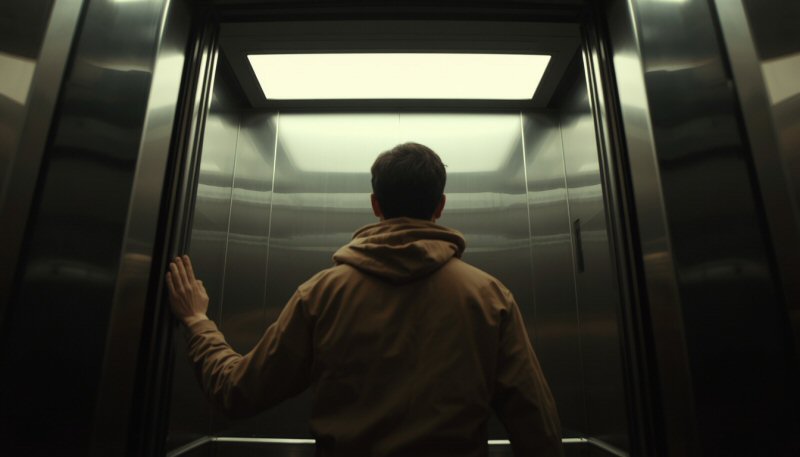
The doors close. For a second nothing happens. Then the floor seems to leave you. A hollow, slightly nauseating dip opens under the ribs, as if the stomach had stayed on the previous floor and the rest of you had gone on without it. A second later the cabin is moving smoothly and the feeling is gone. Going up can do the opposite: a brief heavy press in the gut and knees.
Nothing in the abdomen has detached. The sensation is two honest instruments reporting the same event — a short linear acceleration — and they do it on slightly different clocks. One instrument is the otolith organs of the inner ear. The other is the mass of the viscera themselves. Modern elevators make the report especially clean because they start and stop faster than a staircase ever did.
What This Sensation Feels Like
The classic “drop” is brief. It lives in the upper abdomen and lower chest more than in the true pelvis. Some people feel it as emptiness, some as a flutter, some as a single beat of queasiness. It is not the same as nervous butterflies, which are a gut-brain blood-flow and motility shift before a social event. The elevator version is timed to the first half-second of motion, not to a thought.
Direction matters. Starting downward, or cresting the first hill of a roller coaster, produces the hollow drop. Starting upward, or the bottom of that same hill, produces heaviness — as if the floor had gained weight. Constant-speed travel, even at high velocity, feels like standing still. The sensors that generate the lurch care about change in velocity, not about speed itself.
A few people add a brief lightheaded flash or a need to hold the rail. That is usually the same acceleration showing up in blood-pressure reflexes and in the vestibular nuclei, not a sign that the cabin is unsafe.
Common Causes
The inner-ear half of the story sits in two small pouches, the utricle and the saccule. Their floors and walls are lined with hair cells whose cilia are embedded in a gelatinous sheet topped with dense calcium-carbonate crystals — the otoconia. Gravity and linear acceleration pull on those crystals. When the head (and the elevator) accelerate downward, the crystals lag for a moment relative to the skull. The hair cells fire a pattern that the brain reads as “falling.” When the cabin accelerates upward, the crystals press harder and the pattern reads as “heavier than one g.”
That architecture was mapped in detail by Jay Goldberg and César Fernández in the vestibular laboratories at Chicago and later UCLA, work that still anchors how physiologists talk about otolith afferents. Dora Angelaki and colleagues later showed how those linear-acceleration signals are combined with canal signals and with vision so the brain can tell tilt from translation. An elevator is almost a pure translation: the cabin moves in a straight line and the head does not pitch. The otoliths therefore get a relatively uncontaminated message.
The visceral half is simpler physics. The liver, stomach and intestines have mass. They are slung from the diaphragm and the abdominal wall by ligaments and mesentery, not bolted to the spine. When the floor drops, the body follows the cable; the viscera take a few tens of milliseconds to catch up. Stretch receptors in the mesentery and in the wall of the stomach report that brief lag. The vagus nerve carries a share of that report. The feeling is not imaginary, and it is not the stomach “falling through” an opening. It is inertia, the same reason coffee sloshes when you set the mug down too fast.
A third contributor is expectation. If your eyes say the walls are still, and your feet then lose a fraction of their usual load, the mismatch is the same family of conflict that makes some passengers carsick. In a closed elevator the visual world is the cabin. The otoliths disagree with that world for one beat. People who already have a sensitive vestibular system feel the beat more.
Why This Happens
Linear acceleration is one of the oldest things a vertebrate nervous system has had to detect. Fish use otoliths to know which way is down and whether they are rising through the water column. Land animals kept the same organs and added canals for rotation. Humans then built boxes that change vertical speed in a fraction of a second — faster than walking down a slope, slower than a true free fall.
Ernst Mach, in the nineteenth century, was already using elevators and falling frames to argue that the sense of “down” is an acceleration problem, not a mystical gravity sense. Later aviation physiologists, including Ashton Graybiel and Fred Guedry, put people on linear tracks and in elevators to measure how brief changes in g are perceived. A short downward acceleration is consistently reported as a drop in the stomach and a lightening of the feet. A short upward acceleration is reported as heaviness. The thresholds are low. You do not need a theme-park launch; an ordinary office elevator is enough.
The reason the feeling fades so quickly is that otoliths and viscera both adapt to a new constant velocity. Once the cabin is moving at a steady rate, the crystals sit as they do at rest, the organs rest in their slings, and the brain treats the new speed as the new zero. That is why you cannot feel how fast a smooth elevator is traveling — only when it starts, slows, or changes direction.
There is a small blood-flow piece as well. A downward start slightly unloads the vessels of the legs for a moment; an upward start does the reverse. Baroreceptors notice. In a healthy person the adjustment is invisible. In someone already close to orthostatic lightheadedness, the same half-second can add a flicker of gray at the edges of vision.
Less Common but Serious
Most elevator lurches last one or two seconds and match the motion of the cabin. That pattern is benign.
A spinning room that continues after the elevator stops is not an otolith-and-viscera story. That is more often a canal or central-vestibular problem. Hearing change, roaring in one ear, or a drop that comes with a severe one-sided headache needs a different workup than “I hate glass elevators.”
Red ear syndrome, migraine variants, and rare vascular events can produce sudden ear or head sensations that people mislabel as a “drop.” They are not timed to the first movement of a lift. Persistent nausea, vomiting, or imbalance after ordinary elevator rides — especially if stairs feel the same — belongs with a clinician who can examine the vestibular system, not with a lecture on otoconia.
A true free-fall sensation that happens in bed, without any motion of the room, is a different event (often a hypnic phenomenon or a brief vestibular discharge) and should not be forced into the elevator explanation.
Hidden Triggers
Speed profile. Older hydraulic lifts start more gently. Newer traction elevators with sharp acceleration profiles make a cleaner otolith transient. People notice the new building more than the old one and blame “worse nerves.”
Visual reference. A glass elevator that shows the atrium falling away adds a strong visual drop to the otolith drop. A windowless cabin leaves you with only the inner ear and the gut. Either can feel worse depending on which cue you trust.
Hunger and an empty stomach. A hollow viscus sloshes more obviously than a full one. The same acceleration after a large meal can feel like pressure instead of emptiness.
Anxiety about heights or enclosed spaces. The acceleration signal is real; the emotional amplifier is also real. Anticipating the lurch makes the first millimeter of motion easier to detect, which then confirms the fear.
Dehydration, a skipped meal, or a recent inner-ear cold. All lower the threshold at which a normal acceleration feels dramatic.
When to Worry
Worry less about the half-second hollow feeling that starts and stops with the cabin.
Worry more if:
- The spinning or dropping continues after you step into the lobby.
- One ear loses hearing or fills with noise at the same time.
- You fall, cannot walk a straight line, or see double.
- The “drop” happens in bed or at a desk, with no acceleration around you, and keeps repeating.
- Headache, weakness, or slurred speech shares the episode.
Those are not elevator physics.
Myths vs Facts
Myth: Your stomach physically drops through the diaphragm. Fact: Ligaments and mesentery keep the viscera in the abdomen. What “drops” is the relative position of a mass that has inertia, by millimeters, for a fraction of a second.
Myth: Only anxious people feel it. Fact: Otoliths and viscera do not require an anxiety diagnosis. Anxious attention can turn up the gain on a signal that is already there.
Myth: If you feel it, the elevator is unsafe or dropping too fast. Fact: You are detecting a designed acceleration. Safety systems and counterweights are a separate question from whether your saccule noticed the start.
Myth: Going up and going down should feel the same. Fact: Opposite accelerations produce opposite otolith and visceral reports — light versus heavy.
Myth: Children who laugh on elevators are being dramatic. Fact: Smaller bodies and a less practiced vestibular system often make the transient more obvious. Many adults simply stopped commenting on it.
How to Manage It
Look at a stable point in the cabin rather than at a phone. A visual reference that moves with you reduces the conflict between “the walls are still” and “my otoliths say we just fell.”
Ride with slightly bent knees. A soft lower limb absorbs part of the acceleration the way a ski bend absorbs a bump. Locking the knees sends more of the transient into the spine and the gut.
Exhale on the start instead of bracing with a held breath. A rigid abdomen makes visceral lag easier to feel.
If glass elevators are the worst version, stand toward the back wall so the moving atrium is less of the visual field.
Eat something small if you know you are riding hungry. You are not treating a disease. You are giving the stomach a little mass so the slosh report is quieter.
People who also get carsick as passengers can use the same logic they already know from travel: give the inner ear a consistent story. Natural motion includes starting and stopping. A sealed box that hides the start is what feels odd.
When to See a Doctor
See someone promptly if elevator rides leave you spinning, if hearing changes, if you cannot walk out of the lobby in a straight line, or if drop-like spells happen without any motion. Mention migraine history, recent head injury, new medicines, and whether stairs or cars do the same thing. A vestibular exam, and sometimes an audiogram, sorts a sensitive but normal otolith system from an ear or brain problem that only happens to show up in lifts.
FAQs
Why do I feel it more going down than up? Downward starts unload the otoliths and the viscera. The nervous system treats a brief reduction in effective gravity as more novel than a brief increase. Many people also watch the floor numbers and anticipate the descent.
Is this the same as weightlessness? Only in miniature. True weightlessness is a sustained zero-g state. An elevator gives you a short slice of reduced or increased g and then returns you to one g at a new constant speed.
Why do roller coasters feel stronger? They change acceleration by a larger amount and often add rotation. Canals and otoliths fire together. The visceral lag is bigger. The elevator is the polite version of the same physics.
Can I train it away? Habituation helps. People who ride the same lift daily notice it less by the second week. The sensors still fire; the brain stops treating the firing as news.
Does this mean I have an inner-ear problem? Not by itself. An inner-ear problem is more likely if the world keeps moving after the cabin stops, or if one ear is involved. A clean, motion-locked lurch is what a working otolith organ is for.
Why do I sometimes feel it in my throat or chest instead of my stomach? The diaphragm and mediastinum move a little when abdominal contents lag. Stretch there is reported as chest-hollow or throat-hollow rather than low-belly drop.
Conclusion
The elevator does not steal your stomach. It asks two old sensors — crystals on hair cells, and organs on slings — to report a brief change in vertical speed. They do it faithfully. The hollow beat is that report arriving in awareness before the cabin has even finished its first meter. Once the speed is constant, both sensors go quiet again, which is why the rest of the ride feels like standing in a closet. You can hold the rail if you like. You do not have to treat a working inner ear as a malfunction.