
Mild toe curling inside shoes is common from tight fit, habit, or muscle balance. Most cases stay flexible and improve with roomier footwear and simple toe work.
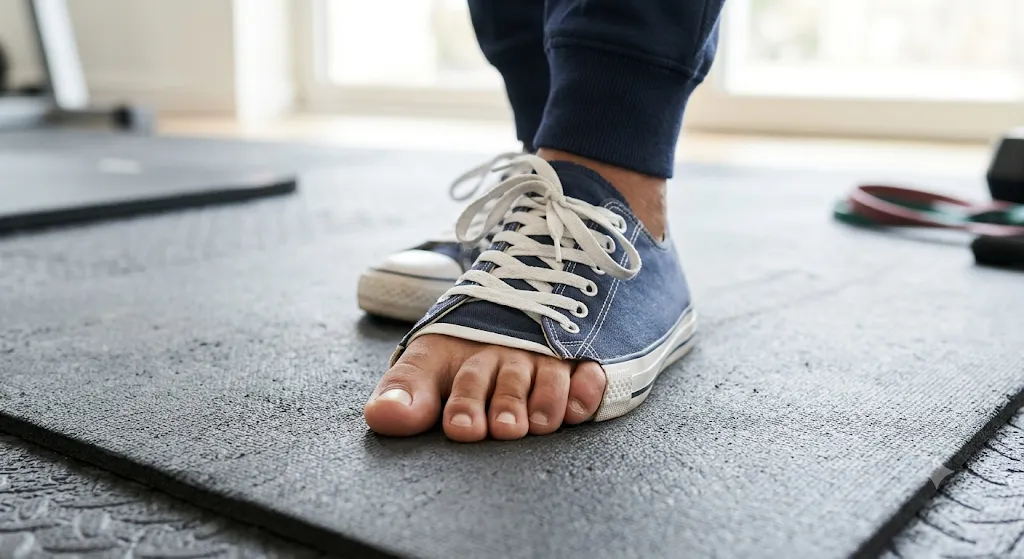
You slip on your everyday shoes and notice your smaller toes are already slightly curled. By afternoon they feel tighter, almost gripping the insole. When you kick the shoes off, the toes take a moment to flatten again. It is a small thing, easy to ignore, until the same pattern shows up in every pair you own.
Mild, temporary toe curling inside shoes is very common. It usually reflects the space the shoes give the toes, the way the foot muscles share work, or a habit the feet have learned. In most people it stays flexible and does not progress. When the same curled position is held for years, the tendons and joints can adapt, which is why podiatrists pay attention to early signs.
What This Feels Like
People describe a few overlapping versions:
- Smaller toes that rest bent at the middle joint once the shoe is on
- A subtle gripping feeling, as if the toes are trying to hold the shoe in place
- Relief and flattening when the shoes come off, at least at first
- A corn or callus forming on the top of the bent joint or under the tip
- Occasional cramping after a long day in the same pair
The sensation is usually more noticeable in shoes with a narrow or short toe box. It can appear in one toe or several, most often the second or third. Many people first notice it only when they look down after taking their shoes off.
Common Causes
The most frequent reasons are mechanical and ordinary.
Tight or short shoes crowd the toes so they cannot lie flat. High heels shift weight forward and add pressure. Shoes that are too loose in the heel can make the toes grip with every step to keep the shoe from sliding. Over time the small muscles inside the foot that straighten the toes can become relatively weaker than the longer tendons that flex them. The result is a resting curl that the shoe then reinforces.
A longer second toe (sometimes called Morton’s toe) is more likely to be forced into a bend simply because standard shoe lengths are set by the big toe. Flat feet or high arches change how load is shared across the forefoot and can favor the same imbalance. Age and years of conventional footwear also play a role; the Framingham Foot Study (Hannan and colleagues) found lesser-toe deformities in roughly 30 percent of adults and noted substantial heritability, showing that both shoes and family traits contribute.
Why This Happens
Toes are controlled by two sets of muscles. Intrinsic muscles (including the lumbricals and interossei) sit inside the foot and help keep the toes flat and stable. Extrinsic muscles have long tendons that run from the leg and can flex or extend the toes powerfully. When the intrinsics are under-stimulated—by shoes that keep the toes passive, by flat hard surfaces, or by a toe box that prevents spreading—the longer flexor tendons can dominate. The proximal interphalangeal joint then rests in flexion.
Modern shoes often add a further detail: the upward curve at the front of the sole (the toe spring). Research on walking in sandals with different toe-spring angles has shown that greater curvature reduces the work the toe muscles must do. That is convenient for the step, but it also means the intrinsic muscles get less daily practice. The combination of crowding and reduced active work is a common modern pattern.
For more on how the forefoot is built for a wider stance, see why your forefoot still expects a natural toe spread.
Less Common but Serious Causes
Not every curl is just shoe fit. Nerve irritation or peripheral neuropathy can produce clawing or curling of multiple toes. Inflammatory arthritis can stiffen the joints in a bent position. A severe bunion can crowd the second toe into a hammer position. Rarely, neurological conditions or stroke-related changes affect toe posture.
These patterns usually come with other clues: numbness, burning, weakness that spreads, joint swelling, or a toe that can no longer be straightened even when the shoes are off and the foot is relaxed.
Hidden Triggers
A few everyday factors keep the curl going even after you switch shoes:
- Habitual gripping from years of slides, flip-flops, or backless shoes
- Balance strategies—when ankle or hip stability feels less secure, the toes automatically grip
- Prolonged sitting with feet tucked under the chair
- Tight calf muscles that alter how the foot loads during walking
- Corns or calluses that occupy space and force the toe to stay bent
These are not dramatic, but they add daily hours of the same position.
When to Worry
Most mild curling is worth watching but not urgent. Seek a clinician sooner if:
- The toe no longer straightens fully when you try to flatten it by hand
- Pain, redness, or a corn keeps you from wearing ordinary shoes
- Numbness, burning, or weakness appears in the toes or foot
- The curl appears suddenly after an injury or with new swelling
- Only one foot is affected and the change is progressive over weeks
A flexible curl that improves barefoot and with roomier shoes is the usual benign pattern.
Myths vs Facts
Myth: Curled toes always mean you are developing permanent hammertoes.
Fact: Early curling is often reversible. The joint stays flexible for a long time if the crowding and muscle imbalance are reduced.
Myth: Only high heels cause this.
Fact: Any shoe that is short, narrow, or pointed can do it. So can loose shoes that force the toes to grip.
Myth: If it does not hurt, it cannot progress.
Fact: Pain often appears later, after the skin or joint has already adapted. Early room in the toe box is still useful.
How to Manage It
Start with the shoes. Look for a toe box that is both wide and deep enough that the toes can rest flat without pressure on top or at the tips. A half-inch of space beyond the longest toe is a practical guide. Lower heels reduce the forward push. Avoid pointed styles for daily wear.
Barefoot time on safe surfaces lets the intrinsic muscles work. Simple toe spreads and gentle straightening stretches, done daily, help keep the joints mobile. Toe spacers or a wide sandal for part of the day can interrupt the habitual curl. If balance or ankle stability feels off, a few weeks of single-leg standing practice often reduces the automatic gripping.
If corns have already formed, protective padding and a short period in open or roomy footwear usually lets the skin calm. Persistent pain or a toe that is becoming rigid is worth a podiatry or orthopedics visit; early flexible hammertoes respond well to footwear changes and targeted exercises, while rigid ones may need more formal care.
Related sensations in tight shoes are covered in toes that go numb in shoes and toes that cramp in tight shoes.
When to See a Doctor
See a clinician if the toe stays bent when you are barefoot and relaxed, if pain limits walking, if skin breaks down over the joint, or if numbness or weakness is new. Mention any history of diabetes, arthritis, or prior foot injury. Most people never need more than shoe changes and simple mobility work; the visit mainly confirms that the curl is still flexible and that nothing else is driving it.
FAQs
Is it normal for only one or two toes to curl?
Yes. The second and third toes are the most common, especially if the second toe is longer than the big toe.
Will wearing roomier shoes reverse it?
If the joint is still flexible, yes. Many people see clear improvement within weeks of switching to shoes with a proper toe box and doing daily toe straightening.
Can stress or anxiety make my toes curl?
Some people notice extra gripping when they are tense or trying to stay balanced. It is usually temporary and improves when the underlying tension or footwear issue is addressed.
Do toe curls mean I need orthotics?
Not automatically. Footwear changes and simple exercises are first. Orthotics can help if the curl is driven by marked flat feet or high arches that a clinician has confirmed.
Is curling toes the same as hammertoe?
Mild temporary curling is the early end of the same spectrum. Hammertoe is the name used once the bend becomes more fixed and the joint no longer straightens easily.
Conclusion
Toes that curl inside shoes are usually responding to the space and the work they are given. Tight or poorly shaped footwear, years of passive support, and ordinary muscle balance shifts explain most cases. The pattern is common, often flexible, and responsive to roomier shoes and a little daily toe mobility. Watching for pain, numbness, or a toe that will no longer straighten keeps the ordinary cases ordinary and the ones that need attention easy to catch early.


