Waking with a sore neck after stomach sleeping is common. The hours of sustained cervical rotation compress one side of the joints and stretch the other, leaving muscles stiff by morning.
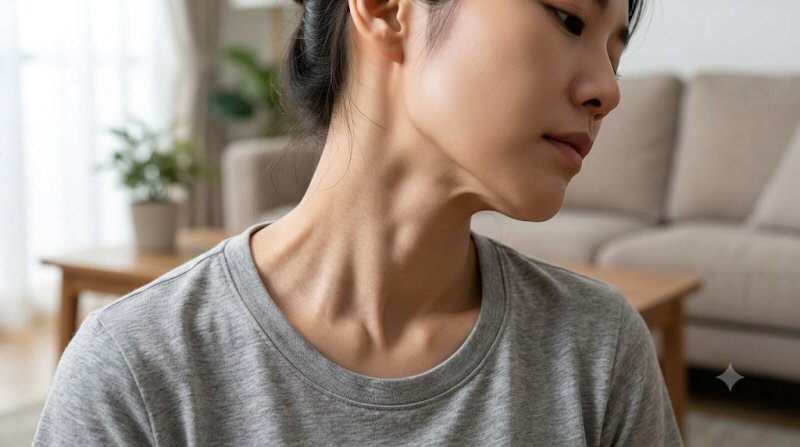
You wake up, turn your head, and the side of your neck protests. The ache is familiar if you often sleep face-down. It is not dramatic—just that tight, one-sided stiffness that takes a hot shower and some gentle movement to loosen. For most people this is an ordinary mechanical result of how the neck spends the night, not a sign of injury.
What This Symptom Feels Like
The soreness is usually localized to one side of the neck, often near the base of the skull or along the upper trapezius. Turning the head toward the tighter side feels restricted; turning the other way may feel slightly better or simply different. Some people notice a dull headache that starts at the back of the head and fades as the morning progresses. The discomfort is rarely sharp on first waking; it is more of a deep, unwilling tightness that eases with heat and movement.
Common Causes
Stomach sleeping (the prone position) requires the head to rotate roughly 70–90 degrees to one side so the airway stays clear. That rotation is held for six to eight hours. The facet joints on the compressed side stay loaded, the opposite side’s muscles and ligaments stay lengthened, and the small suboccipital muscles remain asymmetrically contracted. Over a single night this is usually reversible. When the same side is chosen night after night, the tissues adapt by shortening on one side and becoming less tolerant of the opposite motion.
Pillow height and firmness modify the load. A pillow that is too high increases the rotation and lateral bend; a very flat surface lets the head drop farther into extension on the rotated side. Daytime posture also contributes: hours of forward-head screen work leave the deep neck flexors under-used and the suboccipitals overworked, so the overnight position simply reveals an already-sensitive system. Research on sleep position and neck pain consistently finds that prone sleepers report more morning stiffness than side or back sleepers, although individual tolerance varies.
Why This Happens
The cervical spine is built for movement, not for hours of static end-range rotation. Most of the available rotation occurs at the top two segments (atlanto-axial joint); the lower segments share less. When the head is held near the end of that range, the joint capsules and surrounding muscles experience continuous low-level compression or stretch. Blood flow through the smaller vessels can be mildly reduced on the compressed side, and the muscles accumulate metabolites that register as stiffness once you wake and try to move. Spine researcher Nikolai Bogduk’s work on cervical facet joints and muscle innervation helps explain why this mechanical loading so readily produces local pain that can also refer toward the head or shoulder.
The body also uses the sleep period for tissue recovery. If the neck has already spent the day in prolonged flexion or poor alignment, the overnight rotation can tip the balance from “quiet recovery” into “noticeable morning protest.” This is why some people only feel the soreness after a particularly long desk day even if their sleep position has not changed.
Less Common but Serious Causes
Occasional morning stiffness that resolves within an hour or two is almost always positional. Persistent pain that worsens over days, radiates into the arm with numbness or weakness, or appears with fever, unexplained weight loss, or a history of trauma deserves medical review. Rarely, prolonged extreme rotation has been linked to temporary vascular irritation, but this is uncommon in ordinary sleep. If the pain is accompanied by dizziness, double vision, or difficulty swallowing, seek care promptly rather than waiting to see whether it settles.
Hidden Triggers
An old mattress that lets the pelvis sink can increase lumbar extension and, secondarily, force more cervical rotation. Sleeping with one arm raised above the head adds extra torsion. Alcohol or late caffeine can increase tossing and turning, so the neck spends more time at the extremes. Stress tightens the upper trapezius and levator scapulae; the same muscles then spend the night in a shortened position and wake even stiffer. A recent change in pillow or a new partner who prefers a different mattress firmness can also unmask the issue.
When to Worry
See a clinician if the soreness lasts more than a few days despite position changes, if you develop arm numbness or weakness, if the pain is severe enough to wake you repeatedly, or if you have a history of inflammatory arthritis or recent neck injury. Red-flag symptoms—sudden severe headache, vision changes, or balance problems—need immediate evaluation. For ordinary one-sided morning tightness that eases with movement, simple adjustments are usually enough.
Myths vs Facts
Myth: Stomach sleeping always ruins the neck.
Fact: Many people tolerate it for years without lasting problems. The risk rises when the same extreme rotation is combined with poor daytime posture, an unsupportive pillow, or existing joint sensitivity.
Myth: You must force yourself onto your back immediately.
Fact: Gradual shifts work better for most. Side-sleeping with a pillow that fills the gap between shoulder and head keeps the neck closer to neutral and is easier to adopt than pure back-sleeping for habitual stomach sleepers.
Myth: A special “neck pillow” is required.
Fact: Any pillow that keeps the cervical spine roughly in line with the rest of the spine works. Contoured pillows help some people and bother others; the test is whether you wake with less stiffness.
How to Manage It
Start the day with gentle motion rather than aggressive stretching. Slow head turns, side bends, and chin tucks performed within a comfortable range increase blood flow and reduce the sense of “stuck.” Heat (a warm shower or heating pad) relaxes the shortened muscles; ice can help if the area feels inflamed after an unusually long night in one position.
For the next few nights, try a body pillow or firm cushions placed along one side so that rolling fully onto the stomach becomes less automatic. If you remain face-down, use the thinnest pillow that still feels comfortable so the rotation angle is smaller. During the day, break up screen time with brief walks or simple neck mobility; the neck that moves regularly during waking hours tolerates the occasional overnight rotation far better. Related articles on pillow height and morning stiffness and on why the neck expects regular motion expand on these everyday adjustments.
When to See a Doctor
Most positional neck soreness improves within a week of changing sleep position and adding gentle daytime movement. If it does not, or if new neurological symptoms appear, a clinician can check for other contributors such as facet irritation, early degenerative changes, or referred pain from the upper back. Imaging is rarely needed for straightforward morning stiffness that follows a clear positional pattern.
FAQs
Why does only one side hurt?
Because the head is turned predominantly to that side. The compressed facets and shortened muscles on that side become the ones that protest first.
Will switching to my side fix it overnight?
Often the next morning is noticeably better, but full adaptation can take several nights as the tissues regain balanced length and the habit of rolling changes.
Is a firm or soft mattress better?
Support matters more than absolute firmness. A surface that prevents the pelvis from sinking deeply reduces the compensatory cervical rotation needed for comfortable breathing.
Can this cause long-term damage?
For most people it produces temporary stiffness rather than structural injury. Years of the same extreme position plus poor daytime posture can contribute to asymmetric muscle tightness and facet sensitivity, which is why gradual change is worthwhile.
Does sleeping without a pillow help stomach sleepers?
A very thin pillow or none at all reduces the rotation angle for some people, but many find the resulting extension uncomfortable. Experiment for a few nights and keep whichever arrangement leaves the neck least stiff on waking.
Conclusion
A sore neck after a night of stomach sleeping is a common, mechanical response to hours of sustained rotation. The joints and muscles are doing exactly what they are asked to do under those conditions. Small changes—thinner pillow, gradual shift toward side-sleeping, and more varied neck motion during the day—usually restore comfortable mornings without the need for further intervention. The neck that moves freely while you are awake tolerates the occasional awkward night far more easily.