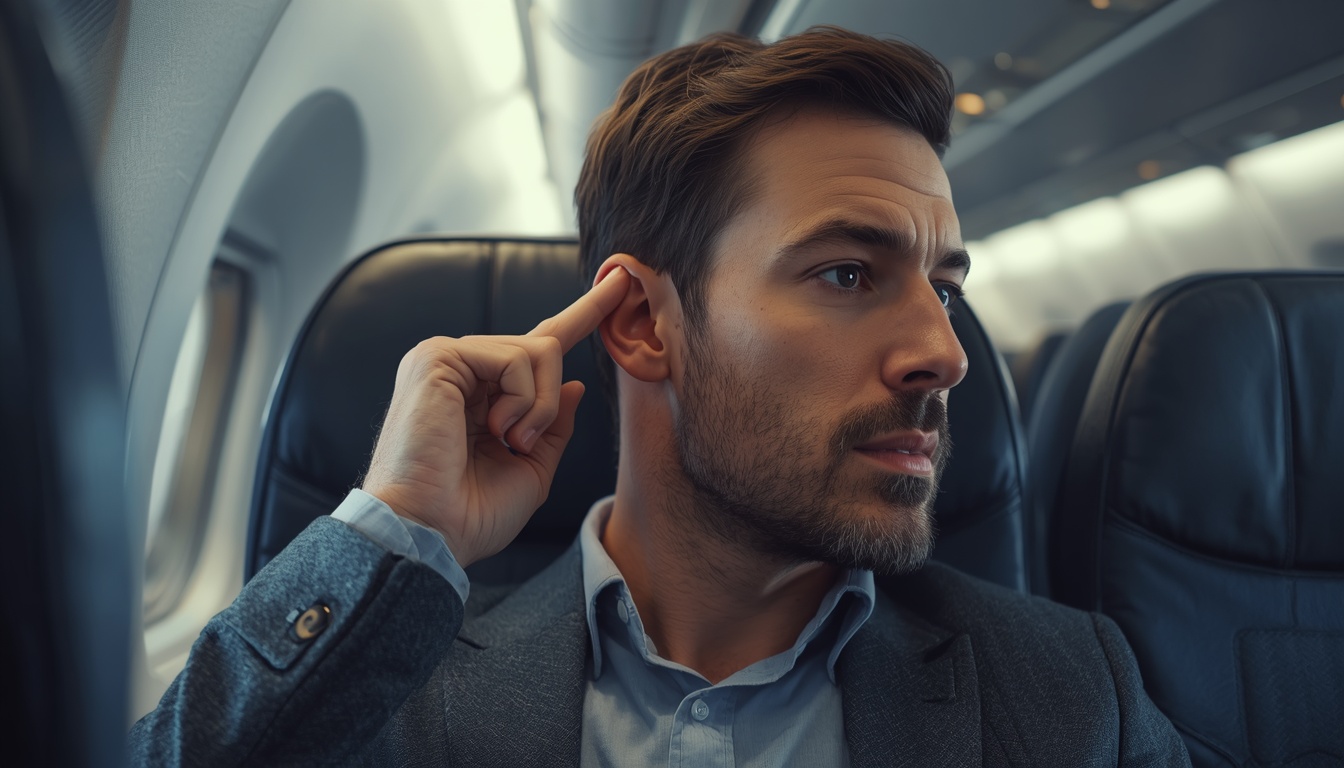
Tight, flaky, or split lips in flight are usually very dry cabin air meeting a thin vermilion barrier—not proof the plane stole a day’s water. Here is when it is ordinary and when it is not.
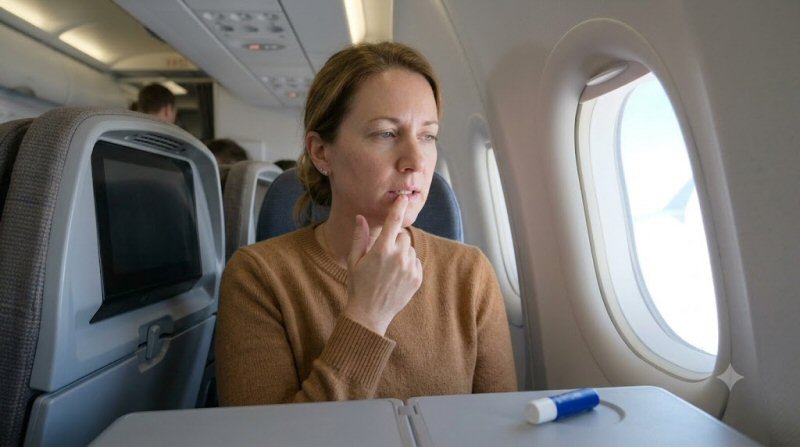
You boarded with ordinary lips. Mid-flight they feel tight when you smile. By descent the vermilion looks dull, a flake sits at the lower edge, and licking them has made the sting worse. The first sip of water helps the mouth and does almost nothing for the lip surface.
For most healthy adults, chapped lips on a plane are a short barrier problem in desert-dry cabin air, not a medical event and not proof that the aircraft “dehydrated your face.” Lips are a thin, poorly oiled strip of skin that already struggles in heated rooms. Cabin humidity, mouth breathing, a gasper vent, and the habit of licking stack the same way they do for chapped lips in dry indoor air, a dry mouth in flight, and gritty eyes at altitude.
What This Symptom Feels Like
Typical in-flight chapping is:
- Tightness when you talk, smile, or drink from a cup
- A dull, matte look instead of the usual sheen
- Fine flakes at the lower lip or the corners
- A brief sting after salty snacks, citrus, or tomato juice
- The urge to lick, which feels better for a few seconds and worse after
- Often worse on a long-haul flight, after a nap with the mouth open, or if you already had winter dryness
It usually eases within a day or two of ordinary indoor humidity, water, and a simple occlusive balm. It should not include spreading redness, yellow crust, fever, or a rash that leaves the lip border.
Common Causes
Several ordinary cabin factors stack.
Very dry cabin air. Outside air at cruise is extremely cold and holds almost no moisture. Once it is compressed and conditioned, cabin relative humidity often sits around 10–20 percent. Work on aircraft cabin environments by Niren Nagda and colleagues has long listed dry skin, dry eyes, dry nose, and dry throat among the most common passenger complaints. Lips sit in that same list because they evaporate faster than cheek skin.
A thin barrier by design. The vermilion—the red part of the lip—has a thinner stratum corneum, fewer oil glands, and less of the lipid “mortar” that Peter Elias and colleagues mapped in ordinary skin. Keratin researchers such as Kathi Madison and Philip Wertz, and later work comparing facial sites, showed that this strip loses water more easily than nearby face skin. Ya-Xian and co-workers measured how thin that outer layer can be. Cabin air simply exposes a design that already leaks.
Licking. Saliva is water plus enzymes. It wets the surface, then evaporates and takes more water with it. Repeating the cycle in 15-percent humidity is a reliable way to turn tightness into fissures.
Mouth breathing and vents. A blocked nose, a dropped jaw during sleep, or the overhead gasper aimed at the face moves dry air across the lip. The same airflow pattern dries the mouth and the tear film.
Salt, acid, and alcohol on the surface. Pretzels, citrus, tomato juice, and a small glass of wine leave residue on a barrier that is already thin. They do not “poison” the lip; they sting a cracked surface.
Mild fluid shift, not emptying. Sitting for hours can leave you a little puffy in the hands and face while the lip surface still feels tight. That combination is cabin physiology, not two opposite diseases.
Why This Happens
Lips were built for a humid face, not for a pressurized tube at 35,000 feet.
Ordinary skin holds water with a brick-and-mortar outer layer: dead cells sealed by ceramides, cholesterol, and fatty acids. Elias’s group showed that when that mortar thins, transepidermal water loss (TEWL) rises and the surface feels tight. The vermilion starts with a handicap—few sebaceous glands, little hair, and a thinner “brick” layer—so TEWL is already higher than on the cheek. Drop ambient humidity from a comfortable 40–50 percent to cabin teens, and evaporation outruns replacement.
Saliva makes the math worse. It is hypotonic relative to damaged skin. Each lick is a brief wet dressing followed by evaporative cooling and more water loss. Cabin air, unlike a bathroom after a shower, never gives the surface time to re-equilibrate.
The result is a predictable sequence: tightness, dullness, flake, then a small split at the wet-dry line if you keep licking. It is the same sequence as winter indoor chapping, sped up by altitude humidity.
Less Common but Serious Causes
Most flight chapping is mechanical dryness. A smaller group needs a different label.
Angular cheilitis. Painful cracks exactly at the corners, sometimes with yeast or bacteria in a chronically wet fold, are not the same as mid-lip flake. They linger after the flight.
Contact reaction. A new balm, mint, cinnamon, or sunscreen stick can inflame the vermilion. Burning that starts after a product, not after two dry hours, points here.
Cold sores. A tingling patch that becomes a cluster of blisters is herpes simplex, often triggered by sun, stress, or dryness—not “cabin burn.”
Nutrient or medicine effects. Isotretinoin, some chemotherapy, and rare nutrient deficits cause persistent cracking on the ground as well as in the air. A plane does not create those overnight.
Systemic dryness. Very dry mouth plus dry eyes plus dry lips that never recover off the plane can belong with Sjögren-type patterns or other mucosal disease. That is a pattern over weeks, not one arrival.
Hidden Triggers
A few details make cabin lips worse than they need to be.
- The gasper vent pointed at the mouth
- Sleeping with the mouth open after a stuffy takeoff
- Licking after every salty bite
- Flavored or “plumping” balms with menthol, camphor, or cinnamon
- Alcohol wipes or hand gel transferred to the lip
- Cabin sun through a window on a long daytime sector
- Already-chapped winter lips that had no reserve
When to Worry
See a clinician if:
- Cracks last more than a week after you leave dry air
- There is spreading redness, yellow crust, swelling, or fever
- Painful splits sit only at the corners and keep returning
- A tingling patch becomes blisters
- Dry lips travel with a persistently dry mouth and dry eyes on the ground
- You cannot eat or drink because of pain
- A white or red patch does not match ordinary flake
One tight flight is almost never an emergency.
Myths vs Facts
Myth: The cabin sucked a day’s water out through your lips.
Fact: You lose some moisture from skin and breath, but chapping is surface evaporation from a thin barrier, not proof of whole-body dehydration.
Myth: Drinking more water will instantly heal the lip.
Fact: Hydration helps mucosa and comfort. The vermilion still needs an occlusive layer because water alone evaporates in 15-percent humidity.
Myth: Licking is the natural treatment.
Fact: Licking is the most common way to turn tightness into a split.
Myth: Any balm with a strong tingle is working.
Fact: Menthol and camphor often increase blood flow and sting; they do not rebuild lipid mortar.
Myth: Chapped lips on a plane mean you are getting sick.
Fact: Dry air explains most cases. Infection has other signs—fever, pus, spreading sores.
How to Manage
You do not need a flight-specific medical kit. You need less evaporation and less licking.
- Apply a plain occlusive balm before boarding and again after meals. Petrolatum or a simple wax-oil stick beats a watery gloss.
- Point the gasper away from your face.
- Breathe through the nose when you can. A brief saline spray can keep the nose open so the mouth stays shut.
- Drink water for comfort. Pair it with a snack you actually chew so saliva rises.
- Skip licking. If you catch yourself, re-apply balm instead.
- Avoid flavored, mint, or “plumping” products in flight.
- After landing, keep the same occlusive on for a day. Ordinary indoor humidity does the rest.
These steps sit in the same family as protecting the mouth and eyes in cabin air: reduce dry flow across a wet surface, then cover what still evaporates.
When to See a Doctor
Book a visit if cabin chapping is only the visible tip of year-round cracking, if corners stay raw, if blisters keep returning, or if dryness of mouth and eyes never clocks off. A clinician can sort barrier failure from contact allergy, infection, or a wider mucosal pattern. For a single flight, home care is the first move.
FAQs
Why do my lips chap on a plane when my cheeks do not?
The vermilion is thinner and has fewer oil glands than cheek skin. It was already the leaky site. Cabin humidity just makes the leak obvious.
Does the recycled air itself damage lips?
The problem is low moisture content, not a toxin in recirculated air. Fresh-air fraction does not restore humidity to a living-room level.
Is lip balm allowed through security, and does it matter?
A small stick is ordinary carry-on in most regions. What matters more is using a bland occlusive instead of licking.
Why does water help my mouth but not my lips?
Saliva and drinks wet mucosa from the inside and the surface. Lip skin needs an oil or wax layer to slow TEWL. Water on bare vermilion evaporates.
Can I use leftover sunscreen stick on my lips in flight?
Only if it is meant for lips and does not sting. Many face sunscreens irritate the vermilion. A dedicated balm plus window shade is simpler.
How long should tightness last after landing?
Hours to a day or two is common. A week of worsening splits is not “normal cabin lag.”
Conclusion
Chapped lips on a plane are a thin barrier meeting air that was never designed for human skin. Cabin humidity, a vent, mouth breathing, and licking explain most of the tightness and flake. Cover the surface, stop the lick cycle, and let ordinary indoor air finish the job. Persistent corners, blisters, or dryness that follows you home deserve a look—but one dry sector is your vermilion doing what Elias’s barrier work already predicted.