Gritty, burning eyes in flight are usually a thin tear film meeting very dry cabin air and fewer blinks—not an infection that started at the gate. Here is when cabin dryness is ordinary and when it is not.
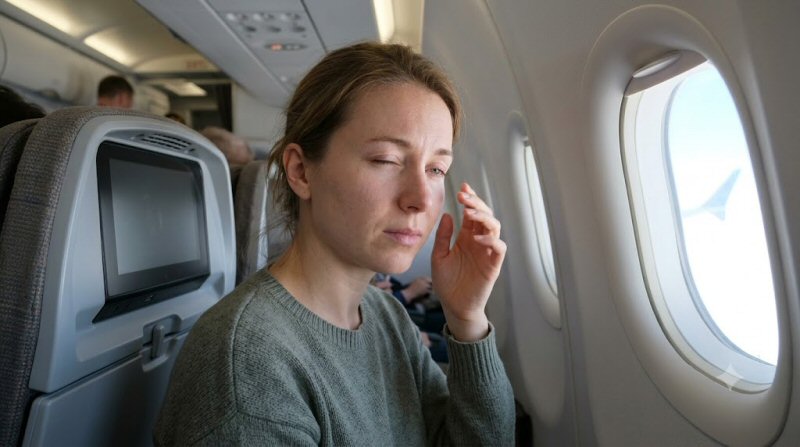
You boarded with comfortable eyes. An hour in, the whites feel sandy. Blinking does not quite clear the grit. The air vent is a little too close. Contact lenses that felt fine at the gate now scrape. By descent you want to rub, and the airport lights look slightly smeared.
For most healthy adults, dry eyes on a plane are a temporary moisture problem. Cabin air is far drier than a living room. Recirculated flow, a cold window, and long stretches of looking at a screen or a book all speed evaporation from the tear film. It is the same dryness family as post-screen sandy eyes and an indoor dry nose, turned up by altitude-style humidity.
What This Symptom Feels Like
Typical in-flight eye dryness is:
- Grit, sand, or a mild burn rather than stabbing pain
- A need to blink more, or a blink that does not finish the job
- Mild redness and a watery reflex that still leaves the surface dry
- Blur that clears for a second after a full blink or a drop
- Contact lenses that feel tight, itchy, or suddenly “there”
- Often worse on a long-haul flight, in a window seat, or with the gasper vent aimed at the face
It usually builds over the first hour or two. It should ease after landing once you leave the dry cabin, blink normally, and the air moistens. Pain that is sharp, light that is intolerable, a sudden drop in vision in one eye, or discharge that is thick and colored is a different story.
Common Causes
The usual recipe is evaporation plus incomplete blinks, not a virus that boarded with you.
Very dry cabin air. Most commercial cabins sit around 10 to 20 percent relative humidity. Living rooms are often closer to 30 to 50 percent. Researchers who study indoor air and the ocular surface, including Peder Wolkoff, have shown that low humidity and moving air thin the tear film and raise evaporative stress. Cabin surveys associated with work by Niren Nagda and others documented that same dry-air profile as a routine feature of cruise, not a fault in one aircraft.
Fewer complete blinks. Kazuo Tsubota’s group measured how screen and reading tasks cut blink rate and how many blinks fail to close fully. A seatback film, a laptop, or a book does the same job at altitude. Donald Korb and colleagues described incomplete blinks as a way to starve the meibomian glands that oil the tears. Without that oil lid, water leaves faster.
Moving air from the vent. A gasper aimed at the face is a small indoor wind. Moving air strips the aqueous layer even when humidity is already low. A cold window adds a local draft and a temperature drop that the lids were not briefed for.
Contact lenses. A soft lens sits on the tear film and increases the evaporative surface. In dry cabin air the lens dehydrates a little, tightens, and feels like grit even when the eye is only moderately dry.
Salt, alcohol, and low fluid intake. Cabin snacks and drinks are often salty. Alcohol and cabin diuresis leave you a little less well hydrated. The tear glands still work, but the film they spread is a thinner budget.
Why This Happens
The tear film is a thin, three-layer coat: oil from the meibomian glands, water from the lacrimal gland, and mucus that helps the water stick. Jennifer Craig, Michael Lemp, and the Tear Film and Ocular Surface workshops mapped how quickly that coat fails when humidity falls and blinks go incomplete.
In ordinary weather the lids meet fully many times a minute. Each meeting spreads a fresh oil slick and tops up water. Cabin air lowers the water vapor around the eye. A vent adds convective loss. A screen or a book holds the lids slightly open. The oil layer breaks into dry spots. Nerves in the cornea report grit. Reflex tearing may follow, which is why dry eyes can look wet and still feel terrible.
The same surface also explains related cabin complaints. Low humidity dries the lining of the nose and throat. Fluid shifts and sitting can puff the face after landing. The eye problem is mostly evaporation, not the same pooling that swells ankles.
Your tear system still expects weather, a full blink, and air that is not desert-dry. A sealed metal tube at cruise is none of those things for several hours.
Less Common but Serious Causes
Most cabin grit is evaporative. A smaller group of patterns needs a lower threshold for care.
A true flare of dry-eye disease. People who already have meibomian gland dysfunction or aqueous-deficient dry eye feel the cabin more sharply. The flight does not create the disease. It unmasks it.
Contact-lens overwear or a tight lens. A lens that dries and binds can scratch the surface. Pain that stays after the lens is out, light sensitivity, or a white spot on the cornea is not ordinary cabin dryness.
Infection or inflammation that happened to coincide with travel. Redness with thick discharge, crusting that glues the lids, or pain that worsens after landing is not explained by humidity alone.
A corneal abrasion from rubbing. Dry eyes invite rubbing. A fingernail or a lens edge can scrape the surface. Sudden sharp pain and tearing after a rub is a reason to stop and get the eye checked.
Rarely, a more serious red eye. Sudden vision loss, a curtain, double vision, or a painfully red eye with nausea is not a humidity story.
Hidden Triggers
A few ordinary cabin habits make dryness louder.
- A gasper vent pointed at the face or at the fellow passenger’s face that still hits you
- A window seat with a cold pane and a draft along the fuselage
- Hours of a seatback screen with a low blink rate
- Sleeping with partly open lids in dry air
- Makeup, waterproof mascara, or lid products that clog meibomian openings before boarding
- Antihistamines, some blood-pressure medicines, and isotretinoin, which reduce tear volume
- Air-conditioning after landing that continues the same dry-air theme
When to Worry
Ordinary cabin dryness eases with blinking, a preservative-free drop, and moist air after you leave the aircraft. Get prompt care if you notice:
- Sudden vision loss, a dark curtain, or new double vision
- Severe light sensitivity or pain that does not ease after landing
- A white or gray spot on the cornea, or a lens you cannot remove comfortably
- Thick yellow or green discharge, or lids stuck shut
- One eye that is much worse, swollen, or accompanying a headache and nausea
- Symptoms that last more than a day or two after an ordinary flight and keep worsening
One-sided severe pain is not “just the air.” Treat it as an eye problem, not a travel souvenir.
Myths vs Facts
Myth: Cabin air is dirty, so dry eyes mean an infection. Fact: Recirculated cabin air is filtered. The usual insult is dryness and airflow, not a new germ in every seat row.
Myth: Watery eyes cannot be dry eyes. Fact: Reflex tearing is common when the surface is irritated. The water that spills over is not a stable film.
Myth: Drinking a lot of water on the plane will fix the grit by itself. Fact: Hydration helps a little. The bigger levers are humidity, blinks, vents, and drops. You cannot drink the tear film back into place in an hour.
Myth: Sleeping the whole flight protects the eyes. Fact: Sleep with incomplete lid closure in 10 percent humidity can leave the exposed strip even drier.
Myth: If contacts feel fine at takeoff they will feel fine at landing. Fact: Soft lenses lose water in dry air. Many comfortable morning lenses feel tight by hour three.
How to Manage It
You do not need a new diagnosis for a dry cabin. You need less evaporation.
Aim the vent away from your face. Sideways or closed is kinder than a personal wind tunnel.
Blink on purpose. Full lid meetings every few seconds while you read or watch. Look at a distant cabin feature now and then so the gaze resets.
Use preservative-free lubricating drops. A single-use vial before boarding and mid-flight is the most useful tool most travelers have. Ointments blur and are better after landing.
Consider leaving lenses for long-haul flights. Glasses remove one evaporative surface. If you wear lenses, a fresh pair and drops help more than pushing a dry lens.
Skip the extra salt and alcohol if your eyes always suffer. They are not the main cause, but they do not help the budget.
A cool, unused gel mask after landing can soothe without the germ risk of a reused warm compress on the jet bridge. Save warm lid massage for home if your meibomian glands run thick.
After you land, give the surface weather again. Outdoor air that is not desert-dry, a few minutes without a screen, and a drop if needed usually close the episode.
The tear system still expects the weather and blinks that outdoor life used to provide. A long cruise is a dry indoor room that moves.
When to See a Doctor
See an optometrist or ophthalmologist if cabin dryness is routine, if contacts have become hard to wear, or if redness and grit last beyond a short trip. Mention medicines, screen hours, and whether mornings at home already feel sandy. People with known dry-eye disease, autoimmune surface disease, or recent eye surgery should treat long flights as a planned evaporative load and pack drops rather than discovering the problem at cruise.
Urgent care or an eye emergency service is the right place for sudden vision change, severe pain, a lens that will not come out, or a spot on the cornea.
FAQs
Why do my eyes water and still feel dry on a plane? The surface is irritated, so the lacrimal gland dumps extra water. That reflex tear is watery and poorly oiled. It runs off instead of coating.
Are airplane air vents bad for your eyes? They are optional wind. Dry moving air evaporates tears faster than still dry air. Aim them away.
Should I wear contact lenses on a long flight? Many people can for a short hop with drops. Long-haul is kinder in glasses. If you wear lenses, use preservative-free lubrication and take them out if they tighten.
Can cabin dryness damage my eyes permanently? Ordinary flights cause temporary evaporative stress. Repeated severe dryness plus rubbing or a bound lens can scratch the surface. That is avoidable, not inevitable.
Why is a window seat worse? The pane is cold. Air sliding along it is an extra draft. Aisle seats have their own traffic, but they often spare you that local chill.
Will a humidifier bottle or facial mist fix it? A clean mist can feel nice for a minute. It does not replace an oil layer or a full blink, and shared bottles are a hygiene problem. Drops and vent direction do more.
Conclusion
Gritty eyes at cruise are usually a thin tear film meeting desert-dry cabin air, a vent, and too many half-blinks. The feeling is miserable and very common. It is not, by itself, a sign that the aircraft made you ill.
Aim the air away, blink fully, pack preservative-free drops, and give contacts a rest on long sectors. If pain is sharp, vision drops, or one eye looks truly angry after landing, treat that as an eye appointment, not a travel story. For everyone else, the surface remembers humidity as soon as you leave the tube.