A sore or catching thumb after a long scroll is often tendon overload at the wrist from repeated flicking and pinch — not instant arthritis.
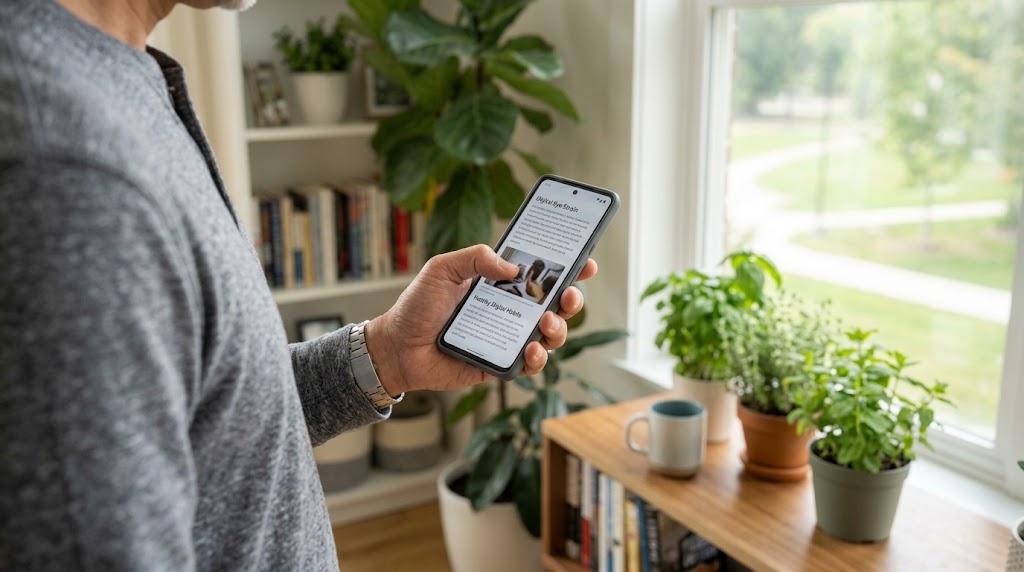
You put the phone down after a long stretch of stories and your thumb feels like a tired hinge. The base of it is thick. The first flick of the next session stings. Sometimes a tiny catch lives on the thumb side of the wrist when you lift a mug. The feed did not give you arthritis in one evening. It asked two small tendons to do a job they were built for in short bursts, for an hour without a pause.
A sore thumb after scrolling is common. Where the ache sits, and whether it fades when you rest the joint, tells you whether this is ordinary tendon load or something that needs a different plan.
What This Symptom Feels Like
Most people point to one of three spots.
The first is the thumb side of the wrist, just above the snuffbox, where two tendons share a tight tunnel. The ache is a dull burn that sharpens when you lift the thumb away from the palm, wring a towel, or pick up a child. A classic self-check — making a fist around a tucked thumb and tipping the wrist toward the little-finger side — reproduces the sting. That is the Finkelstein test Fritz de Quervain’s tendon sheath problem is named after.
The second is the thumb’s own knuckle and the fleshy thenar pad. The joint feels used, not locked. Pinching the phone, tapping hard, or holding a large device in one hand loads the carpometacarpal joint at the base of the thumb.
The third is a brief catch or creak as the thumb extends, sometimes with a tender cord along the forearm. That is often the same first-compartment tendons plus the muscle bellies that feed them.
The ordinary version eases overnight or after a quieter day. Swelling is modest. The thumb still works. Numbness in the fingers is a different map and is covered separately in phone-related finger numbness.
Common Causes
A modern phone is a large slab operated almost entirely by one digit. The thumb abducts, extends, and flexes thousands of times in a session, often with the wrist cocked toward the thumb. That combination loads a small tunnel.
First dorsal compartment tendons. Abductor pollicis longus and extensor pollicis brevis share a fibro-osseous sheath on the thumb side of the wrist. Fritz de Quervain described the resulting tenosynovitis in 1895. Repeated thumb flicking and radial deviation thicken the sheath and irritate the tendons inside it. Clinical series on “texting thumb” and smartphone tenosynovitis, including work by researchers such as Sharan and colleagues on handheld-device overuse and Berolo’s survey of mobile-device postures, keep finding the same pattern: more daily minutes and more one-handed use track with more thumb-side wrist pain.
Pinch and the basal thumb joint. A large phone held in one hand asks the thumb to pinch against four fingers for a long time. The first carpometacarpal joint is a saddle built for opposition, not for isometric clamp. People with early wear at that joint feel the scroll as a deep ache at the heel of the thumb rather than a sharp wrist sting.
Wrist angle. Holding the phone with the wrist bent toward the thumb narrows the first compartment. Gustafsson’s kinematic studies of texting posture showed that one-handed use parks the thumb near end range more often than two-handed tapping. End-range plus repetition is how tendons get angry.
Shared desk load. The same thumb already spends the workday on a trackpad or the space bar. Evening scroll is often the last load in a 24-hour budget, not a unique injury. Wrist ache after pointing devices follows a similar office story in mouse-related wrist ache.
Why This Happens
Tendons glide through sheaths on a thin film of synovial fluid. They tolerate high load when the load is brief and varied. They protest when the same short motion repeats while the sheath is compressed.
De Quervain’s compartment is a bottleneck. When the tendons swell even a little, friction rises. Friction creates more swelling. The first flick of the morning then feels like sandpaper because overnight rest did not fully empty the congested sheath.
The thumb is also a relatively new specialist. Human opposition evolved for tools, texture, and intermittent pinch, not for a glass rectangle that never leaves the dominant hand. A related mismatch — thumbs built to pinch and hang rather than to flick a feed — is the theme of why your thumbs still expect to pinch and hang.
None of this requires a tear. Most post-scroll ache is irritable tissue, not a ruptured pulley. Blood flow and glide return when the repetition stops and the wrist comes out of radial deviation.
Less Common but Serious Causes
A smaller group of people have a true first-compartment stenosis that will not settle with rest, or basal thumb osteoarthritis that the phone merely unmasks.
Red flags are different from a tired tendon. A thumb that locks and will not extend, a hot swollen joint after a bite or puncture, sudden inability to pinch after a fall onto the hand, or pain that wakes you every night for weeks needs a clinician. Numbness in the thumb plus index and middle fingers points more toward the median nerve than toward de Quervain’s sheath. A rapidly spreading red streak or fever is infection, not scrolling.
Pregnancy and the postpartum months raise the odds of de Quervain’s tenosynovitis because fluid and lifting loads stack on the same tunnel. That version is still mechanical. It is not a sign the joint is ruined.
Hidden Triggers
A few everyday details make the same scroll worse.
One-handed giant phones. The wider the device, the farther the thumb must reach. Two hands cut the reach in half.
Radial-deviated “selfie” wrist. Tipping the wrist toward the thumb to get a better camera angle parks the tendons in the tightest part of the sheath.
Gaming and rapid tap. Fast repeated flexion is a different insult from slow scrolling, but it uses the same compartment.
New parents and kettlebells. Lifting a baby with the thumbs hooked under the armpits, or gripping a heavy handle, can flare the same tendons the feed started.
Cold morning starts. A stiff sheath plus an immediate long scroll is a reliable way to feel the first flick.
When to Worry
Worry less when the ache is local, started after a long session, eases with rest and a quieter grip, and the thumb still has strength.
Worry more when any of these show up:
- The thumb locks, catches hard, or will not straighten
- Pain is severe at rest or at night for more than two weeks
- The joint is hot, red, or clearly swollen after an injury
- Pinch is weak enough that jars slip
- Numbness spreads through the fingers rather than staying as tendon pain
- Symptoms followed a fall onto an outstretched hand
Those patterns deserve an exam, not another stretch video.
Myths vs Facts
Myth: A sore thumb after scrolling means you already have arthritis.
Fact: Most short-term cases are tendon-sheath irritation. Basal thumb arthritis exists and can coexist, but a single long session does not create bone-on-bone change.
Myth: You must stop using a phone forever.
Fact: Changing grip, switching hands, using two thumbs, and taking micro-breaks usually calms the sheath. Total abstinence is rarely required.
Myth: A splint will weaken the thumb if you wear it for a few days.
Fact: A short spell of rest in a thumb-spica position is a standard first step for de Quervain’s symptoms. Weakness comes from months of unused muscle, not from a weekend of support.
Myth: Cracking or stretching the thumb aggressively will “loosen the tendon.”
Fact: Forcing the Finkelstein position as a stretch often inflames the sheath. Gentle motion in a pain-free range is safer than a daily provocation test.
How to Manage It
Change the job before you chase gadgets.
Use two hands. Rest the phone on a table or a pillow so the thumb flicks without holding the whole device. Switch the dominant hand every few minutes. Keep the wrist closer to straight instead of cocked toward the thumb.
Shrink the session. A timer at 15–20 minutes is less heroic than it sounds and more effective than waiting for pain. Stand up between chapters. The same break helps neck and shoulder load from phone posture.
Unload the tunnel for a few days if the Finkelstein test is sharply positive. A simple thumb-spica splint that leaves the fingers free is the usual first aid. Ice after a flare and a short course of an anti-inflammatory, if you can take one, are reasonable. A clinician can add a targeted injection when rest is not enough.
Keep the rest of the hand working. Light putty pinch, opening the hand against a rubber band, and hanging from a bar when the flare settles all give the thumb the varied load it evolved for. Avoid jumping straight back into a two-hour one-thumb session the morning the ache fades.
When to See a Doctor
See a clinician if rest and a better grip have not changed the story after two to three weeks, if pinch is failing, or if the joint looks inflamed rather than merely tired. Hand specialists still use Finkelstein’s test, ultrasound of the first compartment, and, when needed, a carefully placed steroid injection. Surgery to open the sheath is reserved for stubborn cases and is not the first conversation after one loud weekend of scrolling.
Urgent care is for injury, locking, infection signs, or a hand that suddenly cannot pinch after trauma.
FAQs
Is texting thumb a real diagnosis?
It is a popular name for overuse of the same tendons de Quervain described. The anatomy is real. The phone is a modern trigger, not a new disease.
Why does it hurt more in the morning?
The sheath stiffens overnight. The first abduction of the thumb then shears a slightly swollen tunnel. A few gentle movements before you pick up the phone often blunt that first sting.
Can I keep working if my job is on a phone all day?
Usually yes, with two-handed use, a stand, voice input, and scheduled hand changes. Jobs that cannot change grip may need a short splint window and a workplace review.
Does this mean I will get a frozen thumb?
No. Untreated severe de Quervain’s can stay painful, but the thumb does not freeze the way a frozen shoulder does. Strength and glide typically return when the sheath calms.
Are grip strengtheners a good idea while it hurts?
Not in a flare. Heavy pinch loads the same compartment. Resume light varied loading after the sharp edge is gone.
Why does lifting a kettle or a baby hurt the same spot?
Those tasks use radial deviation and thumb extension under load — the same two motions as a long scroll. The phone was the rehearsal. The kettle was the concert.
Conclusion
A thumb that aches after scrolling is usually two tendons and a saddle joint doing a repetitive job they were built to do in short, varied bursts. Change the grip, shorten the session, and give the sheath a quieter week before you assume the joint is worn out. The feed will still be there when the thumb is ready. The thumb will last longer if it is not the only finger invited to the job.