
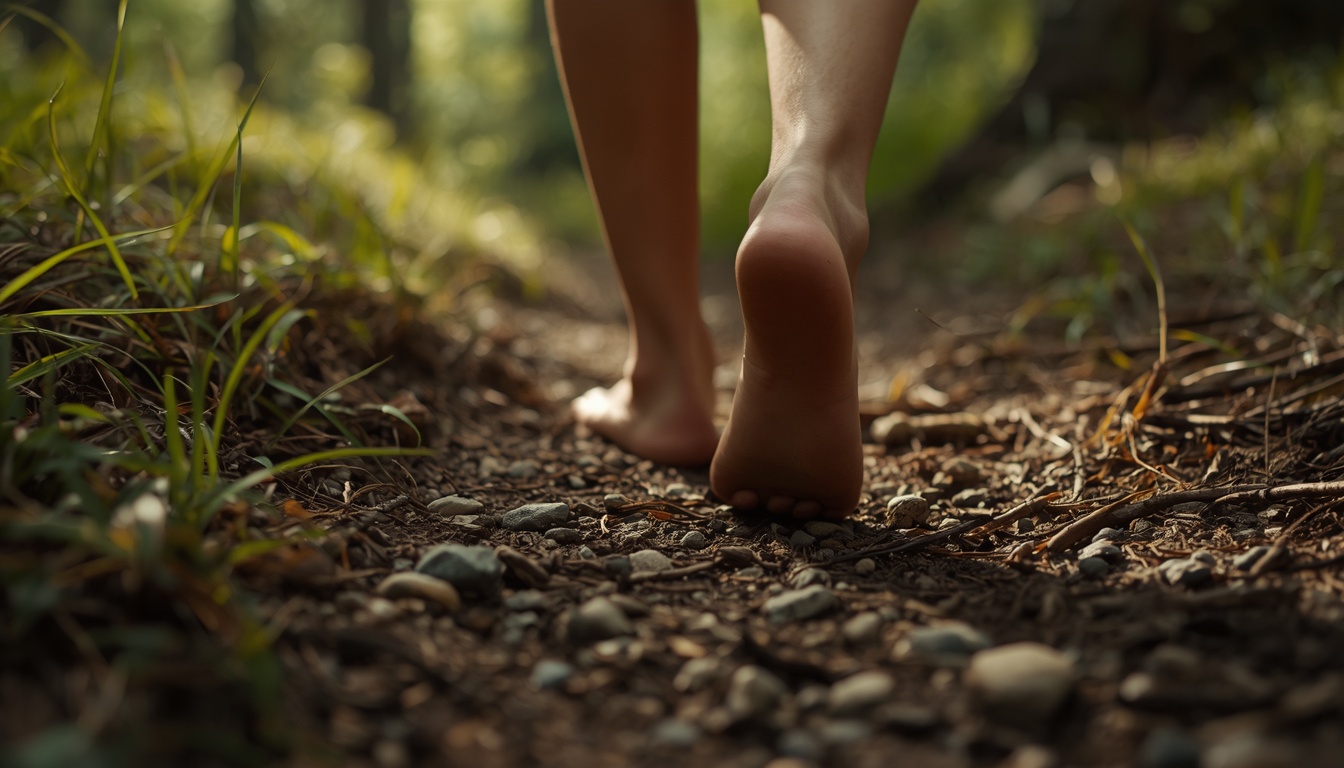
For the vast majority of human evolution, every step delivered rich information. The sole of the foot met soil, grass, sand, roots, stones, and shifting ground. That constant sensory feedback trained the small muscles of the foot, refined balance, and coordinated the entire kinetic chain from toes to hips and spine. The foot was both a sensor and a dynamic platform.
Today most steps land on flat, hard, predictable surfaces—concrete, tile, wood, or thickly cushioned shoe soles. The rich stream of information is muted. Over years and decades, the feet adapt to this quieter world: intrinsic muscles do less work, arches may become less responsive, and the fine adjustments that once protected knees, hips, and balance become less practiced.
Many of the balance problems, joint complaints, and “age-related” instability we accept as normal begin with this simple mismatch. The feet still expect uneven ground. Modern floors and shoes largely stop providing it.
What This Mismatch Often Feels Like
People notice the effects in different ways. Some develop flatter or more flexible arches and feel less stable on uneven trails or when standing on one leg. Others experience chronic foot fatigue, plantar discomfort, or a sense that their feet “give out” more easily. Knee or hip pain that appears without a clear injury can sometimes trace back to altered loading patterns that began farther down the chain.
In later adulthood the consequences become more obvious: reduced confidence on stairs, slower recovery of balance after a small stumble, or a higher risk of falls. These changes are often labeled simply as aging. Yet a substantial portion of the decline in foot strength, plantar sensation, and reactive balance is accelerated by decades of reduced sensory input and mechanical demand.
The Ancestral Foot in Action
Humans evolved as bipedal walkers and runners on complex natural terrain. The foot developed a remarkable combination of mobility and stability: a longitudinal arch that stores and returns energy, intrinsic muscles that actively control that arch, and dense sensory receptors on the plantar surface that continuously inform the nervous system about pressure, texture, and slope.
Habitually barefoot or minimally shod populations consistently show different foot characteristics from those raised in conventional modern footwear. Their feet tend to be wider, with stronger intrinsic muscles, stiffer and more functional arches under load, and more even pressure distribution. Plantar sensation remains acute even when protective calluses form. The foot stays an active, adaptable structure rather than a passive passenger inside a rigid or heavily cushioned container.
This was not an optional upgrade. It was the default operating system for millions of years.
How Modern Surfaces and Shoes Change the Equation
Two major shifts occurred relatively recently in evolutionary terms.
First, the ground itself became uniform. Flat indoor floors and paved outdoor surfaces remove the constant micro-adjustments required on natural terrain. The foot no longer has to conform, grip, or rapidly correct for irregularities with every step.
Second, footwear changed. Conventional shoes often include thick cushioning, elevated heels, toe springs (the upward curve at the front), arch supports, and relatively stiff soles. These features reduce the work the foot must do and dampen the sensory signals reaching the brain. Research shows that greater toe-spring curvature decreases the force the foot muscles need to generate during push-off. Cushioning lowers impact sensation while the actual force transmitted upward remains significant. Over thousands of daily steps, the cumulative reduction in muscular demand and sensory feedback is substantial.
The result is a quieter, less demanding environment for the feet. Intrinsic muscles that once stabilized the arch and controlled fine movements receive less stimulus. Proprioceptive acuity—the ability to sense exact position and pressure—declines more than it would from aging alone. The kinetic chain above the foot (ankle, knee, hip, and core) receives slightly altered timing and loading information, which can contribute to compensatory patterns over time.
Common Drivers and Hidden Triggers
Several everyday factors reinforce the mismatch:
- Near-constant use of conventional cushioned or supportive shoes, even indoors
- Living and working almost exclusively on hard, level surfaces
- Limited time barefoot or in minimal footwear on varied natural ground
- Sedentary patterns that further reduce overall foot and lower-leg loading
- Rapid transitions to minimal footwear or barefoot activity without gradual strengthening (which can temporarily increase injury risk)
- Age-related declines in sensation that are amplified by long-term sensory deprivation
Less obvious contributors include shoes that are too narrow (restricting natural toe splay), habitual use of elevated heels that alter calf and Achilles length over time, and the absence of regular single-leg balance challenges that once occurred naturally on uneven ground.
The Kinetic Chain Connection
The foot is the foundation of the kinetic chain. When it is strong, mobile, and well-informed by sensory input, it helps distribute forces and maintain alignment farther up the body. When it is weaker or less sensitive, the ankle, knee, and hip often compensate. These compensations can appear as altered gait, increased stress on joint surfaces, or reduced ability to recover from small perturbations.
Improved foot strength and plantar sensation have been linked to better static and dynamic balance, particularly in middle-aged and older adults. Minimal footwear interventions that increase daily sensory input and muscular demand have produced measurable gains in toe-flexion strength and intrinsic muscle size within months. These changes support the idea that many “age-related” deficits are at least partly reversible when the original sensory and mechanical environment is partially restored.
When to Pay Closer Attention
Consider the role of foot function if you notice:
- Progressive loss of balance confidence, especially on uneven surfaces or in low light
- Recurrent ankle sprains or a sense of instability
- Knee, hip, or lower-back discomfort that lacks a clear traumatic cause
- Visible changes in foot shape, arch height, or toe alignment over time
- Difficulty standing on one leg for more than a few seconds with eyes open or closed
- Foot pain or fatigue that improves when walking barefoot on safe natural surfaces and worsens in restrictive shoes
These patterns do not automatically mean footwear is the sole cause, but they are signals that the foundation deserves attention.
Myths vs Facts
Myth: Cushioned shoes protect the joints by absorbing impact.
Fact: Cushioning changes the rate of loading and reduces sensation, but the total force still travels up the kinetic chain. Reduced sensory feedback can lead to less precise movement control.
Myth: Flat feet or weak arches are purely genetic and fixed.
Fact: While genetics influence baseline structure, habitual footwear and surface exposure strongly affect muscle strength, arch stiffness under load, and functional performance.
Myth: Going barefoot or switching to minimal shoes is automatically safer.
Fact: Sudden transitions without gradual strengthening raise the risk of overload injuries. Adaptation takes time and progressive exposure.
Myth: Balance problems in older adults are inevitable and mostly neurological.
Fact: Plantar sensation and foot strength decline with age, but decades of reduced sensory input and muscular demand accelerate the process. Targeted restoration can improve function.
Myth: Arch supports permanently fix foot problems.
Fact: Supports can provide temporary comfort or offloading, yet long-term reliance may further reduce the stimulus the intrinsic muscles need to stay strong.
Practical Ways to Give Feet More of What They Expect
The goal is not to abandon shoes entirely or romanticize a pre-modern life. It is to reintroduce appropriate sensory and mechanical challenges in a safe, progressive way.
- Spend time barefoot at home on clean, safe surfaces. Begin with short periods and increase gradually.
- Walk on natural varied terrain (grass, firm dirt, sand, gentle trails) whenever practical, starting with short sessions.
- Consider minimalist or barefoot-style footwear for part of the day once foot strength has improved. Look for thin, flexible soles, wide toe boxes, and little or no heel elevation.
- Practice simple foot-strengthening movements: short-foot exercises, toe yoga (lifting and spreading toes independently), towel scrunches, and single-leg balance holds.
- Include single-leg stance practice daily, progressing from eyes open to eyes closed or on a slightly unstable surface as control improves.
- Choose shoes that allow natural toe splay and avoid excessive toe spring or rigid support for everyday wear when possible.
- Transition slowly. Increase barefoot or minimal-footwear time by small weekly increments and listen for signs of overload (persistent soreness, unusual fatigue, or sharp pain).
These practices restore some of the information and demand the feet evolved to handle without requiring a complete lifestyle overhaul.
When to See a Professional
Persistent foot pain, significant balance impairment, recurrent falls, or joint pain that interferes with daily life warrants evaluation by a clinician, physical therapist, or podiatrist experienced in functional foot assessment. Imaging or gait analysis may be useful in some cases. A professional can also guide a safe strengthening and transition plan, especially for people with existing injuries, neuropathy, or significant structural concerns.
Frequently Asked Questions
Is it safe for older adults to go barefoot or try minimal shoes?
Many middle-aged and older adults gain measurable improvements in strength and balance with gradual exposure. However, those with reduced sensation (for example from neuropathy), severe balance deficits, or open wounds on the feet should proceed only under professional guidance and prioritize safety.
How long does it take to strengthen the feet?
Studies of daily minimal-footwear use have shown significant increases in toe-flexion strength within six months. Noticeable improvements in control and comfort often appear earlier with consistent practice.
Do I need special “barefoot” shoes?
Not necessarily. Any thin, flexible, wide-toebox shoe that allows the foot to move and sense the ground can help. Dedicated minimalist designs make the transition more systematic for some people.
Can modern shoes cause permanent damage?
They more often produce reversible deconditioning than irreversible structural damage. The earlier sensory input and muscular demand are restored, the greater the potential for improvement.
What about children?
Allowing children ample barefoot time on safe varied surfaces supports natural foot development, wider toe splay, and stronger intrinsic muscles during the years when the foot is still highly adaptable.
Conclusion
The human foot is an extraordinary sensory and mechanical organ shaped by millions of years of contact with complex natural ground. Modern flat surfaces and cushioned, supportive shoes have quietly reduced the information and workload those feet receive. Over a lifetime, the resulting decline in strength, sensation, and reactive control contributes to many of the balance and joint problems we attribute solely to age.
Recognizing the mismatch reframes the problem. Instead of accepting progressive instability as inevitable, we can deliberately restore some of the sensory richness and muscular demand the feet still expect. Walking on uneven ground, spending time barefoot, choosing less restrictive footwear, and training the intrinsic muscles are not nostalgic gestures. They are practical ways to give an ancient system more of the input it was built to use—supporting clearer balance, more resilient joints, and greater confidence with every step.