A click or brief fullness as an elevator rises or drops is usually the ear equalizing a small pressure change, not damage. A swallow often finishes the pop.
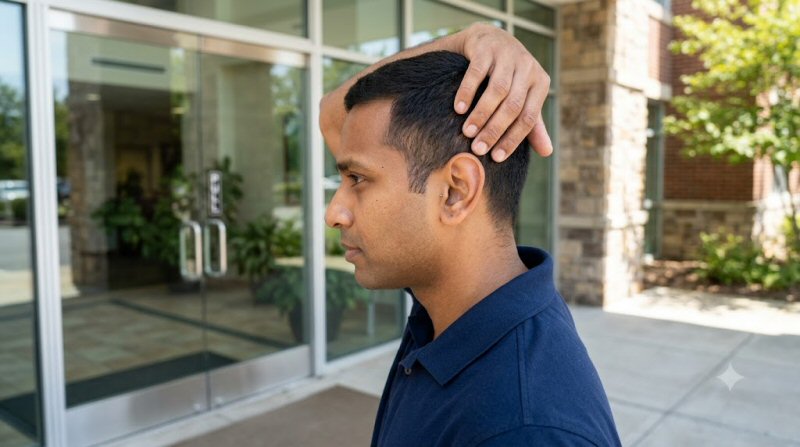
The doors close, the floor presses up, and somewhere between the third and the twelfth story one ear clicks. Sometimes both do. Sometimes nothing happens until the lobby, when a swallow finishes the job with a soft pop and the world sounds clear again. It can feel oddly medical for a ride that lasted twenty seconds. It is usually the same small equalizing event the ear uses on a hill, a tunnel, or a yawn.
A few floors are not a flight. The pressure change is modest. The eardrum is simply good at noticing it. The pop is the ear catching up, not the ear giving way.
What This Pop Feels Like
Most people describe a click, a crackle, or a brief muffled patch that clears as the car levels off. One ear often goes first. The other may follow a floor later, or only after a swallow, a yawn, or a sip from a bottle. Sound can seem slightly dull or farther away for a few seconds, then snap back. A mild fullness behind the drum is common. Sharp pain is less common on an ordinary office ride and more common if the tube is already sticky from a cold.
The timing tracks the ride. It starts as the car accelerates up or down, or as it stops. It should not begin hours later with no pressure change at all. The same click can show up in a car climbing a mountain road, in a fast glass lift on the outside of a hotel, or even on a long escalator in a deep station. If a swallow in the lobby clears it, the system did what it was built to do.
Why a Few Floors Are Enough
Air pressure falls a little as you go up. A rough working figure is about 12 pascals for each meter of height, near 1 hectopascal for every 8 meters. A 40-meter rise, a modest tower, is only a few hectopascals. Cabin pressure on a flight drops by something closer to 200 hectopascals. The elevator is a small step. The middle ear is a small closed pocket, about a milliliter of air behind the drum, so a small outside change is enough to bow that thin membrane.
Sven Ingelstedt and colleagues mapped how middle-ear pressure drifts and how gas exchange across the lining slowly changes it even without a ride. Jacob Sadé’s work on middle-ear gas made the same point from the mucosa side: the pocket is not a sealed jar forever, but it is sealed on the time scale of an elevator. Until the tube opens, the drum is the part that moves. That movement is what you feel. A click is often the tube snapping open and the pressures meeting, the same event described in why a swallow pops the ears.
The stomach-drop on the same ride is a different sensor. That lurch is the inner ear’s otoliths and the gut lagging the floor, covered in why an elevator makes the stomach drop. One ride can deliver both feelings. They are not the same problem.
The Tube That Does the Click
The Eustachian tube runs from the middle ear to the back of the nose. At rest it is closed, which keeps sniffles and mouth sounds out of the ear. It opens when the tensor veli palatini and related palate muscles tug during a swallow or a yawn. Adam Politzer spent much of nineteenth-century otology on that passage and on ways to ventilate it. Antonio Maria Valsalva’s forced breath against a closed nose and mouth is the maneuver still named for him, useful in small doses and unkind if you force it through pain.
Charles D. Bluestone and Erdem I. Cantekin showed how often the tube fails to open on demand, especially in children, whose tubes are shorter and sit more horizontally. Anita Bylander’s recordings found the same pattern: many children need a bigger pressure gap, or a more deliberate swallow, before the click arrives. William J. Doyle and Cuneyt M. Alper later traced how the tube, the lining, and gas exchange share the job of keeping the drum near neutral. Björn Magnuson showed that a hard sniff can pull the middle ear negative on purpose. The elevator is the outdoor version of that experiment, run by the building instead of the nose.
Harry G. Armstrong and Joseph C. Farmer Jr. described the larger version in aviation and diving: if the tube stays shut while outside pressure changes a lot, the drum is pushed in or out, fluid can seep into the middle ear, and hearing dulls. That is barotrauma. A lobby pop is the successful small version of the same reflex. The failed version is why a cold plus a landing can hurt for a day, the pattern in ears that stay full after a flight.
Why Some Rides Pop and Others Do Not
A clear tube may open on its own as the car moves, so you notice nothing. A slightly sticky tube waits for a swallow. A cold, allergy, or the tail of a sinus week swells the nasopharyngeal end and delays the click until you are already in the hall. Reflux that reaches the back of the nose can do the same without a stuffed feeling in front. Children pop more obviously because their tubes equalize less efficiently. Pregnancy and some hormonal shifts swell mucosa and can make a familiar lift suddenly loud.
Speed matters less than people think. A smooth fast car and a slow one can feel similar if the total height is the same. What changes the feeling is whether you swallow on the way. Talking, chewing, or sipping gives the palate muscles a reason to open the tube before the drum has to complain. A silent ride with a clenched jaw gives it fewer chances.
Descending is often the louder direction. Outside pressure rises, the drum is pushed in, and the tube has to open against that push. Ascent lets middle-ear air expand and can vent more easily. Divers and fliers have said this for a century. An elevator is the same physics with a shorter script.
Hidden Triggers
A recent cold is the classic one. The ride did not cause the fullness. It revealed a tube that was already slow. Allergy season does the same, especially if the nose is blocked on the side that pops late. Hard nose-blowing just before you step in can leave one ear negative, so the lift starts from an uneven place. Earplugs or a tight headphone seal do not change middle-ear pressure, but they make the click seem louder because outside sound is damped.
Decongestant pills and sprays change the picture for a few hours by shrinking the lining. They are a tool for a known bad equalizer before a flight, not a daily elevator habit. Antihistamines can dry the nose and sometimes make the tube feel stickier. Smoking and very dry heated air swell and irritate the back of the nose. A jaw that stays clenched on the ride simply skips the swallows that would have done the job.
When to Worry
A click that clears with a swallow, on both sides or one, with normal hearing a minute later, is ordinary. Worry starts when the ride leaves real damage signals.
Get a prompt check if pain stays sharp after you are back at ground level, if hearing remains muffled past a day, if fluid or blood drains from the ear, or if the world spins rather than briefly sways. Spinning vertigo plus a pressure change can be an inner-ear problem, not a simple tube click. A sudden drop in hearing in one ear, with or without a pop, needs urgent assessment even if the elevator seems like a handy explanation.
One ear that never clicks, week after week, with a blocked feeling and no cold, deserves an exam. So does a pop followed by crackling that never clears, or fullness with fever and a draining ear. Severe pain on a flight descent is a bigger pressure story than a building and should not be filed under “elevators do this.” Facial weakness, double vision, or a new one-sided hearing loss are not tube trivia.
Myths vs Facts
Myth: a pop means the eardrum tore. Fact: the common click is the tube opening. A true perforation usually brings a louder event, pain, and often drainage or a sudden hollow sound, and it is rare from a few floors.
Myth: only flights change ear pressure. Fact: any height change can. Hills, tunnels, elevators, and fast mountain roads are the same mechanism at different doses.
Myth: you should pinch the nose and blow hard every time. Fact: a swallow or yawn is enough for most rides. A gentle Valsalva is a backup. Forcing air through pain can bruise the drum or the inner ear.
Myth: one ear popping means that ear is weaker for life. Fact: tubes open unevenly all day. A cold on one side explains a lopsided week.
Myth: the stomach drop and the ear click are one symptom. Fact: they share the ride and almost nothing else. One is motion sensing. The other is air pressure.
How to Make the Ride Quieter
Swallow as the car starts and again as it slows. A sip of water, a yawn, or a piece of gum gives the palate a job. If you know your tubes are slow, start the swallows early rather than waiting for the dull patch. Stay a little more upright than a full chin-tuck if you can. Treat the cold that is really driving a bad week: saline, time, and not diving or flying until the nose is open.
Skip a forceful nose blow in the lobby if the ear already feels tight. If you use a gentle equalizing breath, keep it soft and stop if it stabs. People who get true pain on flights sometimes learn a pressure device or a timed decongestant with a clinician. An office lift rarely needs that kit.
Children who complain on every ride are usually showing normal immature tube function. A swallow, a drink, or a small yawn is the remedy. Pain that makes a child cry after an ordinary building, or hearing that stays down, still deserves a look.
When to See a Doctor
See someone if fullness or dulled hearing lasts more than a day or two after ordinary height changes, if pain is sharp rather than a click, if only one ear has been blocked since a cold and is not improving, or if vertigo, drainage, or a sudden hearing drop appears. Recurring pain on every flight or mountain drive is worth an ear exam before the next trip, even if elevators are only a nuisance. Fever, a swollen ear, or weakness in the face belongs on a sooner list.
Most lobby clicks never need a visit. They need a swallow and a reminder that the drum is doing accounting.
FAQs
Is it normal for only one ear to pop in an elevator?
Yes. The tubes do not open in perfect unison. A slight cold, a recent sniff, or the way you swallowed last can leave one side a floor behind. It should still clear with a yawn or a sip.
Why does the pop happen more on the way down?
Descending outside pressure pushes the drum inward. The tube has to open against that push. Rising pressure in the middle ear often vents more easily. The same pattern is why airplane landings bother people more than takeoffs.
Can an elevator actually hurt the eardrum?
A few floors almost never do. Pain that lingers, drainage, or hearing that stays down can mean the tube did not open and the drum or the middle ear took the pressure, more often after a cold or on a much larger change such as a flight or a dive.
Should I pinch my nose and blow?
Not as the first move. Swallow, yawn, or sip. A gentle blow against a pinched nose is a backup if fullness remains. Stop if it hurts. Hard forcing is how a small pressure gap becomes a bruised ear.
Does a cold make elevator pops worse?
Yes. Swelling at the back of the nose makes the tube sticky, so the click comes late or with a dull ache. The ride is the test, not the cause. Equalizing usually improves as the nose does.
Are children more likely to notice this?
They are. Their tubes equalize less reliably, which Bluestone, Cantekin, and Bylander documented in ordinary life, not only on airplanes. A drink or a yawn on the ride is usually enough. Persistent pain or hearing loss is not.
Conclusion
An elevator pop is a small pressure ledger. The building changed the outside air a little. The middle ear noticed. A swallow opened the tube, the drum settled, and the click was the receipt. That is normal physiology, the same system that handles hills and landings, running on a shorter trip. Pain that stays, hearing that does not come back, spinning, or drainage is a different entry. Everything else is a cue to sip something on the way down.