
Your wrists evolved for varied side-to-side movements under load from tools and climbing. Modern desks often keep them fixed. Here's why that matters and what to do.
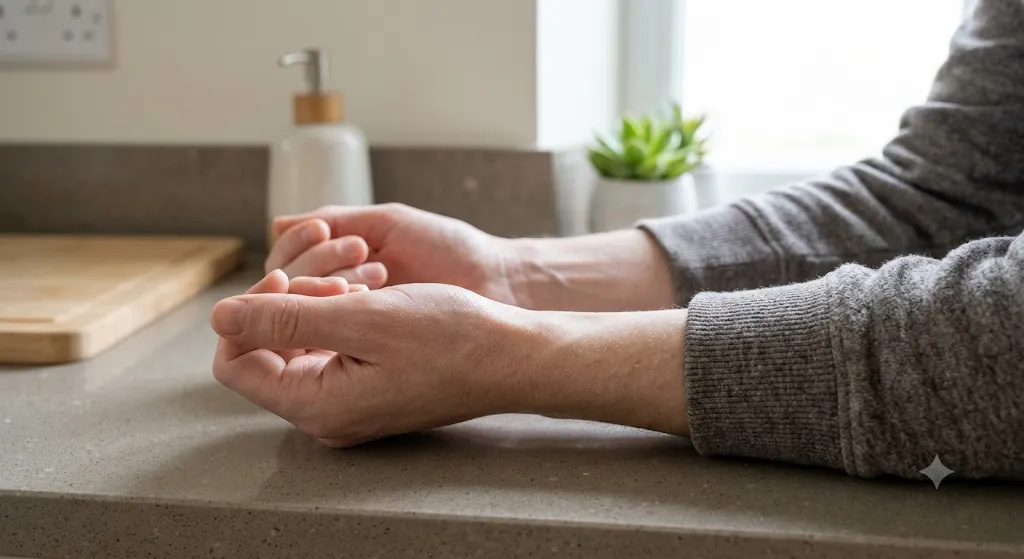
Your wrists can feel oddly stiff or tired after a long day at the computer, even when you have not lifted anything heavy or done any sports. The ache is not always from typing too hard. Sometimes it is from doing almost no side-to-side movement at all. Human wrists are built for occasional radial and ulnar deviation—the side-to-side tilt of the hand—under light to moderate load. Modern keyboards, mice, and phones rarely ask for that motion. The result is a joint that still expects variety it no longer receives.
What Side-to-Side Wrist Loading Actually Means
Radial deviation tilts the hand toward the thumb; ulnar deviation tilts it toward the little finger. Both movements happen at the radiocarpal and midcarpal joints. In daily life they appear when you turn a key, swing a hammer with control, grip a tool at an angle, or steady yourself on uneven ground while climbing. The range is modest—roughly 20 degrees radial and 30–40 degrees ulnar in most people—yet the muscles and ligaments that control it are well developed. Functional anatomists such as Kapandji have long noted that these small side motions are essential for precise tool use and for distributing load across the carpal bones rather than concentrating it in pure flexion or extension.
When the wrist stays locked in a near-neutral position for hours, those control muscles and the joint surfaces receive little of the gentle compression and shear they evolved to handle. The tissues do not break; they simply become less ready for the next time you need the motion.
The Movement Your Wrists Were Built For
Ancestral human activity involved frequent gripping of irregular objects, climbing, carrying, and tool-making. All of these tasks recruit the radial and ulnar deviators—muscles such as flexor carpi radialis, extensor carpi ulnaris, and the smaller interossei that fine-tune the angle. Electromyographic studies (classic work by Basmajian and later researchers) show these muscles fire not only for pure side tilt but also to stabilize the wrist during any loaded grip that is not perfectly straight. In short, side-to-side control was a normal part of an active day, not a special exercise.
Modern life removed most of that demand. A keyboard keeps the hands almost parallel; a mouse keeps the wrist largely still or slightly extended. Even many “ergonomic” setups prioritize neutral alignment and ignore the need for occasional deviation under light load. The joint still expects the old pattern.
What Happens When Side Loading Is Rare
Over months and years of limited side motion, the capsule and ligaments can feel tighter when you finally need the range. The muscles that control deviation become less efficient, so other tissues take more of the load when you do use the motion. Some people notice a vague ache on the thumb or pinky side of the wrist after a long desk day, or a sense that the joint “needs a stretch” that ordinary wrist circles do not fully satisfy. This is not the same as carpal-tunnel symptoms or acute tendinopathy; it is more often a simple under-use pattern. Related issues can appear when the wrists are also kept in prolonged flexion or extension, a pattern discussed in articles on loaded wrist flexion and forearm twist and grip.
When to Worry
Most desk-related wrist stiffness improves with movement and rest. See a clinician if you have persistent swelling, sharp pain that wakes you at night, numbness or tingling into the fingers, visible deformity, or pain that follows a fall or sudden load. Those signs can indicate fracture, ligament injury, nerve compression, or inflammatory conditions that need proper assessment. Ordinary stiffness after sitting is rarely one of these.
Myths vs Facts
Myth: Only heavy weights or sports matter for wrist health.
Fact: Light, varied loading—including occasional side-to-side angles while carrying a bag or using a tool—keeps the joint surfaces and control muscles ready. Complete stillness is the bigger mismatch.
Myth: A perfectly neutral wrist all day is always best.
Fact: Neutral is a good default for typing, but the wrist also needs short periods of deviation under mild load to maintain full function. Constant neutrality is not what the joint evolved for.
Myth: Stretching alone fixes the problem.
Fact: Stretching restores range; light loaded movement restores the control and joint nutrition that stretching alone does not provide.
Simple Ways to Give Your Wrists What They Expect
You do not need special equipment. A few short practices each day are enough:
- When you carry a grocery bag or water bottle, let the wrist tilt slightly to the side for a few steps rather than locking it straight. Keep the load light.
- Once or twice a day, sit or stand and slowly tilt both hands toward the thumbs, then toward the little fingers, holding each end for a few seconds. Add a light fist or a small weight (a book or water bottle) if it feels easy.
- Use ordinary tools—a screwdriver, a whisk, a garden trowel—for a minute or two with a natural wrist angle instead of forcing a perfectly straight grip.
- During desk breaks, rest your forearms on the desk and gently slide the hands side to side while keeping the fingers relaxed.
- If your wrists also feel stiff in the morning, the same light side motions can help after the joint has had time to warm up. Morning stiffness patterns are covered in more detail in our piece on morning wrist stiffness.
Stop any movement that produces sharp pain. The goal is occasional gentle loading, not aggressive stretching or heavy side-bending.
FAQs
Is side-to-side wrist motion the same as twisting the forearm?
No. Forearm twist (pronation and supination) happens mainly at the elbow and radioulnar joints. Side-to-side wrist motion (radial and ulnar deviation) happens at the wrist itself. Both are useful; they are different movements.
Can too much side loading cause problems?
Yes, if it is sudden, heavy, or repetitive without recovery. The issue for most desk workers is too little, not too much. Occasional light use is the middle path the joint seems built for.
Do wrist braces help or hinder this?
A brace that locks the wrist neutral can reduce irritation during a flare, but long-term continuous bracing removes the very motion the joint needs. Use braces for short periods when advised, then return to gentle movement.
Why do my wrists click when I tilt them sideways?
A single painless click is often normal joint cavitation or a tendon gliding over a bony edge. Frequent painful clicking or a sense of instability deserves a clinical check.
Is this related to carpal tunnel syndrome?
Not directly. Carpal tunnel involves median-nerve compression, usually with numbness. Simple under-use stiffness does not compress the nerve. If you have tingling or numbness, get it evaluated rather than assuming it is just stiffness.
How quickly can I expect improvement?
Many people notice less end-of-day ache within one to two weeks of adding a few minutes of light side-to-side loading and general wrist movement. Full restoration of easy range can take longer if the tissues have been under-used for years.
Conclusion
Your wrists still expect the occasional side-to-side tilt under light load that tool use, carrying, and climbing once supplied. Modern fixed postures remove that demand without removing the joint’s design. A few deliberate, gentle moments of deviation each day—while carrying something light or simply moving the hands side to side—are usually enough to keep the tissues ready. The change is small, the mismatch is real, and the fix is straightforward.


