
The flexor carpi radialis helps bend the wrist under load. Modern desks keep it quiet. Here is why that mismatch can leave the forearm tight and what still helps.
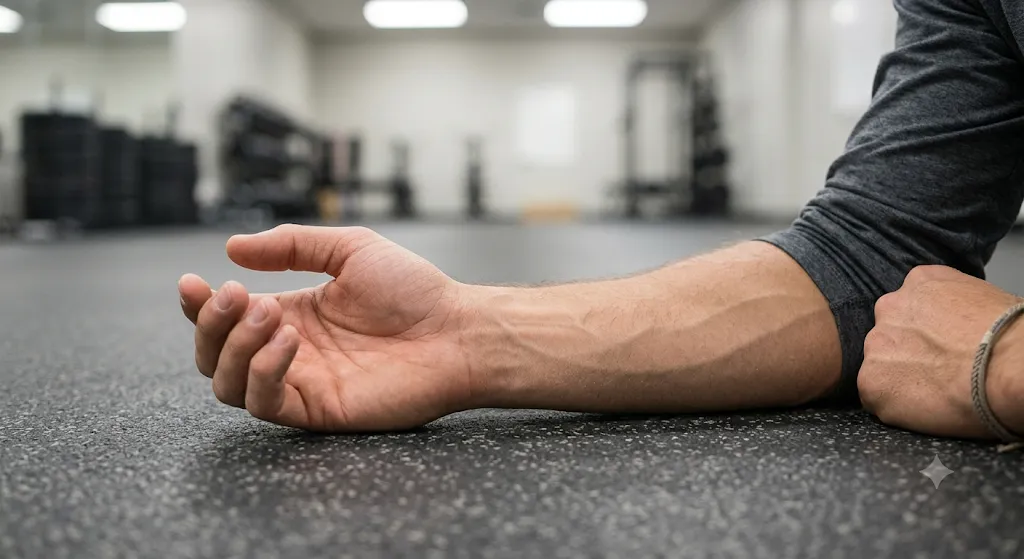
You finish a long stretch of typing and notice a dull tightness along the inner forearm, just below the elbow, that eases when you make a loose fist and gently bend the wrist. Nothing dramatic—just the sense that the muscle has been sitting in a lengthened, quiet position for hours. That muscle is often the flexor carpi radialis, and it still expects occasional work that modern desk life rarely provides.
What This Feels Like
The sensation is usually a mild, localized ache or stiffness on the palm side of the forearm, closer to the wrist or mid-forearm. It can feel better when you actively flex the wrist or grip something for a moment, then return when you go back to the keyboard. Some people notice it more after prolonged mouse use or when the wrist has been held slightly extended. It is rarely sharp or associated with numbness unless something else is also going on.
What the Flexor Carpi Radialis Actually Does
The flexor carpi radialis is a forearm muscle that starts at the medial epicondyle of the humerus (the bony bump on the inside of the elbow) and runs down to insert mainly at the base of the second metacarpal bone in the hand. Its primary jobs are wrist flexion—bending the palm toward the forearm—and radial deviation, which tilts the hand toward the thumb side. It also assists with elbow flexion and contributes to grip stability when the wrist needs to stay firm under load.
Electromyography studies, including classic work by John V. Basmajian, have shown that this muscle is recruited during tasks that require controlled wrist flexion against resistance: carrying a heavy bag with the palm up or partially flexed, hammering, climbing, or using hand tools that demand a strong, bent-wrist posture. In quiet, unsupported positions it stays relatively silent.
Why It Still Expects Loaded Flexion
For most of human evolutionary history, the hands were used for climbing, carrying, digging, processing food, and tool use that regularly involved loaded wrist flexion. Gripping a branch, lifting a stone, or chopping with a simple tool placed the flexor carpi radialis under intermittent tension and shortening. Those brief bouts of work kept the muscle and its tendon accustomed to both lengthening and active contraction.
Modern life inverted the pattern. Keyboards and mice typically hold the wrist in slight extension or neutral, which places the flexor carpi radialis in a lengthened position while it does very little active work. The muscle is not being damaged by this posture, but it is also not receiving the occasional loaded shortening cycles it was built to handle. Over weeks and months the result can be a sense of tightness, reduced endurance for gripping tasks, or a feeling that the forearm “needs to move” after long sedentary periods. Related patterns appear in other hand and forearm muscles that also expect more varied grip and wrist positions; see how the lumbricals still expect a curled grip and how the hands lost their daily workout.
Common Everyday Triggers
Long stretches of keyboard or mouse work with the wrists extended are the most frequent modern trigger. Driving with hands on the top of the wheel, holding a phone for long periods, or carrying light loads with the wrist locked straight can produce the same quiet lengthening. Cold environments can make the sensation more noticeable because muscle tissue becomes less compliant. On the other hand, a single session of heavy gripping or wrist-flexion exercise after weeks of desk work can leave the muscle sore the next day—the classic delayed response of a tissue that has not been loaded recently.
When It Is Harmless and When to Pay Closer Attention
Mild inner-forearm tightness that eases with gentle movement and does not interfere with grip strength is usually a postural and loading mismatch rather than injury. It becomes more important to investigate if the pain is sharp, wakes you at night, is accompanied by tingling or numbness in the fingers, or if grip strength drops noticeably. Those features can point toward medial epicondylitis, carpal tunnel involvement, or other nerve or tendon issues that deserve a clinician’s assessment. Persistent one-sided weakness or pain after a specific trauma also warrants evaluation.
How to Give It the Occasional Load It Still Expects
The goal is not aggressive strengthening but brief, comfortable loaded flexion a few times a week. Simple options include:
- Light wrist curls with a small dumbbell or a water bottle, palm up, performed for two sets of 8–12 slow repetitions. Keep the movement smooth and stop if sharp pain appears.
- Carrying a moderately heavy grocery bag or briefcase for a minute or two with the palm facing up or partially flexed, rather than always letting the wrist hang straight.
- Hanging from a bar or sturdy surface for short periods (if your shoulders allow), which recruits the flexors as stabilizers.
- Changing keyboard and mouse height so the wrists sit closer to neutral rather than extended, reducing the constant lengthened position.
These small additions restore the intermittent shortening and tension the muscle expects without turning desk life into a workout. People who already do climbing, racket sports, or manual work often notice the tightness less because the natural loading is still present.
Myths vs Facts
Myth: Inner forearm tightness after typing always means tendon damage.
Fact: Most of the time it reflects a muscle that has been held lengthened and quiet; gentle loaded movement usually settles it.
Myth: You should stretch the flexors aggressively every hour.
Fact: Prolonged stretching of an already lengthened muscle can increase discomfort. Brief active flexion and position changes are usually more helpful.
Myth: Only heavy weights count as useful load.
Fact: Light resistance or the weight of a grocery bag is enough to reintroduce the shortening cycles the muscle evolved to handle.
Frequently Asked Questions
Why does the tightness ease when I make a fist and bend my wrist?
Active flexion shortens the flexor carpi radialis and its tendon, which temporarily reduces the stretch sensation that builds up while the wrist sits extended on a keyboard.
Is this the same as tennis elbow or golfer’s elbow?
Not usually. Golfer’s elbow (medial epicondylitis) involves the common flexor origin and is more painful with resisted wrist flexion or gripping. Simple positional tightness after desk work is milder and improves with movement and position changes.
Can better wrist posture alone solve it?
Neutral wrist posture reduces the constant lengthening, which helps. Adding a little occasional loaded flexion still matches the muscle’s ancestral pattern more closely and often improves the sense of comfort.
Should I worry if only one arm feels tight?
Mild asymmetry is common because one hand usually dominates mouse or tool use. If the difference is large, strength is reduced, or pain is sharp, it is worth having a clinician check for local tendon or nerve irritation.
Does cold weather make this worse?
Yes for many people. Cooler muscle tissue is less compliant, so the same lengthened position feels tighter. Warming the forearm with light movement or a warm cloth often eases the sensation.
Conclusion
The flexor carpi radialis is a straightforward muscle built for intermittent loaded wrist flexion—the kind of work that came with climbing, carrying, and tool use. Desk life keeps it mostly quiet and slightly lengthened, which can leave a familiar inner-forearm tightness. Brief, comfortable loaded flexion a few times a week, combined with more neutral wrist positions, usually restores the balance the muscle still expects. If the sensation stays mild and improves with movement, it is a normal mismatch rather than a sign of damage.


