
Your wrists were shaped by climbing, rising from the ground, and closed-chain force. Modern fine-motor life leaves them under-loaded until the first real push-up or plank reveals the mismatch.
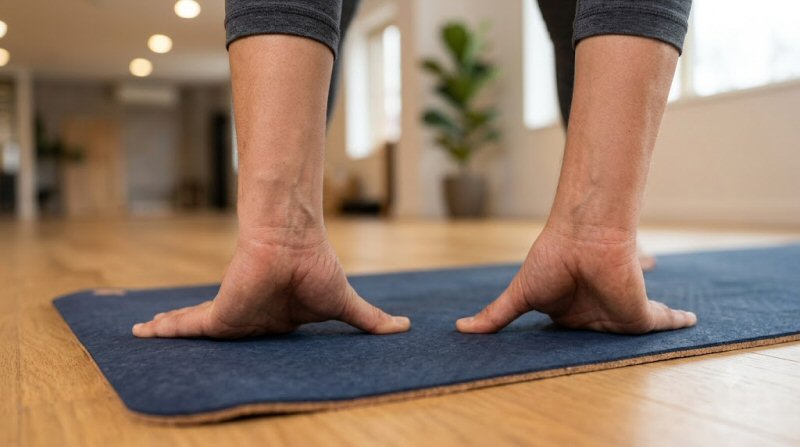
Most of us spend the day moving our hands in open space—typing, scrolling, lifting a mug, or steering a car. The wrists stay relatively unloaded. Then comes a push-up, a plank, yoga, or simply getting up from the floor, and the same wrists suddenly complain. The ache, the sense of instability, or the sharp pressure on the back of the hand is common enough that many people simply avoid those positions. Yet the wrist is built to transmit force when the hand is fixed and the body moves relative to it. That closed-chain demand was ordinary for much of human history and is now rare.
What This Sensation Usually Feels Like
The complaint is rarely dramatic at first. It often shows up as a dull ache across the back of the wrist when the palm is planted and the wrist is extended, a feeling that the joint is “weak” or “wobbly,” or a quick pinch near the thumb side during the first few repetitions of a floor-based exercise. Some people notice stiffness afterward that eases with gentle movement. Others feel the wrists are fine for daily tasks but immediately protest under body-weight load. The sensation is usually bilateral, though one side may feel more sensitive if it has been used less or has an old minor injury.
Why the Wrist Still Expects Occasional Weight-Bearing
The human hand transitioned from a weight-bearing locomotor organ in our primate ancestors toward a tool of fine manipulation. Even so, the wrist retained the capacity—and the structural expectation—for closed kinetic chain loading. Climbing, scrambling over uneven ground, rising from a squat or from the floor, and transmitting force through a planted hand all place compressive and shear loads through the radiocarpal joint. Roughly 80 percent of that load travels through the radius, with the remainder crossing the ulna via the triangular fibrocartilage complex. Ligaments, especially on the dorsal and radial sides, and the carpal bones themselves are organized to manage these forces when the hand is fixed.
Comparative anatomy shows that African ape wrists carry features related to forceful, weight-bearing postures; modern human carpal morphology appears to have retained and reorganized elements of that heritage while adding greater mobility for manipulation. In everyday ancestral life, those loads arrived in short, varied bouts rather than as constant desk work or as sudden, unprepared full-body push-ups. The tissues therefore expect periodic, moderate compressive loading to maintain cartilage nutrition, ligament stiffness, and proprioceptive familiarity. When that loading disappears for months or years, tolerance declines.
Biomechanical studies of push-ups illustrate the demand clearly. Forces through the distal radius can reach substantial levels even at modest body-weight percentages, and the distribution changes with wrist angle. Extension shifts pressure more toward the scaphoid side of the joint and increases tensile demand on the scapholunate ligament complex—exactly the structures that often become irritated when an unprepared wrist is suddenly loaded in deep extension. Neutral or mildly flexed positions (as in a fist or knuckle push-up) tend to distribute force more evenly. Classic joint-physiology descriptions, such as those by I.A. Kapandji, map how the carpal rows move and lock under these loads; later kinetic work on push-up variants confirms that the wrist is not a passive hinge but an active force-transmission structure.
Common Modern Triggers
The most frequent trigger is simply the sudden return to floor-based movement after a long period of almost pure open-chain hand use. Desk work, phone scrolling, and keyboard typing keep the wrist in a relatively neutral or mildly extended posture without meaningful compression. When the same person then attempts a standard push-up, a plank, or even a deep downward-dog style stretch, the joint encounters an unfamiliar combination of extension and load. Poor technique—elbows flared, wrists dumped into extreme extension, or shoulders collapsed—amplifies the mismatch. Related modern patterns include prolonged mouse use that keeps the wrist extended under light but constant tension, and the absence of any daily habit of pushing oneself up from the floor or a low seat.
These patterns sit alongside other under-used upper-limb expectations. Just as hands still expect varied grips beyond flat swiping, and shoulders still expect a natural hang rather than a permanent forward posture, the wrists retain an expectation of occasional closed-chain work. The same principle appears in the preference for a neutral resting posture when the joint is not under load.
Less Common but More Serious Causes
Persistent dorsal wrist pain that worsens specifically with extended weight-bearing can reflect occult dorsal ganglia, partial scapholunate ligament irritation, or early radiocarpal cartilage changes. A history of a fall onto an outstretched hand raises the possibility of residual ligament laxity or a missed scaphoid injury. Ulnar-sided pain that increases with gripping or pronation may point toward triangular fibrocartilage issues or positive ulnar variance rather than simple under-loading. Inflammatory arthritis, crystal disease, or referred pain from the neck or elbow are less common but possible when the ache is accompanied by swelling, warmth, morning stiffness lasting more than an hour, or systemic symptoms.
Myths vs Facts
Myth: Wrists were never meant to bear weight, so any push-up is inherently bad.
Fact: The joint is well adapted to moderate, varied closed-chain loading; problems usually arise from sudden extremes or from years of almost zero loading followed by high demand.
Myth: If your wrists hurt in a plank, you should simply avoid all floor work forever.
Fact: Most people can regain tolerance with graded exposure, better wrist angle, and progressive loading rather than complete avoidance.
Myth: Wrist pain during push-ups always means a torn ligament.
Fact: Temporary discomfort from deconditioning or technique is far more common; true structural injury usually includes swelling, giving-way, or pain that persists at rest.
How to Restore Gradual Tolerance
Begin with positions that keep the wrist closer to neutral. Wall push-ups or countertop push-ups allow force transmission with less extension. Moving to hands-and-knees on a firm but padded surface, then gradually shifting more weight forward, reintroduces compression in a controllable way. Fist or knuckle variations (if the knuckles tolerate them) or the use of push-up handles that permit a neutral wrist can reduce peak ligament tension while still loading the joint. Short holds—ten to twenty seconds—repeated several times, are often better tolerated than long static planks at first.
Add simple mobility: gentle wrist circles, controlled flexion and extension without load, and light self-massage of the forearm extensors. Strengthen the surrounding muscles with open-chain work (light dumbbell wrist curls, reverse curls, and grip exercises) so the joint is not asked to stabilize alone. Over weeks, progress the angle and the duration rather than jumping to full floor push-ups. Getting up from the floor using the hands several times a day is a practical, low-skill way to meet the same expectation without formal exercise.
If the wrists feel warm or swollen after a session, reduce the load or the extension angle the next day. Consistency with modest demand usually rebuilds tolerance faster than occasional heroic efforts.
When to See a Doctor
Seek assessment if pain is sharp and localized, if the wrist swells or locks, if you cannot bear even light weight without a sense of instability, or if symptoms follow a clear injury. Night pain that wakes you, progressive weakness, or numbness into the fingers also warrants evaluation. A clinician can distinguish simple deconditioning from ligament, cartilage, or nerve issues and may recommend imaging if the history suggests structural change. Early attention prevents a minor mismatch from becoming a chronic pattern.
Frequently Asked Questions
Is it normal for wrists to hurt the first time I try push-ups after years of desk work?
Yes. The sudden combination of extension and body-weight compression is outside the recent loading history of most modern wrists. Gradual reintroduction usually resolves it.
Should I do push-ups on my fists instead of flat palms?
Many people find a neutral wrist more comfortable because it reduces extreme extension and shifts load distribution. If the knuckles themselves are sensitive, start with wall or elevated variations instead.
Will strengthening my forearms alone fix the problem?
Forearm strength helps, but the wrist joint itself benefits from some compressive, closed-chain exposure. Both open-chain strengthening and progressive weight-bearing tend to work better together.
How long does it take to rebuild tolerance?
Most people notice improvement within two to four weeks of consistent, graded practice. Full comfort under heavier loads can take longer if the joint has been unloaded for years.
Can yoga or Pilates make this worse?
Poses that load a deeply extended wrist (certain planks, downward dog, or arm balances) can irritate an unprepared joint. Modifications that keep the wrist closer to neutral or reduce the percentage of body weight usually allow continued practice while tolerance returns.
Conclusion
Your wrists still carry the structural memory of hands that pushed, climbed, and rose from the ground. Modern life has replaced most of that closed-chain demand with fine, open-chain tasks. The resulting mismatch is ordinary, not a sign that the joint is broken. Gentle, progressive return to occasional floor support—done with attention to wrist angle and load—usually restores the tolerance the tissues expect. When the ache stays sharp, swollen, or unstable, a professional check is the sensible next step. In the meantime, the simplest daily habit is often the most effective: use your hands, now and then, to push yourself up from the floor.


