The trapezius evolved to carry loads, shrug a pack, and steady the shoulder girdle all day. Desk shrugs and strap-free living leave it tight and tired. Here is how to give it the job it still expects.
The muscle that fans from the base of your skull to the middle of your back did not evolve to hover over a laptop. The trapezius is a broad, three-part sheet built to lift, steady, and carry. It shrugged baskets, slung children, and kept a pack from sliding while the legs did the walking. Today it often lives in a half-shrug that never clocks out — and then we wonder why the place where the neck meets the shoulder feels like cable.
This is not a lecture against backpacks or a demand that you train like a porter. It is a clearer job description. The trapezius still expects occasional real load, full-range lowering of the shoulders, and a scapula that moves. When the only “load” is the weight of your own arms hanging forward toward a screen, the upper fibers do endurance work they were never meant to do alone.
Nearby tissues tell the same story. The scapulae still want hanging and reaching, as we wrote in why your scapulae still expect you to hang. The neck still wants a horizon, not a phone. The trapezius sits in the middle of that neighborhood and pays the rent when the neighbors stop moving.
What the Trapezius Is For
Anatomists divide the trapezius into upper, middle, and lower parts that share a nerve and a mission: control the scapula and the base of the neck.
- Upper fibers lift the shoulder girdle and help tilt the head
- Middle fibers pull the scapula toward the spine
- Lower fibers depress and upwardly rotate the scapula so the arm can go overhead
That combination is a carrying system. A pack, a water vessel, a child on one hip — all ask the girdle to rise a little, then stabilize so the load does not bounce. The lower and middle fibers keep the blade from winging. The upper fibers supply the shrug that clears the load off the neck for a moment and then, in a well-trained pattern, let it settle onto the bony shelf of the shoulder.
Electromyography studies of carrying and of backpack use show the trapezius working as a stabilizer, not only as a lifter. That matters. A stabilizer likes frequent, moderate demand. It does not like eight hours of low-level emergency shrug followed by no load at all.
The Ancestral Job Versus the Desk Job
For most of human history the upper body hauled. Firewood, water, game, infants, trade goods. Even when the walk was long, the shoulders changed shape through the day: shrugged to hoist, dropped to rest, rotated to reach, loaded on one side and then the other. The trapezius got both work and release.
The modern default is different. Arms hang forward. The head sits ahead of the shoulders. The upper trapezius shortens to hold the girdle up because the middle and lower fibers are quiet and the scapula has nowhere useful to go. There is no pack to organize the shoulder. There is a messenger bag that yanks one side, or no bag at all, and a chair that invites a collapse through the chest.
Gym culture sometimes adds a second mismatch: heavy shrugs with no overhead reaching, no hanging, and no loaded carries. The upper fibers get thicker and tighter. The lower fibers stay under-employed. The neck still hurts.
Why a Pack Changes the Conversation
A well-fitted backpack does something a laptop posture never does. It puts weight onto the shoulder girdle through broad straps, asks the thoracic spine to stay a little proud, and gives the trapezius a real object to stabilize. The load is shared with the hips if the pack has a hip belt. The arms are free. The head can look at the horizon.
That does not mean a 20-kilogram school bag is medicine. Overloaded or one-shouldered bags are a different problem, especially in growing kids. The useful idea is modest, close-to-the-spine load for ordinary walks — groceries in a backpack, a light daypack on a trail, a toddler in a well-fitted carrier used for short bouts. The muscle recognizes the task.
Farmers carries, suitcase carries, and racked carries in training are the gym translation of the same job: the girdle steadies a load while the legs travel. They train the trapezius as a posture muscle instead of as a decorative shrug.
What Tight Upper Traps Are Trying to Say
A tight upper trapezius is often a substitute, not a prime mover that became ambitious. When the lower trapezius and serratus do not upwardly rotate the scapula, the neck muscles hoist. When the thoracic spine does not extend, the shoulders cannot sit back, so the upper fibers hold a permanent “almost shrug.” When you breathe high in the chest all day, those same fibers assist inspiration they should not have to own.
Massage that only grinds the upper trap treats the volunteer and ignores the job posting. The volunteer will clock in again tomorrow. Pairing soft tissue work with hanging, reaching, loaded carries, and a lower-trap cue — gently sliding the shoulder blades down and together without puffing the chest into a military pose — is a more complete sentence.
Breathing belongs in the same paragraph. A seated day that never uses the diaphragm leaves accessory muscles on duty. Our piece on the breath that was never meant for seated life is the longer version of that mismatch.
Hidden Triggers of a “Pack-Less” Neck
A few modern habits keep the upper fibers on a night shift:
- Phone use with the hand lifted and the shoulder parked near the ear
- A laptop screen that sits too low, so the head and shoulders travel forward together
- One-strap bags that force a permanent hike on one side
- Overhead clothes rods and shelves that you reach with a shrugged shoulder instead of a rotated scapula
- Stress that lives in the jaw and the upper shoulder as a single piece
- Heavy winter coats that quietly teach a lift you forget to drop
- Training programs built only from pressing and curling, with no carry and no hang
How to Give the Muscle Its Old Job
You do not need a wilderness expedition. You need small, repeatable doses of the original task.
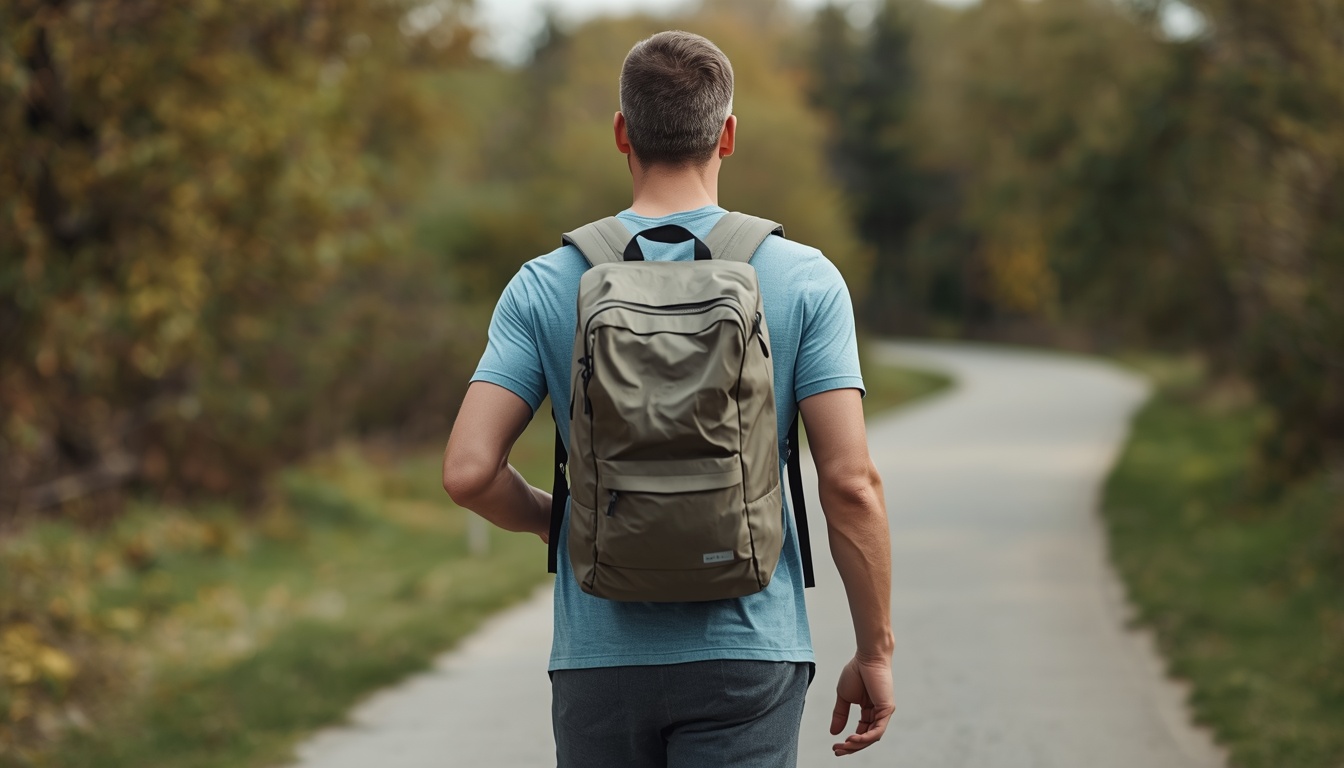
- Walk with a light backpack once or twice a week. Keep the load modest and high on the back. Use both straps.
- Carry groceries in a suitcase-carry: one heavy bag at the side, shoulder packed down, ribs quiet, walk 40 to 80 meters, switch hands.
- Hang from a bar for 10 to 20 seconds if your shoulders tolerate it. Let the blades upwardly rotate instead of shrugging into the ears.
- Reach a high shelf with the arm long and the shoulder blade sliding, not with a cringe toward the ear.
- Practice a low shrug and a slow drop. Lift the shoulders toward the ears on purpose, then spend three seconds lowering them. The lowering is the part desk life skips.
- Look at the horizon when you walk. A lifted gaze helps the girdle settle. See also why your neck still expects a horizon.
If a movement stings sharply into the arm, makes the hand tingle, or reproduces true nerve pain, stop and get a professional look. “Give the trap a job” is not a treatment plan for a pinched nerve or an acute disc problem.
Myths vs Facts
Myth: Strong upper traps are the goal.
Fact: Balanced traps are the goal. Upper fibers that never lengthen and lower fibers that never work are a common source of the “coat-hanger” ache.
Myth: Stretching the neck for two minutes fixes the problem.
Fact: Stretching can feel good. Without a new job for the scapula and a reason to drop the shrug, the stretch is a brief rental.
Myth: Backpacks are bad for everyone.
Fact: Overloaded, low-slung, or one-shouldered bags are hard on growing spines and tired shoulders. A close-fitting, moderate pack on a walk is closer to the ancestral task than empty hands and a forward head.
Myth: If it hurts, the muscle should be left alone.
Fact: Irritable tissue needs dosing, not always rest in a slump. Gentle load and full-range lowering are often kinder than complete stillness — the same principle we use for joints that expect motion.
When to Worry
Most “tight traps” are mechanical and habitual. Get prompt care if neck or shoulder pain follows an injury, if you have fever and a stiff neck, if a headache is sudden and severe, if an arm becomes weak, or if pain runs below the elbow with numbness that is new and progressing. Unexplained weight loss, night pain that does not change with position, and a lump over the collarbone also belong in a clinic, not in a carry program.
A Simple Week of Pack Work
Think of this as exposure, not a challenge:
- Two walks with a light daypack, 20 to 40 minutes
- Three short suitcase carries in the kitchen or parking lot
- A few hangs or high reaches on days your shoulders feel friendly
- Hourly “drop the shoulders” cues while you work, paired with a look toward the far wall
That is enough for many people to feel the upper fibers stop humming by evening. If sitting is still the main event of the day, the pack cannot do all the work. The sits still have to be interrupted. Variety is the original program — the same idea as muscles that expect all-day variety.
FAQs
Should I stop stretching my upper traps?
No. Stretch after you have used the muscle as a stabilizer, not as the only intervention. A loaded walk plus a gentle side bend is more complete than a side bend alone.
Are kettlebell carries better than a backpack?
They are cousins. A pack spreads load across both shoulders and is easy to use on an ordinary errand. A carry is more intense and easier to dose in a gym. Both beat an empty, shrugged desk hour.
Why do massages feel amazing and then fade by Thursday?
Because the job posting did not change. The volunteer reported back to work. Give the lower trap and the carry pattern something to do between appointments.
Can kids use this idea?
Kids already carry packs. The useful adult lesson for them is fit and weight, not more load. Straps on both shoulders, a bag that sits high, and a weight that is a small fraction of body weight remain the sensible rules.
What if hanging hurts the shoulders?
Skip hanging. Use high reaches, wall slides, and light carries instead. Pain that pinches at the front of the shoulder with elevation deserves a look at the rotator cuff and scapular rhythm, not a tougher hang. See why the rotator cuff still expects reaching behind.
Conclusion
The trapezius is not a villain that shortened out of spite. It is a carrying muscle waiting for a carry. Desk life asked it to hover. Gym shrugs asked it to thicken. Neither is the old job. A modest pack, a grocery carry, a hang, and a deliberate drop of the shoulders put the sheet back to work the way it was built to work — as a stabilizer for a body that still knows how to haul things through the world.