
The tibialis anterior is designed to control how your foot lowers after each step. Flat floors and cushioned shoes often leave this shin muscle under-challenged, which can lead to fatigue, stiffness, or that familiar front-of-shin ache.
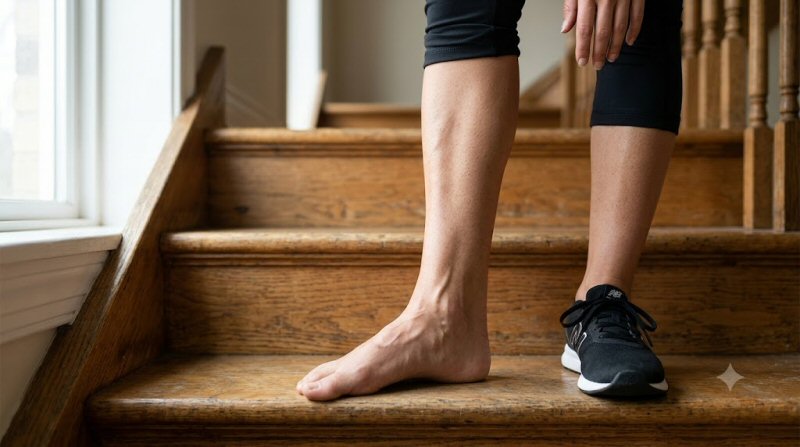
You notice it most after a long day on hard floors or when you finally take a walk on uneven ground. A tight, almost burning sensation runs down the front of your shin, or your foot feels a little clumsy when you try to lift it. The muscle responsible is the tibialis anterior—the long strap that runs along the outside of your shinbone and attaches near the top of your foot. It is built to control the precise lowering of your foot after each heel strike. When that controlled drop disappears from daily life, the muscle has less reason to stay ready.
What This Feels Like
The sensation is usually a dull ache or fatigue along the front and outer side of the lower leg, sometimes with a mild pull when you walk uphill or simply lift your toes. It can show up as stiffness first thing in the morning or after sitting, then ease once you start moving. Some people describe it as the front of the shin “complaining” after a day in supportive shoes on concrete. It is rarely sharp or sudden; more often it is a quiet, accumulating tightness that makes the next step feel slightly less automatic.
Common Causes in Modern Life
Most of us now walk on surfaces that are almost perfectly flat. Sidewalks, office floors, and gym tracks ask very little of the small adjustments the tibialis anterior used to make on dirt, roots, or uneven trails. Cushioned shoes further reduce the need for active control at the ankle. The muscle still fires, but the eccentric work—the slow, controlled lengthening that happens right after heel contact—is minimized. Over weeks and months that reduced demand can leave the muscle less resilient, so ordinary walking starts to feel effortful.
Desk jobs compound the pattern. Hours of sitting keep the ankle in a fixed position; when you stand, the first few steps require a sudden return to active dorsiflexion. The muscle is asked to switch from quiet to precise control without a gradual warm-up. The result is often that familiar front-of-shin fatigue by late afternoon.
Why This Happens
Human gait evolved on varied terrain where the foot needed constant, subtle control. After the heel touches down, the tibialis anterior lengthens under load to lower the forefoot gently rather than letting it slap the ground. Biomechanists such as Jacquelin Perry mapped this phase in detail: the muscle works eccentrically to decelerate plantarflexion and keep the foot stable as weight transfers forward. On irregular ground that control also helps you adjust to small changes in slope or surface compliance.
Modern environments remove most of those small surprises. The muscle receives less of the daily, low-level loading it is calibrated for. Over time the neuromuscular pattern becomes less precise, and the tissue itself can become less tolerant of even ordinary eccentric work. The same mismatch appears in other lower-leg tissues; the shins still expect soft landings and the ankles still expect uneven ground for related reasons.
Less Common but Serious
True compartment syndrome, stress fractures, or nerve entrapment can produce front-of-shin pain, but they usually bring additional signs: marked swelling, progressive weakness, numbness that persists, or pain that worsens rather than eases with light movement. These are uncommon in the absence of a recent rapid increase in running volume or trauma. The everyday version linked to under-use is far more frequent and typically responds to simple changes in loading.
Hidden Triggers
Sudden changes in footwear—moving from a higher drop shoe to a flatter one, or starting barefoot-style walking without a gradual transition—can overload a tibialis anterior that has grown unaccustomed to the demand. Walking or running only on the treadmill, which provides a perfectly consistent surface and a slight forward assist, further reduces the eccentric challenge. Even tight calves or limited ankle dorsiflexion can shift extra work onto the front of the shin as the body tries to clear the foot during swing.
When to Worry
Seek professional assessment if the ache is accompanied by visible swelling that does not settle overnight, if you cannot lift your foot against gravity, if numbness or tingling spreads into the foot, or if pain continues to intensify over several days despite rest and simple activity modification. Pain that wakes you at night or is sharply localized to a single spot on the bone also deserves attention. In the absence of those features, the more common pattern is manageable with gradual reintroduction of the movement the muscle expects.
Myths vs Facts
Myth: Front-of-shin pain always means shin splints that require complete rest.
Fact: Many cases are simple under-use fatigue. Complete rest often leaves the muscle even less prepared for the next bout of walking.
Myth: You need special orthotics or a high-drop shoe to protect the shin.
Fact: While a temporary shoe change can help during a flare, long-term resilience usually improves when the muscle is gradually asked to control the foot again on varied surfaces.
Myth: Stretching the front of the shin is the main solution.
Fact: Light stretching can feel relieving, but the muscle primarily needs controlled eccentric loading and regular daily use, not just passive lengthening.
How to Manage
Start with short bouts of walking on surfaces that are not perfectly flat—grass, packed dirt, or even a gently sloping driveway. Keep the pace easy and the duration brief at first so the tibialis anterior can relearn the controlled drop without overload. A few minutes of slow heel walks (walking on your heels with toes lifted) can remind the muscle of its job, but stop if the front of the shin begins to burn sharply.
During the day, stand and take a few deliberate steps every hour rather than remaining seated for long stretches. If you wear very cushioned shoes most of the time, alternate with a pair that has a lower drop for short indoor walks so the ankle must participate more. Strengthening can be as simple as seated toe raises against light resistance, focusing on a slow lowering phase. Consistency matters more than intensity; the goal is to restore the frequent, modest loading the muscle evolved to handle.
Related patterns appear when other parts of the lower leg are under-challenged. The calves still expect hills and stairs for their own reasons, and restoring variety across the whole chain often reduces the isolated front-of-shin complaint.
When to See a Doctor
Contact a clinician if the discomfort persists beyond two weeks of gradual activity changes, if you notice progressive weakness or foot drop, or if pain is accompanied by redness, warmth, or swelling that suggests inflammation beyond ordinary muscle fatigue. A sports-medicine physician or physical therapist can assess gait, ankle mobility, and muscle strength and rule out less common causes. Most people with the everyday version improve once daily movement once again includes the controlled foot lowering the tibialis anterior is built for.
FAQs
Why does the front of my shin hurt after walking on concrete?
Concrete offers almost no give and very little variation. The tibialis anterior performs less of its usual eccentric control, then feels the difference when any extra demand appears.
Is it normal for the shin to feel tight in the morning?
Yes. Overnight stillness lets the muscle and surrounding fascia settle into a shortened, less fluid state. A few minutes of gentle walking usually restores the normal glide.
Can supportive shoes cause this problem?
They can contribute. Shoes that heavily cushion and control the foot reduce the daily work the tibialis anterior is meant to do, so the muscle becomes less tolerant of ordinary walking.
Should I stop walking if the front of my shin aches?
Complete rest is rarely necessary. Shorten the distance, choose a softer or more varied surface, and slow the pace. The muscle usually recovers faster when it continues to receive gentle, controlled loading.
Does this get worse with age?
The underlying mismatch is present at any age, but reduced daily variety and longer periods of sitting can make the under-use more noticeable over time. Regular short walks on mixed surfaces help maintain the muscle’s readiness.
Conclusion
The tibialis anterior is not a muscle that thrives on perfect flatness and constant support. It is calibrated for the small, repeated act of lowering the foot with control after each heel strike. When modern surfaces and shoes remove most of that work, the muscle can grow quietly less capable, and ordinary steps begin to register as fatigue or tightness. Restoring brief, regular exposure to varied ground and simple controlled movements usually brings the sensation back into the range the body expects. The shin is simply waiting for the controlled drop it was built to manage.


