
The temporalis still expects a side-to-side chew on fibrous food. Soft meals and a screen clench leave the temple muscle short and tired, then a steak or gum aches.
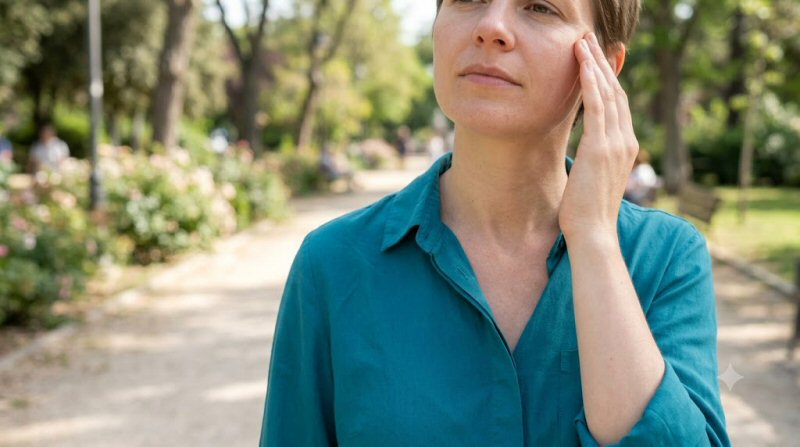
The ache sits in the temple, just above the cheekbone and in front of the ear, and it often shows up at the wrong moment. A bagel that is tougher than usual. A stick of gum that lasts through a meeting. A night of teeth lightly together at a laptop, then a morning where the side of the head feels used. The muscle under that spot is the temporalis, a broad fan on the side of the skull that lifts and pulls the jaw back. It still expects a rhythmic side-to-side chew on food that actually needs grinding. A soft modern meal, followed by hours of a quiet clench, gives it the opposite job.
That mismatch is common, and it is usually muscular. The temple can feel tired, tight, or tooth-achy without a cracked molar or a migraine. It is not the same as a sudden one-sided headache with vision change, a locked jaw that will not open, or pain after a blow to the face. Those need a clinician. A temple that complains after gum, a tough crust, or a long screen day is usually the older chewing pattern showing up late.
What This Temple Ache Feels Like
People describe a dull band from the temple toward the upper teeth, or a tired burn that builds while they chew on one side. Some notice it only when they press the hollow above the zygomatic arch, where the muscle belly is thin and easy to find. Others feel the jaw wants to rest slightly forward, or that opening wide for a yawn tugs at the same spot. Clenching during concentration is easy to miss until the teeth separate and the temple throbs.
The pain is easy to misfile as a sinus headache or an eye strain headache. The temporalis refers into the temple, the eyebrow, and the upper teeth, a pattern Janet Travell mapped in the trigger-point literature and that clinicians still use as a clinical map, not as a complete explanation. A true sinus ache usually comes with congestion and facial pressure that changes when you bend. Screen-related eye ache sits behind the eyes and eases when the gaze goes long. Temporalis ache tracks with chewing, clenching, and palpation of the muscle itself.
It also differs from the click of a jaw joint. A click on opening is usually the disc shifting. Temporalis pain can sit beside that click, or appear with a perfectly quiet joint. The muscle and the joint share a neighborhood. They do not share a single cause.
What the Muscle Was Built to Do
The temporalis fills the temporal fossa and narrows into a tendon on the coronoid process of the mandible. Anterior fibers run nearly vertical and close the jaw. Posterior fibers run more horizontal and retract it, pulling the chin back after the jaw has slid forward. Theo van Eijden’s anatomical work on the jaw closers described that fan as several functional parts, not one simple strap. During a real chew those parts take turns.
William Hylander’s electromyography in primates, and the human chewing studies that followed from researchers such as Alan Hannam and Charles Gibbs, showed a sided pattern. On the working side, where the food is, the jaw closers fire as the teeth come together. On the balancing side they fire too, but the timing and the force are not identical. The motion is not a straight up-and-down bite. It is a lateral swing, a grind, and a return. Fibrous plants, dried meat, and seeds asked for many of those cycles. The temporalis was built for that repetition, with rest between meals, not for a single hard clamp held for an hour.
Why a Soft Day Leaves It Sore
Daniel Lieberman and others have argued that a soft, processed diet under-loads the jaws that human faces still grow around. Stavros Kiliaridis showed in animal feeding studies that a soft diet changes masticatory muscle size and the way the jaws are used. The everyday version is quieter. Yogurt, bread without crust, and meals eaten in a few bites never recruit the posterior temporalis for a real retract-and-grind. The muscle stays capable. It just stops getting the motion it was paced for.
The modern substitute is often a clench. Screen work, driving, and concentration bring the teeth into light contact without food between them. Jeffrey Okeson’s clinical accounts of masticatory muscle pain treat that low-level isometric hold as a common driver of temple and masseter soreness. A clench loads the anterior temporalis in a shortened position. It does not glide. It does not share the work with a bolus. By evening the same muscle that skipped its side chew is fatigued from a job it was not built to hold.
Then a normal hard food arrives. A crust, a steak, or prolonged gum asks for the lateral grind all at once. The under-used posterior fibers and the over-held anterior fibers both protest. That is the same pattern as jaw ache after gum: the muscle can chew, but it cannot chew for an hour on one side after a day of almost not chewing at all. The jaw that still expects tough food is the larger story. The temporalis is the temple chapter of it.
Less Common but Serious Causes
Temple pain is not always the muscle. Giant cell arteritis in adults over about fifty can cause a new one-sided temple headache, scalp tenderness when brushing hair, jaw pain on chewing that is truly vascular rather than muscular, and visual symptoms. That is an emergency, not a chewing mismatch. Dental infection, a cracked tooth, and sinus disease can also refer into the same region. A temporalis explanation fits a sore muscle that you can press, that tracks with clench or chew, and that eases when the jaw rests. It does not fit fever, swelling in front of the ear, or a bite that suddenly will not close.
Sleep bruxism can overlay the daytime pattern. Frank Lobbezoo and Gilles Lavigne have separated sleep grinding from waking clench: one is a sleep-related movement, the other is a habit while awake. Either can leave the temporalis sore at breakfast. A night guard may protect teeth. It does not restore a side chew, and it does not fix a daytime tooth-together habit by itself.
Hidden Triggers
Chewing on one side only, often because a tender tooth or a recent filling makes the other side shy, trains one temporalis and ignores the other. A large gulp of ice water is harmless. An hour of gum is not. A desk that puts the head forward increases the work of holding the jaw, because the mandible hangs and the closers steady it. Caffeine and a skipped meal do not create the mismatch, but they make a light clench easier to sustain. Cold wind on the temple can make an already irritable muscle feel sharper without being the cause.
Posture matters more than people expect. A phone in the lap flexes the neck and often pairs with a slight jaw jut. Posterior temporalis fibers, whose job is retraction, then sit in a lengthened argument with a forward chin. The ache is blamed on stress. Stress may raise the clench. The missing side chew is what left the muscle unprepared.
When to Worry
Get urgent care for a new temple headache after about age fifty with scalp pain, jaw fatigue on chewing, or any change in vision. Also seek care for a jaw that locks open or shut, swelling in front of the ear, fever, pain after trauma, or tooth pain with a bad taste or a raised bite. Numbness of the face, a droop, or a headache that is the worst of your life is not a temporalis story.
A temple ache that you can point to, that follows gum or a tough meal, and that settles over a day or two of easier chewing is the ordinary pattern. If it is present most mornings for several weeks, or if opening is steadily shrinking, a dentist or a clinician who treats jaw muscle pain should see it. Morning soreness has its own sleep and clench checklist, and it overlaps this one.
Myths vs Facts
Myth: Temple ache after chewing means the jaw joint is damaged.
Fact: A tender temporalis can hurt with a quiet joint. Clicking is a separate disc story. Muscle pain is the more common everyday finding in clinic series of jaw pain.
Myth: A soft diet rests the muscle, so it should feel better.
Fact: A few days of softer food can calm a flare. A permanent soft diet removes the side chew the muscle expects, and the clench often stays. Rest is a pause, not a lifestyle.
Myth: If you are not grinding audibly, the temporalis is idle.
Fact: Waking tooth contact without noise is enough. Many people only notice when they unclench and the temple pulses.
Myth: Gum strengthens the jaw, so more is better.
Fact: Brief chewing can be useful. Prolonged one-sided gum is an endurance test the muscle did not train for. Farella and Michelotti’s work on gum and jaw muscle fatigue is the practical warning.
How to Give It the Chew It Expects
Keep the teeth apart during the day. The rest position is lips closed, teeth slightly separated, tongue quiet on the palate. A sticky note on the monitor works better than a lecture. When you notice a clench, unclench once and let the jaw hang for a breath. Do not stretch the mouth open to the end of range while it is sore.
Put a real chew back in one meal. A crisp apple, a piece of meat that needs grinding, or a raw vegetable, eaten on both sides, is closer to the pattern Hylander described than a smoothie. Ten to twenty deliberate chews per bite is enough. You are not training for a contest. You are reminding the posterior fibers to retract and the anterior fibers to close in a cycle, then stop.
Skip marathon gum while the temple is irritable. If you use gum, keep it to a few minutes and switch sides. Warmth on the temple, not a hard massage on a hot spot, usually settles a flare. A short walk with the jaw loose beats another hour of teeth together. If nights are the problem, ask a dentist about a guard after they have looked at the teeth, and still treat the daytime habit. Guards do not chew for you.
When to See a Doctor
See a dentist or physician if temple pain lasts more than a couple of weeks, if opening is getting smaller, if a tooth is tender to biting, or if you wake with a headache that is clearly in the muscle and is not improving. Mention one-sided chewing, gum use, and whether the teeth meet during work. Imaging is rarely the first step for a muscle you can press and that tracks with clench. It matters when locking, trauma, or a suspected joint problem changes the story.
FAQs
Why does the temple hurt if the jaw joint does not click?
The temporalis can fatigue on its own. Closing and clenching load the muscle belly and its tendon on the coronoid process even when the disc is quiet. A click is optional, not required.
Is a side chew different from biting straight down?
Yes. A straight bite mostly uses vertical closers. A side chew adds lateral grind and jaw retraction, which recruits the posterior temporalis. Soft food rarely asks for that second part.
Can screen work really tire a chewing muscle?
It can, if the teeth stay in contact. The load is small but long. Isometric holds fatigue postural fibers that were built for rhythmic work with rest between meals.
Should I avoid all chewy food?
Only during a sharp flare. A permanent soft diet is how the mismatch continues. Return to moderate chewing on both sides once pressing the temple is only mildly sore.
Does this mean I have a migraine?
Not by itself. Migraine often brings nausea, light sensitivity, or a one-sided throb that is not tender to a finger on the muscle. Muscle pain and migraine can coexist. A new pattern, especially with visual change after midlife, should not be self-labeled.
Will a night guard fix the temple ache?
It may protect enamel and reduce some sleep load. Daytime tooth contact and a missing side chew still need a habit change and a real meal. Many people need both, not the guard alone.
Conclusion
The temporalis still expects a side-to-side grind, a retract, and a rest. Soft meals skip the grind. Screen hours replace it with a clench. The temple ache after gum or a crust is that gap, not a failing joint in most ordinary cases. Separate the teeth during the day, chew both sides of something that needs chewing, and treat a new one-sided temple headache with vision change as a different problem. The muscle is not asking for a harder life. It is asking for the motion it already knows.


