
Prolonged stillness loads the discs and ligaments in ways your spine never evolved for. Frequent small posture shifts help fluid move and muscles rest.
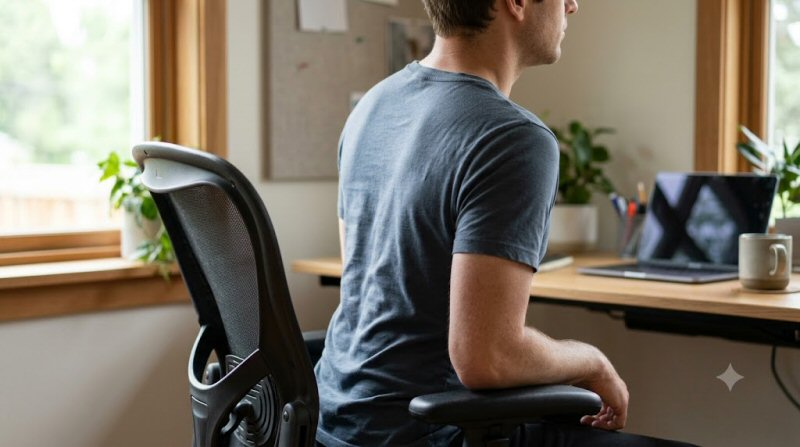
You settle into a chair for a long meeting or a focused stretch of work. Twenty minutes later your lower back feels heavy. Forty minutes later the stiffness has crept higher. You shift, stand for a moment, or lean sideways, and the pressure eases. That small relief is not random. Your spine is built for frequent position changes, and modern stillness asks it to do something it rarely practiced for most of human history.
What Prolonged Stillness Feels Like
The sensation is usually a dull ache or tightness across the lower back that builds slowly. Some people notice it more between the shoulder blades after hours at a desk. Others feel a vague sense that their back is “locked” until they stand and walk a few steps. The discomfort often improves within minutes of changing position and rarely wakes people at night when it is purely postural.
It is different from sharp, sudden pain that follows a twist or lift. Postural stiffness tends to appear after sustained sitting or standing and fades once the spine is allowed to move through a new angle.
Why Your Spine Still Expects Movement
For most of evolutionary time, people did not sit in one chair for hours. Even when they rested, they changed postures. Observations of present-day hunter-gatherer groups, such as the Hadza, show that non-ambulatory time is often spent squatting, kneeling, or sitting on the ground—postures that keep more muscle activity than a typical office chair. David Raichlen and colleagues described this pattern as “active rest” in a 2020 study. The total time spent not walking was similar to industrialized populations, yet the postures themselves involved more continuous low-level muscle work and frequent small adjustments.
A chair removes those adjustments. The lumbar spine is held in a relatively fixed position. Intervertebral discs, which have no direct blood supply, rely on pressure changes to move fluid and nutrients. Alf Nachemson’s classic measurements of intradiscal pressure showed that different postures alter the load inside the disc, and that motion itself helps fluid exchange. When posture stays constant, that exchange slows.
Ligaments and the outer layers of the disc also exhibit viscoelastic creep. Stuart McGill and colleagues documented that prolonged flexion allows the spine to creep further into the flexed position; recovery of normal stiffness takes longer than the time spent flexed. Even modest, repeated shifts reduce the cumulative effect. In short, the tissues that support your spine are designed for intermittent loading and unloading, not continuous static compression.
Common Modern Triggers
Several everyday situations make the mismatch obvious:
- Desk work or meetings where you remain seated for more than 30–45 minutes without standing or shifting.
- Long drives or flights where the seat fixes your pelvis and lumbar curve.
- Standing in one place (cashier, kitchen prep, waiting in line) without weight shifts or short walks.
- Soft couches or chairs that let the pelvis roll backward, increasing flexion and reducing the natural lumbar curve.
- High-focus tasks (coding, reading, video calls) that suppress the small fidgeting movements people make when less engaged.
The common thread is the absence of the micro-movements and posture changes that were normal when people moved between squatting, kneeling, sitting on the ground, and standing throughout the day.
When Stillness Becomes a Problem
Occasional stiffness after a long sit is common and usually harmless. Consider further attention if:
- The ache becomes sharp, travels down one leg, or is accompanied by numbness or weakness.
- Pain persists for days after the activity ends, or wakes you at night.
- You notice progressive difficulty standing fully upright after sitting.
- The same pattern is linked to a recent injury, fever, or unexplained weight loss.
Most posture-related discomfort improves with movement and does not require imaging. Persistent or neurological symptoms warrant a medical evaluation to rule out other causes.
Myths vs Facts
Myth: You must maintain perfect posture all day.
Fact: No single “perfect” posture exists. Frequent change matters more than holding any one position.
Myth: Sitting is always worse than standing.
Fact: Both prolonged sitting and prolonged standing can load tissues. Alternating between them, and adding small movements within each, is more protective than choosing one exclusively.
Myth: A special chair or lumbar roll fixes the problem.
Fact: Support can reduce extreme postures, but it does not replace the need for occasional position changes and walks.
Practical Ways to Give Your Spine What It Expects
Small, regular shifts are more useful than rare, large breaks:
- Stand or walk for 1–2 minutes every 30–45 minutes of sitting. Even a short trip to refill water counts.
- While seated, shift your weight from one sit bone to the other, lean slightly forward then back, or perform a gentle pelvic tilt every few minutes.
- When standing still, rock from heel to toe or take a few steps in place.
- After a long flexed period (driving, deep desk work), spend a minute standing tall and walking before lifting or twisting.
- Vary your seating surfaces when possible—chair, stool, floor cushion—so the lumbar curve and hip angle change.
These habits recreate the intermittent loading your discs and ligaments evolved with. They also reduce the continuous low-level muscle effort that leads to fatigue.
Related reading on the site includes how your spine still expects you to walk more than you sit, why your discs still expect walking and a night unload, and what happens when your lower back aches after standing still.
Frequently Asked Questions
How often should I change position?
Every 20–45 minutes is a practical range for most people. The exact interval matters less than avoiding multi-hour stretches of complete stillness.
Does fidgeting help?
Yes. Small shifts in weight, pelvic tilts, and brief leans change pressure on the discs and give muscles brief rest periods. They are not a substitute for standing and walking, but they are better than remaining frozen.
Is standing all day the solution?
No. Prolonged standing also loads the spine and legs. The advantage comes from alternating positions and adding movement within each posture.
Will a standing desk fix back stiffness?
It can help if you use it to change positions regularly. Standing still for hours creates its own set of complaints. The benefit is in the variation, not the height of the desk.
Why does my back feel better after a short walk?
Walking introduces cyclic loading that helps fluid move through the discs, reduces sustained muscle tension, and restores a more neutral lumbar curve after prolonged flexion.
Conclusion
Your spine is not fragile, but it is not designed for hours of fixed posture either. The discs, ligaments, and supporting muscles expect the frequent small changes that were normal when people moved between varied resting positions and walking. Modern chairs and focused work remove those changes. Restoring them—through short walks, simple shifts, and occasional posture variety—reduces the cumulative load without requiring a complete redesign of your day. The stiffness that appears after a long sit is often just your spine asking for the movement it still expects.


