
The serratus anterior still expects a push and an overhead reach that keeps the shoulder blade on the ribs. Desk days leave it quiet, then a high shelf feels weak.
Reach into the back of a high cupboard and the shoulder can feel oddly soft. The arm goes up, then the blade on that side seems to float, or a dull ache sits under the armpit and along the ribs. Push a heavy door and the same side tires before the chest does. None of that has to be a torn cuff. A broad, thin muscle on the side of the rib cage was built to pin the shoulder blade to the ribs every time you pushed, reached, or climbed. Most desk days never ask it to.
That muscle is the serratus anterior. Its name comes from the saw-tooth slips that run from the upper ribs into the inner border of the scapula. You cannot see most of it. You notice it when it is late to the job.
What a Quiet Serratus Feels Like
It is rarely a sharp pop. More often the shoulder feels unstable at the end of a reach. A bag strap digs in, and the blade on that side sits a little higher or wings out when you push against a wall. After a long typing day the ache is under the armpit, not in the neck knot people already know. Some people feel a catch when they roll onto that shoulder in bed. Others notice that a push-up, even from the knees, collapses at the shoulder before the arms give out.
A true wing is obvious: the inner edge of the blade lifts off the ribs like a small fin when the arm reaches forward. A smaller lag is easier to miss. The blade is slow to rotate upward, so the arm feels blocked around shoulder height even though the joint itself is fine. That lag is what a lot of “I just slept on it wrong” mornings actually are.
What the Serratus Was Built to Do
The scapula is not glued to the back. It slides on the rib cage. To lift the arm overhead, the blade has to rotate up and stay flush. Verne Inman’s classic shoulder studies in the 1940s described that partnership: the glenoid, the socket, has to turn upward as the arm rises, or the cuff and the bursa get pinched under the shelf of the acromion. The serratus anterior, working with the trapezius, is the upward rotator that makes the socket follow the arm.
It is also the muscle that protracts the blade, drawing it forward around the ribs when you push. Punching, bracing a fall, shoving a branch aside, pressing up from the ground: all of those load the serratus. Florence Kendall’s muscle-testing work treated a strong serratus as the difference between a blade that stays on the ribs and one that wings. Donald Neumann later summarized the same mechanics for clinicians: without serratus force, the scapula tips and the arm loses a stable base.
Ancestral loading was not a set of push-ups. It was mixed. Reaching into a tree, pushing off the ground, carrying a child on one hip, bracing while pulling. The serratus expects brief, fairly strong contractions spread through the day, then a rest with the arm hanging. It does not expect eight hours with the blade parked forward and the muscle barely asked to hold.
Why a Desk Leaves It Late
Sitting with the arms in front of the body shortens the small muscle under the collar, pectoralis minor, and lets the blade tip forward. Paula Ludewig’s shoulder-impingement research found that people with painful reaching often have less upward rotation and more anterior tilt of the scapula. The serratus is the muscle that should oppose that tip. If it is under-recruited, the cuff works in a smaller space. The ache then gets blamed on the rotator cuff, which is downstream of a blade that never got a stable platform.
Shirley Sahrmann’s movement work made the same point in plain language: the shoulder problem often starts at the scapula. W. Ben Kibler called the resulting pattern scapular dyskinesis, a visible change in how the blade moves, not a diagnosis by itself. Dyskinesis can be a habit. It can also be a nerve. The long thoracic nerve, described in winging cases since Charles Bell, runs a long exposed course to the serratus. A stretch, a blow to the side of the neck, or sometimes a viral illness can quiet the muscle for weeks. That is a different problem from a desk that simply never asks for a push.
Electromyography helps separate the two. Michael Ekstrom’s work on common rehab exercises found high serratus activity in a push-up plus, the extra reach at the top of a push-up, and in a dynamic hug. John Decker’s shoulder EMG studies found a similar pattern: the plus, not just the bend of the elbow, is what recruits the saw-tooth muscle. A day of mouse clicks does not.
The mismatch shows up in ordinary rooms. A high shelf is an overhead reach with no warm-up. A heavy suitcase is a protracted load on one side. A yoga class that starts with chaturanga asks for the very force the week never trained. The muscle is not weak in the way a cast makes a thigh weak. It is late, and the cuff and the neck try to cover.
Hidden Triggers That Make the Same Ache
A few everyday inputs pile onto the same blade.
Hours of one-sided reaching, as in a checkout lane or a laptop used on a sofa arm, train one serratus and ignore the other. The lag shows up on the quiet side.
A heavy bag on one shoulder keeps the upper trapezius on and the blade elevated. The serratus never gets the long, low hold of a two-handed push.
Mouth breathing and a slumped rib cage change the ribs the muscle attaches to. A stiff thoracic spine, the segment that should rotate when you walk, leaves the scapula with less room to glide. The ribs and the blade are a pair. If you have felt your upper back complain on a long drive, that is the same neighborhood: why your upper back still expects reaching and pulling.
True nerve injury is the hidden one worth naming. Sudden winging after a stretch, a sports collision, or a recent illness is not a posture story. Strength on that side drops for reaching forward, and the inner border lifts clearly off the ribs. Most desk aches are not this. The few that are need a clinician, not another stretch.
When to Worry
Most reach aches settle when the blade is given a daily push and the desk is broken up. Some patterns should not be waited out.
Worry if the inner edge of the shoulder blade lifts off the ribs and stays winged, especially if it appeared after an injury or illness. Worry if reaching forward is truly weak, not just tiring, or if you cannot lift the arm overhead without the blade jumping. Worry if there is numbness, neck pain that shoots down the arm, or night pain that wakes you and is not explained by a new pillow. A fever, unexplained weight loss, or a shoulder that swells is not a serratus story.
Chest pain, sudden breathlessness, or pain into the jaw with a reach is not a shoulder-blade problem. Treat that as urgent.
Myths vs Facts
Myth: A winging shoulder blade always means a trapped nerve. Fact: Clear winging after trauma or illness can be long thoracic nerve injury, the pattern Bell described. A small lag after a desk week is usually under-use. The test is weakness and a visible lift of the inner border, not a general ache.
Myth: Shoulder pain means the cuff is torn. Fact: Inman showed the cuff and the scapula share the job. Ludewig and Kibler showed that a poorly rotating blade narrows the space the cuff uses. Many reach pains improve when the serratus and the upward rotators are trained, without a tear ever being present.
Myth: Stretching the chest is enough. Fact: A tight pectoralis minor can tip the blade, and that muscle has its own modern problem, covered in why your pectoralis minor still expects a reach. Length without a serratus push leaves the blade with nothing to hold it on the ribs. Kendall’s testing and Ekstrom’s EMG both point at a push with an extra reach, not only a doorway stretch.
Myth: You should pin the shoulder blades down and back all day. Fact: The serratus protracts and upwardly rotates. Permanent retraction overworks the rhomboids, which have a different job, described in why your rhomboids still expect you to row. The blade needs both a push and a pull, not a frozen “back and down.”
How to Give It the Push It Expects
The dose is small and frequent. Ancestral use was not a workout block.
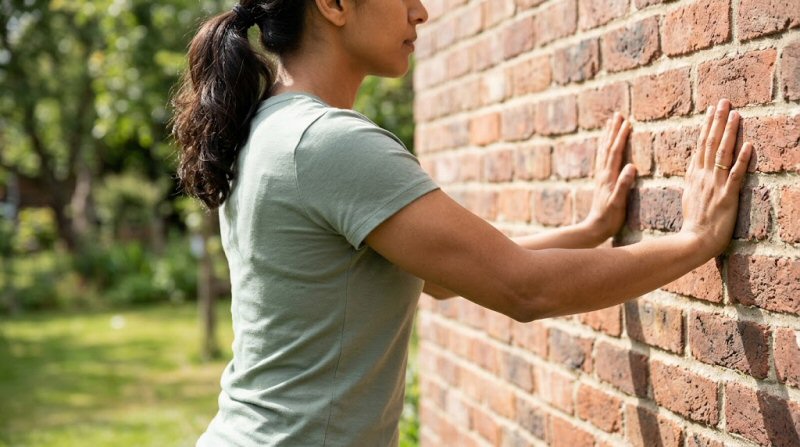
A few times a day, stand at a wall or a counter, hands at shoulder height, and push the chest away so the blades glide forward around the ribs. That is the plus. Ten slow pushes are enough. If the inner border wings, shorten the range until it stays flush.
Once that is easy, a knee push-up with the same extra reach at the top matches the exercise Ekstrom and Decker found most selective. Stop before the hips sag or the blades leap.
Overhead reach belongs in the same day. Place a light object on a shelf you can reach without shrugging to your ears. The shrug is upper trapezius covering for a serratus that has not joined. A slow reach, blade moving up and around, is the pattern Inman described.
Hang from a bar or a sturdy tree branch for a few breaths if the shoulders allow it. A passive hang lets the blade settle; a gentle active hang asks the serratus and the lower trapezius to hold. That is the other half of scapular life, the one in why your scapulae still expect you to hang.
Break the parked position. Every half hour, stand and reach one arm forward, then overhead. Carry a bag in the hand sometimes, not always on one shoulder. Sleeping on the sore side all night keeps the blade compressed; a brief change of side is enough for most people.
Skip aggressive stretching of a winged side. If the nerve is quiet, forcing the blade flat does not wake it. Strength returns over weeks to months in many long thoracic cases, and a clinician should guide that, not a hard gym session in week one.
When to See a Doctor
See someone if winging is new and obvious, if forward reaching is weak, or if the ache lasts beyond a few weeks of simple wall pushes. A sports clinician or physiotherapist can test the serratus against the rhomboids and the trapezius and can tell a habit from a nerve. Imaging is rarely the first step for a desk lag. It matters more when trauma, true weakness, or night pain is in the story.
Sudden chest symptoms are a different door. Do not route those through a shoulder article.
FAQs
Why does my shoulder blade stick out when I push against a wall?
The serratus anterior is supposed to hold the inner border of the scapula on the ribs during a push. If it is under-used, or if the long thoracic nerve is not driving it, the border lifts. A small lag after desk weeks is common. A new, clear wing with weakness needs an exam.
Can a weak serratus cause a rotator cuff ache?
It can contribute. Inman, Ludewig, and Kibler all described a blade that fails to rotate upward, so the cuff and bursa meet the acromion sooner. Training the push often eases a reach ache that never showed a tear. True cuff tears still exist. Night pain and clear weakness on lifting are reasons to get checked.
Are push-ups the only way to wake it up?
No. Ekstrom and Decker found the extra reach at the top, the plus, mattered more than the elbow bend. A standing wall push with that reach is a fair daily dose. Floor push-ups are optional and should wait until the blade stays flush.
How is this different from tight rhomboids?
Rhomboids retract the blade, pulling it toward the spine. The serratus protracts it and rotates it upward. Pinching the blades together all day does not train the push. You want both, at different moments: a row or a hang, and a wall push.
How long before a desk shoulder feels steadier?
A habit lag often eases in two to four weeks of short daily pushes and fewer unbroken sitting hours. Nerve-related winging is slower, often months, and should be followed rather than forced.
Conclusion
The serratus anterior still expects a push, a reach, and a blade that stays on the ribs while the arm goes up. Chairs, keyboards, and one-shoulder bags rarely ask for that. The ache under the armpit and the soft feeling at a high shelf are what a late muscle feels like. A few wall pushes, an honest overhead reach, and a break from the parked blade give it the job it was built for. New winging, true weakness, or pain that is not a shoulder story still deserve a clinician. The everyday version is a mismatch, and it is trainable.


