
The pectoralis minor still expects brief forward reaches and a blade that tips back. Desk hours leave it short, then a high shelf pinches the front of the shoulder.
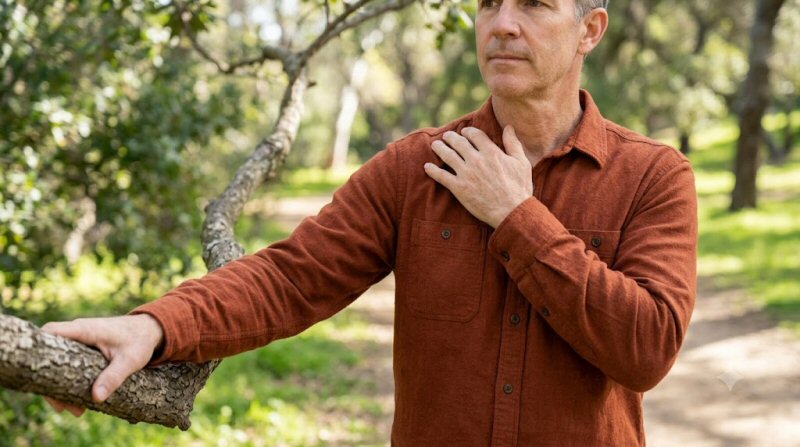
The pinch is easy to misplace. It sits just under the outer collarbone, or deep in the front of the armpit, and it shows up when you reach for a high shelf, buckle a seatbelt behind you, or try to lie flat with the arms open. The shoulder looks rounded even when you think you are standing tall. The muscle most often holding that shape is not the big chest muscle you can see in a mirror. It is the pectoralis minor, a thin triangular strap from the upper ribs to the coracoid, the little hook on the front of the shoulder blade.
That strap still expects short jobs. Reach forward to pull a branch. Brace on your hands to get up from the ground. Tip the blade for a moment, then let it settle back. A keyboard day asks for the shortened position and never the release. The ache that follows is usually a mismatch, not a torn tendon and not a heart warning. True chest pressure with exertion, a swollen arm, or numbness that keeps a finger asleep is a different story.
What This Front-Shoulder Tightness Feels Like
People describe a deep tug when they try to open the chest, as if a cord from the ribs will not let the shoulder blade lie flat. Reaching overhead can pinch at the front or top of the shoulder once the arm passes about ear height. Sleeping on the back with the arms out can feel impossible. Some notice the shoulder creeping forward in photos, or a shoulder blade that wings a little at the bottom corner when the arm lowers from a raise. Others feel it most after a long drive, one hand on the wheel, the same side of the chest quietly braced.
Janet Travell and David Simons mapped referral from the pectoralis minor into the front of the shoulder, the inner arm, and sometimes the ulnar fingers, a pattern that can mimic a neck nerve. The local signature is mechanical. It eases when the blade is allowed to tip back, and it returns when the shoulders stay rounded. It does not usually arrive with sweating, nausea, or pressure that spreads into the jaw. Those belong to chest pain that needs urgent care, not a muscle-length problem.
It is also easy to blame the pectoralis major, the broad fan that adducts and internally rotates the arm. The major is the surface muscle. The minor sits underneath, attaches to the shoulder blade rather than the arm bone, and changes how the blade sits before the arm ever moves. Florence Kendall separated the two in muscle testing for that reason. A tight major limits opening the arm out to the side. A tight minor limits the blade’s ability to tilt backward and rotate upward.
What the Muscle Was Built to Do
The pectoralis minor usually starts on the third, fourth, and fifth ribs, near the costal cartilage, and inserts on the medial border of the coracoid process. Donald Neumann’s kinesiology texts describe the actions cleanly. With the ribs fixed, it protracts the scapula, depresses it, and tilts it anteriorly, so the bottom of the blade lifts slightly off the rib cage. With the scapula fixed, it can lift the ribs and help a forced breath, which is why a hard climb or a braced push can recruit it as an accessory breathing muscle.
Those are brief, loaded jobs. Reaching into a bush, pushing off the ground, climbing, carrying a load against the chest, and taking a deep breath with the arms occupied all ask the minor for a short contraction, then a return to rest. The shoulder blade was not meant to live in anterior tilt. Upward rotation and a posterior tilt are what clear the arm overhead. Paula Ludewig’s scapular-kinematic work, with John Borstad and others, tied a shorter pectoralis minor to more anterior tilt and less upward rotation at rest. The blade starts the reach already tipped the wrong way. The space under the acromion narrows before the arm has done much work.
John Borstad measured resting pectoralis minor length and found shorter muscles in people with forward shoulder posture. Shirley Sahrmann had already described the same adaptive shortening in movement-impairment exams: a coracoid that sits forward, a blade that will not lie quiet on the ribs, and a reach that pinches. The muscle is doing an old job in a new schedule. The job was a reach. The schedule is now all day.
Why Desk Days Leave It Short
A screen places the hands in front of the body and the gaze down. The scapula follows the hands. Protraction and anterior tilt are exactly the pectoralis minor’s shortcut. Hold that shape for hours and the muscle does not need to be injured to feel tight. Muscle held short loses the habit of length. Connective tissue stiffens around the new resting position. The first overhead reach of the evening then asks for a range the tissue has not visited since morning.
Typing is not a reach in the ancestral sense. A real reach loads the serratus anterior to wrap the blade forward on the rib cage, then lets the rhomboids and lower trapezius bring it home. The shoulder blade still expects hanging and a full reach, not a quiet hover over a keyboard. When serratus and lower trapezius stay underused, pectoralis minor becomes the default protractor. Ann Cools and colleagues have described this imbalance in overhead athletes and in desk-side shoulders alike: too much anterior tilt, too little posterior tilt, and a blade that wings or dumps when the arm lowers.
The chest muscle people train in the gym can make the pattern worse if it is the only push they do. A bench press shortens pectoralis major and, if the shoulder stays shrugged and protracted, keeps the minor short too. The chest still expects a push off the ground, where the shoulder blade is free to slide on the ribs. A fixed bench removes that slide. The minor never gets the long side of its range.
Hidden Triggers
A strap over one shoulder is a small constant pull into elevation and protraction on that side. The minor and the upper trapezius share the day. Backpacks worn on both shoulders are kinder than a one-strap bag, but a heavy pack with the shoulders rolled forward still parks the coracoid in front.
Phone use stacks the problem. Elbows in, wrists up, chin down, shoulders crept forward. The minor is shortened and the neck extensors are lengthened. People often feel the neck first and miss the rib-to-coracoid cord underneath.
Stress breathing recruits it. When the belly stays braced and the breath moves up into the chest, the minor can join as an accessory inspiratory muscle, especially if the arms are fixed on a desk. Hours of that is a postural contraction, not a climb. Cold rooms add a shrug. The minor depresses the scapula while the upper trapezius elevates it, so the two can fight across the same blade.
Sleep position matters. Curling on one side with the shoulder rolled in keeps the minor short all night. Stomach sleeping with the arm overhead can irritate the front of the shoulder for a different reason, compression rather than shortening, and the morning pinch feels similar.
Less Common but Serious
A chronically tight pectoralis minor can narrow the space under the coracoid where the brachial plexus and the axillary vessels pass. Richard Sanders and others have described pectoralis minor syndrome as a form of thoracic outlet compression at that spot, separate from compression between the scalenes. Clues are arm heaviness, color change, swelling, or numbness that follows overhead work or a protracted posture and eases when the shoulder is allowed back. It is uncommon next to ordinary tightness. It is worth naming because stretching alone will not fix a vessel that is being kinked.
Front shoulder pain can also be a biceps tendon, an acromioclavicular joint, or a rotator cuff that is irritated because the blade will not rotate. The minor is often a contributor, not the whole diagnosis. Night pain that prevents sleep, true weakness lifting the arm, or pain after a fall needs a clinician, not another doorway stretch.
When to Worry
Ordinary minor tightness is dull, positional, and worse after sitting or driving. It should not come with chest pressure, breathlessness, sweating, or pain into the jaw or left arm during effort. Those are emergency symptoms until a clinician says otherwise.
Seek care promptly for a cold, pale, or swollen arm, a pulse that feels different from the other side, or numbness and weakness that are new and persistent. A pinch that follows a pop during a lift, or pain that keeps you from lying down at all, also deserves an exam. Fever with shoulder pain is not a posture story.
Myths vs Facts
Myth: A rounded shoulder means the pectoralis major is the only tight muscle.
Fact: The major can be tight, but anterior tilt of the blade is a pectoralis minor finding. Kendall’s length test watches the posterior acromion off the table, not the bulk of the chest.
Myth: You should stretch the chest hard every hour.
Fact: Aggressive doorway stretches can irritate the front of the shoulder if the arm is forced overhead while the blade is still tipped. Gentle opening, plus strengthening the muscles that tip the blade back, works better than yanking the coracoid.
Myth: If it hurts to reach up, the cuff is torn.
Fact: A short minor narrows the space the cuff passes through. Ludewig and Borstad showed the kinematic link. Many overhead pinches ease when the blade learns to tilt back, without a tear ever having been present.
Myth: Good posture means pinning the shoulders down and back all day.
Fact: The blade needs to protract for a real reach. The mismatch is living in protraction, not visiting it. Forcing a military posture all day just trades one isometric hold for another.
How to Give It the Reach It Expects
Break the hold before you chase flexibility. Every half hour, let the arms hang, then reach forward to something real, a shelf, a doorframe, a branch, and bring the blade home. A one-minute change of shape does more than a heroic stretch at midnight.
Open the minor without jamming the shoulder. Stand in a doorway with the forearm on the frame, elbow below shoulder height, and step through only until you feel a mild pull under the collarbone. Keep the shoulder down, not shrugged. Hold twenty to thirty seconds, and stop if the pinch moves into the joint itself. Borstad’s own length research is a reminder that the measurement is a resting position, not a prize for how far you can force the arm.
Train the opposite tilt. A wall slide, a prone Y with the thumbs up, or a light band pull-apart asks lower trapezius and serratus to rotate the blade up and tip it back. The shoulder still expects an overhead reach with the blade free to rotate, not pinned. Two or three slow sets most days is enough. Pain that sharpens as the arm rises is a signal to lower the range, not to push through.
Get up from the floor once a day if your wrists and shoulders allow. A slow push-up position, knees down, lets the blade slide the way a ground push always did. If the front of the shoulder complains, stay higher, hands on a counter, and think about wrapping the blade forward rather than sagging between the shoulders.
Check the bag, the screen, and the breath. Bring the monitor closer so you are not chasing it with a protracted shoulder. Switch a one-shoulder bag side to side, or use two straps. When you notice a high, tight breath, drop the shoulders on a longer exhale. The minor does not need to lift your ribs while you answer email.
When to See a Doctor
See a clinician if the pinch lasts more than a few weeks despite posture changes, if overhead reaching is getting weaker, or if you have arm swelling, color change, or night pain that will not settle. A physical therapist can measure pec minor length, watch the blade during a raise, and separate a muscle-timing problem from a cuff or a joint. Imaging is rarely the first step for a positional ache. It matters after trauma, true weakness, or symptoms that suggest a nerve or vessel.
FAQs
Is a tight pectoralis minor the same as a tight chest?
Not exactly. The pectoralis major is the chest muscle that moves the arm. The minor moves the shoulder blade. You can have one tight without the other, and doorway stretches hit them differently depending on arm angle.
Can this cause numb fingers?
It can contribute. Travell noted referral toward the inner arm and ulnar fingers, and a very tight minor can crowd the plexus under the coracoid. Brief tingling that leaves when you change position is common. Constant numbness, weakness, or a swollen arm needs an exam.
Should I stop pushing exercises?
No. Pushing is part of what the shoulder expects. Let the blade move, keep the shoulder from shrugging toward the ear, and balance pushes with reaches and rows. A bench press with a jammed, protracted shoulder is the pattern to change, not loading itself.
Why does it feel worse at the end of a desk day?
The muscle has been held short for hours. Length and blood flow return when you stand and reach, and the first movements are when you notice the cord. It is a timing problem more than an acute injury.
Does sleeping position matter?
Yes. A night curled with the shoulder rolled in keeps the minor short. Side sleeping with the arm supported slightly forward, or back sleeping with the arms on the ribs rather than stuck out wide, usually feels kinder by morning.
How long before the shoulder sits differently?
Resting posture shifts over weeks of fewer prolonged holds and a little daily blade work, not after one stretch. Borstad and Ludewig’s findings are about resting length and kinematics. Those change with habit, not with a single doorway session.
Conclusion
The pectoralis minor is a reach muscle that modern hours turned into a posture muscle. It still expects to tip the blade forward for a moment, then let it back. Screens, straps, and a braced breath keep the coracoid parked in front, so the first high shelf of the day pinches. Give it real reaches, a milder open at the doorway, and a blade that is allowed to tilt back. The cord under the collarbone usually softens once the job and the schedule match again.


