
Your semitendinosus evolved for deep, loaded knee flexion. Modern sitting leaves it underused—here’s why stiffness appears and what helps.
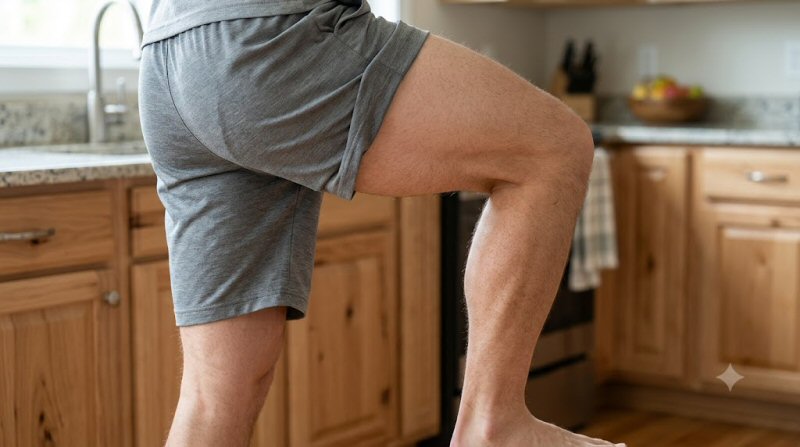
You stand up from a long meeting and feel a dull pull along the inner back of your thigh as the knee straightens. Or you crouch to pick something off the floor and notice the stretch is shorter than it used to be. That band is largely the semitendinosus—one of the three hamstring muscles on the back of the thigh—and it was built for frequent, loaded knee bends: deep squats, climbing, lifting from the ground, and the varied flexion that comes with moving across uneven terrain. Most modern days give it almost none of that.
What the Semitendinosus Actually Does
The semitendinosus is a long, slender muscle that starts on the ischial tuberosity (the sit bone) and runs down the medial back of the thigh to insert on the upper medial tibia via the pes anserinus, alongside sartorius and gracilis. It is one of the biarticular hamstrings, crossing both the hip and the knee.
At the hip it helps extend the thigh and, when the knee is flexed, can contribute to internal rotation of the thigh. At the knee it flexes the leg and, when the knee is already bent, internally rotates the tibia. Because its fibers are relatively long and it has a long distal tendon, it is well suited to excursion—producing force over a useful range of motion rather than pure peak force at one angle. Classic electromyographic work by researchers such as John Basmajian, and later angle-specific studies (including those by Onishi and colleagues), have shown that semitendinosus activity tends to rise at deeper knee-flexion angles compared with the other hamstrings. Its moment arm for knee flexion is also longer in the mid-to-deep range, giving it mechanical advantage precisely where ancestral postures often placed the knee.
In short, the muscle is both a knee flexor that likes depth and a quiet stabilizer that expects variety.
Why Ancestral Life Used It Constantly
Human ancestors spent most of their waking hours on their feet, moving, squatting, climbing, and lifting. A deep squat to rest or to work at ground level, a climb up a slope or tree, or simply rising from a low seat all loaded the semitendinosus through a large range of knee flexion. Even ordinary walking involves a brief swing-phase knee bend that the hamstrings help control and reverse. The medial hamstrings, including the semitendinosus, also help stabilize the knee against rotational forces during these varied steps.
Evolutionary biomechanics work, including studies of hamstring moment arms in early hominins by researchers such as Herman Pontzer and colleagues, shows that these muscles were shaped by the demands of bipedal locomotion and the frequent use of flexed postures. There was almost never a full day spent with the knees locked near full extension or held in a passive mid-flexion while the hips stayed flexed. Occasional deeper bends kept the long fibers pliable and the motor patterns practiced.
That pattern is still what the muscle’s architecture and neural control appear calibrated for. Related articles on the site explore similar ideas for the broader hamstring group and for knee loading in general: why your hamstrings still expect you to pick things up and why your knees still expect varied terrain.
What Modern Days Do Instead
Most desk, driving, and screen days keep the knees in a relatively fixed mid-flexion while the hips stay flexed. The semitendinosus is asked mainly for low-level passive lengthening or occasional light activity when you shift in the chair. Loaded knee flexion through a full range becomes rare. When a deeper bend finally happens—crouching for a dropped pen, stepping up onto a high curb, or getting up from a low seat—the muscle is often stiff, weak in its end range, or both.
Prolonged sitting can also encourage adaptive shortening of the hamstrings. The muscle spends hours in a shortened position at the knee while the hip is flexed, so the easy resting length gradually changes. The result is often a vague tightness along the inner back of the thigh that people notice when they finally straighten the knee or attempt a deeper squat. One-sided habits (always crossing the same leg, or favoring one side when rising) can amplify the mismatch.
The mismatch is not dramatic most days, but it accumulates. The muscle’s preference for occasional deeper, loaded work is simply not met by a day spent mostly seated.
Common Feelings and Why They Happen
People usually notice the underuse in ordinary moments rather than during intense exercise. A dull pull or tightness when standing up after a long sit, a shorter-than-expected stretch when reaching for the floor, or a sense that the back of the knee feels “bunched” after hours at a desk are typical. Some feel a mild ache higher toward the sit bone after a rare day of climbing stairs or squatting.
These sensations are usually the muscle and its tendon protesting a sudden demand after prolonged quiet. The long fibers that are well suited to deep flexion have spent the day near a single length; when they are asked to lengthen or shorten under load, the sensation can feel like stiffness or mild fatigue. Fluid shifts and the normal overnight or post-sitting “gel” of synovial fluid around the knee can add a brief catch that clears with a few steps. None of this requires injury—just the contrast between ancestral variety and modern stillness.
Less Common but Serious Causes
Most semitendinosus tightness is ordinary underuse. Less often, persistent or sharp pain can signal a true strain, tendinopathy at the pes anserinus, or referred pain from the lower back or hip. A sudden pop during a sprint or a deep stretch, followed by bruising or marked weakness, needs prompt attention. Swelling, redness, or warmth along the inner knee can indicate bursitis or, rarely, a more significant issue. Night pain that wakes you, or pain that steadily worsens over days rather than easing with gentle movement, also warrants a closer look.
Hidden Triggers
Several everyday factors make the mismatch more noticeable. A sudden increase in squatting or stair climbing after weeks of mostly sitting loads the muscle before it has adapted. Cold weather can increase the sensation of stiffness until the tissue warms. Dehydration or low magnesium sometimes amplifies ordinary muscle tightness, though it is rarely the main cause. Sleeping with the knees tightly flexed for many hours, or wearing shoes with a high heel that alter knee and hip angles all day, can also leave the semitendinosus feeling shorter the next morning. Even a long flight or car ride with limited leg room can produce the same temporary tightness that a desk day creates.
When to Worry
Ordinary stiffness that eases after a few minutes of walking or gentle movement is common and usually harmless. Seek medical advice if you notice:
- Sharp pain, a pop, or sudden weakness during activity
- Bruising, swelling, or warmth that develops over hours
- Pain that radiates below the knee or into the foot
- Night pain or pain that is clearly worsening rather than fluctuating
- Numbness, tingling, or a change in bowel or bladder function (these point more toward the spine)
These are uncommon, but they are the reasons to get the area examined rather than simply stretching through it.
Myths vs Facts
Myth: Tight hamstrings always mean you need more aggressive stretching.
Fact: The semitendinosus often feels tight because it has been held in one length for hours, not because it is permanently short. Gentle loaded movement through its preferred range usually helps more than forcing a long static stretch.
Myth: Sitting is the only cause.
Fact: Sitting is the biggest modern reduction in variety, but any day that lacks occasional deeper knee bends—long standing shifts, flat walking only, or driving—can leave the muscle under-stimulated.
Myth: If it doesn’t hurt during exercise, the muscle is fine.
Fact: Many people only notice the stiffness later, when they stand or crouch after a quiet day. The absence of gym pain does not mean the daily loading pattern matches what the muscle expects.
How to Manage It
The practical goal is to restore occasional deeper, loaded knee flexion without sudden overload. A few simple habits usually help:
- Stand and do a few slow, controlled knee bends or partial squats every hour or so during desk days. Even 5–8 repetitions through a comfortable range remind the muscle of its preferred work.
- When rising from a chair, pause briefly in a deeper bend before fully standing. This uses the semitendinosus actively rather than letting momentum do the work.
- Include a short walk that involves a curb, a low step, or a gentle slope. Varied terrain loads the medial hamstrings more naturally than flat indoor walking.
- If the muscle feels short, a gentle hamstring stretch held for 20–30 seconds after the tissue is warm is reasonable, but follow it with a few active knee bends so the muscle practices both length and force.
- Stay hydrated and keep overall movement varied. The muscle responds better to frequent small doses of its preferred motion than to one long stretching session.
These are ordinary daily adjustments, not a training program. Most people notice less of the “stuck” feeling within a few days of adding the occasional deeper bend.
When to See a Doctor
If the tightness is new, one-sided, and clearly linked to a recent increase in activity or a long period of sitting, simple movement is usually enough. See a clinician if the pain is sharp, if there is visible swelling or bruising, if you cannot fully straighten or bend the knee, or if the symptoms persist beyond a week of gentle activity. A physical therapist or physician can check for true strain, tendinopathy, or referred pain from the hip or spine and can guide loading that matches the muscle’s architecture rather than fighting it.
FAQs
Is it normal for the back of my thigh to feel tight only after sitting?
Yes. The semitendinosus spends hours near one length during sitting. When you finally stand or crouch, the sudden change in length and the modest load of body weight can feel like tightness even though the muscle itself is not injured.
Does the semitendinosus work differently from the other hamstrings?
It does in some respects. Its longer fibers and its higher activity at deeper knee-flexion angles mean it is particularly suited to the mid-to-deep range that ancestral squatting and climbing used. The other hamstrings share the overall jobs of knee flexion and hip extension but show different peak angles and fiber arrangements.
Will stretching every day fix it?
Gentle stretching can help restore easy length, but the muscle also expects occasional loaded work through that length. Combining a short stretch with a few active knee bends or partial squats usually works better than stretching alone.
Can this tightness affect the knee?
It can contribute to a sense of stiffness around the back of the knee, especially after long sits. True knee-joint problems usually produce different symptoms—swelling inside the joint, locking, or pain with specific twisting. Ordinary semitendinosus underuse rarely causes those.
How quickly should I expect improvement?
Many people notice less of the pull within a few days of adding short, frequent knee bends during the day. If the sensation is still strong after a week of consistent gentle movement, or if it is worsening, it is worth having the area checked.
Conclusion
The semitendinosus is a long-fibered knee flexor that evolved for occasional deep, loaded bends—the kind that came with squatting, climbing, and moving across varied ground. Modern days of prolonged sitting largely remove that stimulus, so the muscle can feel tight or short when it is finally asked to work through its preferred range. The sensation is usually ordinary underuse rather than injury. Restoring a few deeper bends throughout the day, keeping overall movement varied, and paying attention to the difference between mild stiffness and true pain is usually enough to bring the muscle back in line with the loading pattern it still expects.


