
The small muscle behind the knee still expects to unlock a walking bend. Chairs and locked standing leave it quiet, then the first steps feel tight.
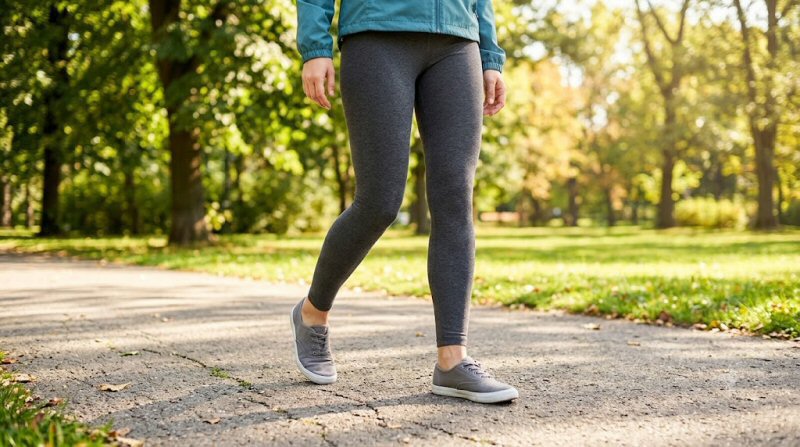
You stand up from a long meeting and the back of one knee feels stuffed, as if the joint forgot the first inch of bending. A few steps later it eases. Nothing gave way. Nothing swelled. The same tightness shows up after a kitchen shift spent with the knees shoved straight back, or on the first downhill after a week of flat sidewalks.
That spot is not just empty space between the hamstrings and the calf. A small, flat muscle called the popliteus sits on the back of the knee, running from the outer femur down to the inner top of the shin. Anatomist R. J. Last called it the key that unlocks the knee. It still expects a real walking bend: a lock at the end of a step, a short unlock to start the next one, and a little rotational work when the ground is not perfectly flat. Modern days rarely give it that job, then ask for it all at once.
What This Tightness Feels Like
The usual version is a deep ache or a band of tightness across the back of the knee, often a little toward the outer side. It shows up in the first steps after sitting, when you straighten all the way and then try to bend, or when you walk downhill and the knee has to control a slow fold. Some people feel a small click as flexion starts, then nothing. The joint does not lock solid. Swelling is absent or barely there. The front of the knee, where the kneecap tracks, is usually quiet.
It is easy to blame the hamstrings. They share the neighborhood. Hamstring tightness tends to pull higher, into the back of the thigh, and eases when you hinge at the hips. Popliteus tightness sits lower, in the crease, and eases once the knee has bent and straightened a few times in a row. A true meniscus catch is different again: it can block motion, swell by evening, and follow a twist.
The Unlock the Knee Was Built For
In the last few degrees of extension the knee does something tidy. The shape of the femoral condyles, the tension in the cruciates, and a small outward rotation of the shin on the thigh screw the joint home. Surgeons still call this the screw-home mechanism. For a moment the knee can stand with less quadriceps effort, ligaments and joint shape sharing the load. That was useful on a long walk, at the end of stance, just before the foot left the ground.
To start bending again, something has to unscrew that lock. Last’s description, and later electromyography by C. H. Barnett and A. T. Richardson, then by John V. Basmajian and J. F. Lovejoy, put the popliteus at the start of flexion. It internally rotates the shin on the thigh, or, if the foot is planted, externally rotates the thigh on the shin. Either way the screw loosens and the hamstrings can fold the knee. Basmajian’s recordings also showed the muscle working during crouched gait and helping to draw the lateral meniscus back so it is not pinched as the knee bends. It is a rotator and a meniscal guide, not a big flexor.
Gait work by Roger Mann and others placed that rotation inside ordinary walking, not only in a clinic test. On uneven ground the demand goes up. A cambered path, a root, a step down asks the posterolateral corner — popliteus, popliteofibular ligament, and the neighboring stabilizers mapped in detail by Robert LaPrade, and earlier emphasized by Jack Hughston — to keep the outer knee from opening while the joint turns. The muscle is small because the job is precise, not because the job is optional.
Why Chairs and Locked Knees Leave It Quiet
A chair holds the knee near a right angle for hours. Screw-home never happens, so the unlock never happens either. The popliteus is not stretched hard and it is not asked to rotate anything. It simply waits. The first stand-up of the afternoon is often a shove into full extension, knees snapped back, then a stiff first step. The unlock is late, clumsy, and felt as a catch behind the joint.
The other modern habit is the opposite pose. People who stand at a counter, a checkout, or a stove often rest on hyperextended knees. Ligaments hold the lock. The popliteus stays quiet because nothing is asking it to unscrew or to steer rotation. Hours later a hill, a squat to a low shelf, or the walk to the car asks for a bend the muscle has not rehearsed.
Flat floors finish the mismatch. Ancestral walking mixed small turns, side slopes, and changes of speed. Those are the loads the posterolateral knee expects, in the same family as the varied terrain your knees still expect. A treadmill belt and a level sidewalk keep rotation near zero. The muscle loses the small daily practice, then complains when a trail or a crowded platform forces a turned step.
Sitting also changes the neighbors. Hamstrings parked short, calves quiet, and a hip that rarely hinges mean the back of the knee is asked to fold without the usual help from the thigh. The hamstrings that still expect you to pick things up and the popliteus are a pair. When both are underused, the crease feels like the weak point.
Common Reasons the Back of the Knee Complains
Most desk-day tightness is disuse plus a sudden bend, not a tear. A few patterns show up again and again.
- Long sitting, then standing by snapping the knees straight before walking.
- Standing shifts with the knees locked back and the pelvis tipped forward.
- A sudden hike, hill, or deep squat after weeks of flat walking only.
- Downhill walking, which loads a slow knee bend with the foot planted.
- New running shoes with a big heel-to-toe drop, which change how the knee unfolds at contact.
- A mild twist days earlier that irritated the posterolateral tissues without a true giving-way event.
A Baker’s cyst can ache in the same crease, usually with a fullness that is worse after activity and sometimes visible swelling. It is often a signal from inside the joint, not a muscle that forgot to unlock. Posterior horn meniscus irritation can mimic popliteus pain, especially if a twist started it and the knee swells. The everyday version has no swelling and fades as the walk continues.
Hidden Triggers
Shoes that block a small toe-out at push-off change tibial rotation at the end of stance. The screw-home still happens, but the timing is off, and the unlock feels late. Very stiff soles do the same on the first steps of the day.
Crossing the same leg for hours pins the outer knee and shortens the posture the popliteus has to undo. A wallet or a phone in a back pocket, already unkind to the hip, adds a small twist through the thigh that the knee then has to absorb.
Fatigue matters. Late in a long standing day the quadriceps stop fine-tuning terminal extension. The knee slams into the lock instead of settling into it. The unscrew on the next bend is harsher. Dehydration and a sudden increase in salty meals do not injure the popliteus, but a puffier joint makes that first bend feel thicker than it is.
When to Worry
Ordinary unlock stiffness is brief, both sides or the side you stand on, and gone after a few minutes of walking. Get it checked sooner if any of these show up.
- The knee truly locks and will not bend or straighten, even after a minute of gentle movement.
- It gives way, especially turning on a planted foot, or felt a pop during a twist.
- Swelling rises within a few hours of an injury, or the back of the knee is hot and visibly full.
- Calf swelling, one-sided warmth, or shortness of breath — clot symptoms are not a muscle story.
- Pain climbs into the calf after a sudden load, which can be a gastrocnemius strain rather than the popliteus.
- Night pain, unexplained weight loss, or a crease ache with no mechanical trigger.
A posterolateral corner injury, the pattern Hughston and later LaPrade described, is uncommon in desk life and usually follows a real sports twist, often with a cruciate injury. It is not the mild tightness after a meeting. If the knee feels unstable on stairs, that is a clinician visit, not a stretch to push through.
Myths vs Facts
Myth: Tightness behind the knee always means the hamstrings are short.
Fact: Hamstrings cross the hip and the knee. Popliteus lives only at the knee and works in rotation. A thigh stretch that never bends and straightens the knee under load often misses the muscle that actually aches.
Myth: You should stand with knees locked to “rest” the legs.
Fact: A soft knee, not a shoved-back knee, is the standing posture that still shares work with muscle. Locked knees borrow the ligaments and skip the unlock practice.
Myth: A click when the knee starts to bend means a meniscus tear.
Fact: A single painless click after sitting is often gas or tendon movement, in the same family as the [knee crack when you stand up](https://research.betterhealthfacts.com/articles/is-it-normal-for-your-knees-to-crack-when-you-stand-up/). Catching, swelling, or a block to motion is the meniscus pattern, not the click alone.
Myth: The popliteus is too small to matter.
Fact: Last, Basmajian, and LaPrade’s anatomical work all treat it as the starter of flexion and a restraint of outer-knee rotation. Small lever, specific job.
How to Give It the Bend It Expects
You do not need a rehab gym. You need the lock and the unlock back in the day, in small doses.
- On stand-up, soften the knees before you walk. One easy bend and straighten on each leg, foot on the floor, beats snapping into hyperextension.
- During standing work, keep a micro-bend. Shift weight. Unweight one leg on a low rail if you have one, rather than hanging on both locked knees.
- Walk a few minutes on a path that is not perfectly flat — a grassy edge, a gentle camber — so rotation returns without a workout.
- On hills, shorten the step. Downhill ache is often a long stride forcing a fast, loaded bend.
- Once the crease is calm, a slow sit-to-stand from a normal chair, knees tracking over the feet, rehearses the unlock under light load. Stop if it swells.
- Skip aggressive “knee circles” or deep twisting lunges while the back of the knee is irritable. The muscle wants controlled rotation, not a forced corkscrew.
Heat before a walk and a short calf and hamstring ease afterward are enough for most desk-day flares. A brace is rarely useful for this pattern and can block the very bend you are trying to restore.
When to See a Doctor
See someone if the tightness lasts more than a couple of weeks despite walking breaks, if stairs feel unstable, or if swelling, locking, or a twist injury is part of the story. A clinician can separate popliteus irritation from a meniscus flap, a cyst, or a posterolateral sprain with a hands-on exam. Imaging is for the cases that do not behave like simple disuse. Physiotherapists who know gait, not only static stretches, are a good match for the everyday version.
FAQs
Why does the back of my knee hurt only for the first minute of walking?
That is the classic unused-unlock pattern. After sitting or locked standing, the first bends reintroduce rotation and flexion. Once the popliteus and the joint surface have moved a few times, the stiffness fades. Lasting pain, swelling, or a limp is a different problem.
Is the popliteus the same as the muscle that cramps in the calf at night?
No. Night calf cramps are usually gastrocnemius or soleus. The popliteus is higher, in the knee crease, and it aches with bending or turning rather than with a pointed foot in bed.
Can sitting cross-legged cause this?
It can contribute. A long crossed-leg posture holds the shin in rotation and leaves the outer knee compressed. Alternating sides and standing up before the crease feels pinched is usually enough.
Should I stretch the back of the knee hard?
A gentle hamstring ease is fine. Forcing the knee straight against a sharp crease pain, or twisting it in a deep squat, irritates the posterolateral tissues. Walking bends do more for this muscle than a long static stretch.
Does a treadmill count as the walking bend it expects?
It counts as flexion and extension. It does not count as rotation on uneven ground. If the ache is from locked standing, a treadmill walk may help. If the ache is from never turning, a short outdoor path with a little camber is closer to the original job.
Can this become a tear if I ignore it?
Simple stiffness from disuse does not slowly become a posterolateral tear. Tears follow force: a twist, a blow, a planted-foot turn in sport. Ignoring desk tightness mostly means the first steps keep feeling rusty. Sudden giving way is the signal to stop and get examined.
Conclusion
The popliteus is a key, not a bulk muscle. It still expects the end of a step to lock the knee and the start of the next bend to unlock it, with a little rotational steering when the ground turns. Chairs skip that sequence. Locked standing borrows the ligaments and leaves the key unused. The back-of-knee tightness on the first steps is often that missing unlock, not a joint that has failed.
Soften the knees when you stand. Walk the bend before you ask for a hill. Save the clinic visit for swelling, true locking, or a knee that gives way. The everyday crease usually wants the job back, in ordinary steps, not a harder workout. EOF


