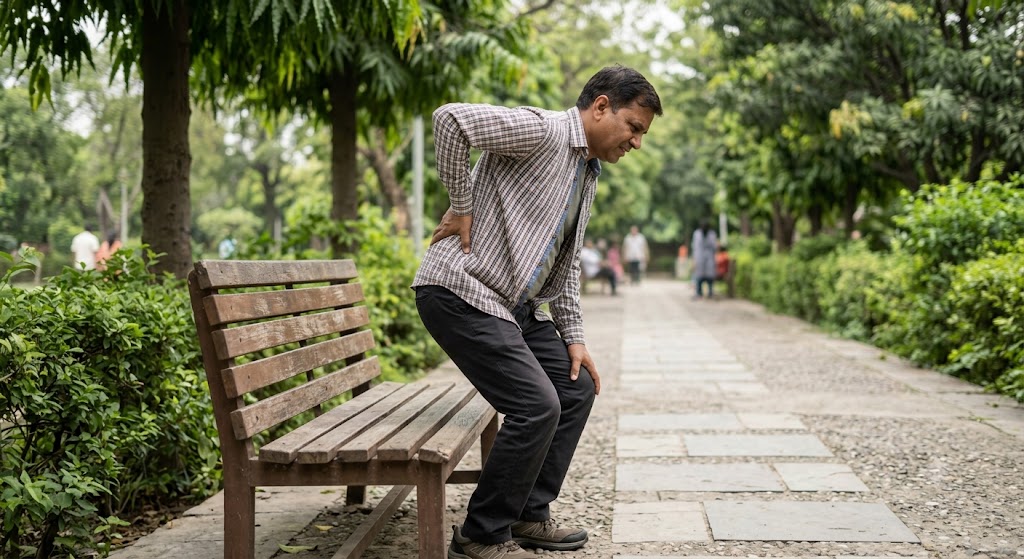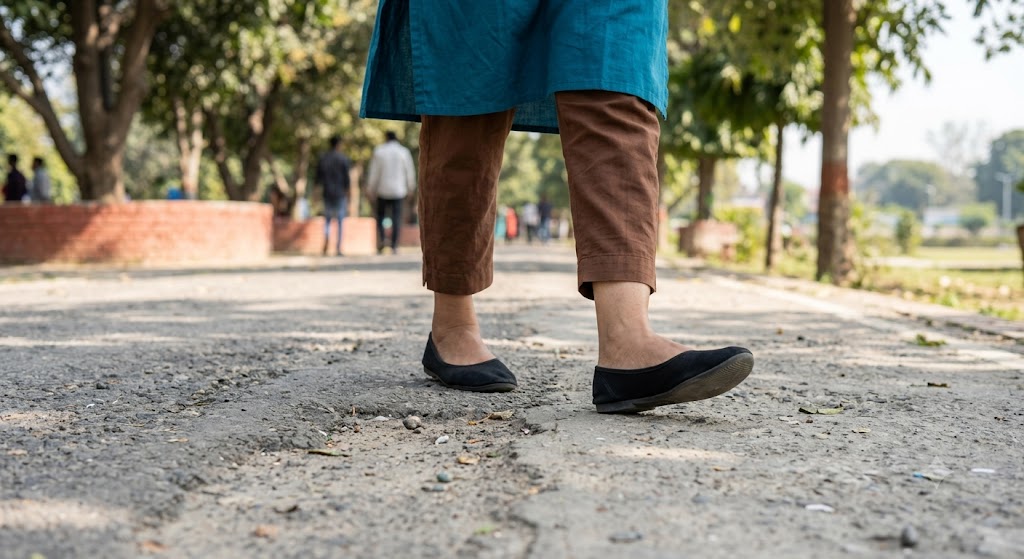
Ligaments are living sensors, not packing tape. They still expect occasional end-range and cyclic load — the cue Woo, Frank, Amiel and Noyes mapped — not a chair-locked mid-range day.

A ligament looks like packing tape. It is not. It is a living, innervated, blood-fed band of collagen that reads how far a joint actually travels and how often that travel is asked for.
Most of a modern day never asks. Hips stay near 90 degrees in a chair. Ankles stay in a shoe last. Shoulders stay in front of the trunk. Knees flex and extend in a narrow corridor of stairs and car seats. The bands that were built to check the last few degrees — the ACL and MCL, the ankle’s lateral complex, the hip capsule, the shoulder’s glenohumeral ligaments — spend the day in mid-range slack.
Savio Woo, Cyril Frank, David Amiel and Frank Noyes spent decades showing that ligaments are not inert rope. They remodel with load. They weaken with immobilization. They carry mechanoreceptors that tell the spinal cord where the joint is about to go. When the day never visits end-range, the tissue and the map both get quieter.
This is not a dare to yank a stiff shoulder to its limit on a Tuesday. It is a map of why ligaments still expect occasional end-range and a pause, and what a mid-range life does to that brief.
What This Tissue Was Built to Do
A ligament connects bone to bone. Its job is not to be the motor. Muscle does that. The ligament’s job is to check the last slice of motion, to share load with the capsule and meniscus, and to report strain to the nervous system before the joint runs off its track.
Collagen in a healthy ligament is aligned along the usual line of pull, cross-linked, and soaked in a water-rich ground substance. Fibroblasts in the tissue keep that matrix. When you load the band inside its working range, those cells get a shear and stretch cue. They keep the collagen. When you lock the joint in a cast or a chair for long enough, the same cells get a different memo: fewer organized fibers, more disorganized scar-like matrix, a drop in stiffness and strength.
Woo’s laboratory at the University of Pittsburgh and the University of California San Diego measured that drop in animals and in human grafts. Immobilization reduced ligament stiffness and ultimate load. Controlled motion after injury protected those properties better than rest. Amiel and Woo showed that even a few weeks of unloading changed collagen mass and cross-links. Noyes documented how the ACL and other knee ligaments fail when the load is sudden and the tissue has not been living at the strain it is asked to catch.
The band is also a sensor. Mechanoreceptors — Ruffini endings, Pacinian corpuscles, Golgi-like endings — sit in ligaments and capsule. Solomonow and others showed that ligament strain can trigger muscle co-contraction around the joint. The check-rein is also a warning wire. A joint that never visits the last degrees sends fewer of those warnings, and the muscles that should catch the last slice get less practice.
Why End-Range Was the Original Cue
Ancestral days were not yoga classes. They were:
- Deep squats to rest, cook and eliminate
- Long strides and hills that took the hip and ankle through more extension
- Reaching, hanging, throwing and pushing that took the shoulder past desk flexion
- Uneven ground that asked the ankle ligaments for sideways check
- Carrying and turning that loaded the knee in slight rotation under compression
- Nights and pauses so the same collagen could swap water and repair
That pattern is almost a textbook ligament program. Occasional end-range. Cyclic load, not a single yank. Rest between bouts. Varied direction so one bundle is not the only one that ever works.
Hips still expect a deep fold partly because the capsule and iliofemoral ligament were built to live with that fold, not only with a chair angle. Cartilage still expects motion rather than rest because the same cycle that feeds cartilage also keeps the capsule from welding itself short. Tendons still expect gradual loading; ligaments are the quieter cousins of the same collagen family, with a lower blood supply and a longer memory for both use and neglect.
Provenzano’s work later made the cellular point sharp: fibroblasts in a ligament align and build to the strain they feel. Take the strain away and the cells do not wait politely. The matrix drifts toward a weaker, less organized state. Put a sensible cyclic strain back and the tissue can recover a good deal of what rest stole — if the joint is not already inflamed or torn.
What Modern Life Quietly Removes
Chairs are not a poison. They are a missing last degree.
All-day mid-range. Sitting parks the hip near 90 degrees, the knee near 90, the ankle in slight plantarflexion. The ligaments that check extension, rotation and inversion barely see their job.
Flat, even ground and a narrow shoe. Ankle ligaments evolved to catch a side-step on dirt and rock. A corridor and a stiff heel-to-toe last shrink that catch.
Forward arms. Desk reach keeps the inferior and anterior shoulder ligaments slack. The last degrees of external rotation and elevation — the ones you need to reach a high shelf or catch a fall — arrive untrained.
One aggressive stretch after ten stiff hours. End-range is a dose. A sudden end-range on a cold, unloaded band is a different dose from many small visits across a day. Woo’s and Noyes’s failure data are about sudden load on tissue that was not living at that strain.
Complete rest after a sprain. Protection for a few days can be wise. Weeks of a boot or a sling without any guided motion is the immobilization protocol those labs already measured: weaker collagen, a noisier joint when you finally ask it to work.
The early result is not a rupture. It is a quieter check-rein: a joint that feels “tight in the middle and unreliable at the edge,” a first hike that rolls an ankle, a first overhead reach that feels like the shoulder ran out of room.
Less Common but Serious
Not every click or loose feeling is “you needed more end-range.”
A true ACL, PCL or high-grade ankle tear, a shoulder dislocation, inflammatory arthritis, a connective-tissue disorder such as Ehlers–Danlos, and a locked or giving-way joint are medical events. Sudden swelling after a twist, an inability to bear weight, a joint that slides out of place, numbness, or pain that wakes you at night need examination — not a deeper squat. Hypermobile people already live at end-range; they usually need control and strength around the band, not more stretch.
Grafts after reconstruction remodel on a slower clock than a healthy native ligament. Woo’s and Amiel’s graft work is the reason surgeons and therapists talk about protected motion rather than “just walk it off.”
Hidden Triggers
A few modern habits subtract end-range without looking dramatic:
- Crossing a knee under a desk for hours, so one collateral ligament lives short
- Sleeping with a sharply flexed wrist or elbow, so those capsules never see extension
- Always taking the elevator, so the ankle never checks a descent
- Stretching only the muscles you can see and never moving the joint through its unused slice
- Returning to a cutting sport the week a sprain “feels fine,” while the ligament is still remodeling
None of these are moral failures. They are missing cycles.
When to Worry
Get care promptly if:
- A joint swells quickly after a twist or landing
- You cannot bear weight, or the joint gives way
- The joint looks deformed or will not straighten
- Pain is severe at rest or at night
- You have a known connective-tissue disorder and a new unstable joint
- Numbness, foot drop or a cold pale limb appears after injury
Those are not “more pigeon-pose” problems.
Myths vs Facts
Myth: Ligaments are dead tape. Once stretched, they stay stretched.
Fact: Ligaments are living tissue. They lose organization with immobilization and can regain a good deal of material properties with guided cyclic load, as Woo, Frank and Amiel showed. A complete tear is a different story.
Myth: If it is stiff, yank it to end-range every morning.
Fact: End-range is a dose. Sudden end-range on a cold, unloaded band is closer to Noyes’s failure setup than to a remodeling stimulus. Warm the joint with movement first. Visit the last degrees, do not attack them.
Myth: A sprain that no longer hurts is fully healed.
Fact: Pain fades faster than collagen remodels. The check-rein can still be weaker and the sensors less accurate for weeks to months.
Myth: Hypermobile people should stretch more to stay comfortable.
Fact: Their ligaments already live near end-range. They usually need strength and control so muscle can share the check, not more excursion.
Myth: Braces replace ligaments.
Fact: A brace can protect a healing band or a loose joint for a task. It does not send the fibroblast the cyclic strain cue the tissue still expects.
How to Give Ligaments a Fairer Day
You do not need a circus split. You need the last degrees to show up on the calendar.
Visit end-range, do not live there. A few slow bodyweight squats to a comfortable depth. A long walking stride on a slight hill. An open-chain ankle circle and a careful inversion-eversion after a walk. A reach to a high shelf after the shoulders are warm. That is the ancestral pattern in miniature.
Cycle, then pause. Collagen likes load and a gap. Several short visits beat one long hang.
Load the muscle around the band. A ligament is happier when the rotator cuff, hip abductors, vastus medialis and peroneals share the last slice. Strength is not the enemy of mobility. It is how end-range stays safe.
After a sprain, protect then move. Follow the clinician’s protected-motion plan. Complete rest is the immobilization protocol the labs already measured.
Change the default geometry. Get off the chair for a few minutes each hour. Take stairs. Walk a slightly uneven path. Reach behind you for a jacket. Those are mid-range interruptions that keep the sensors honest.
None of this replaces a reconstruction, a reduction or an inflammatory workup. It is how you stop asking a mid-range day to prepare you for an end-range second.
When to See a Doctor
See a clinician if a joint gives way, swells after modest twists, will not take weight, or has already dislocated. See one if stiffness is rapidly worsening, if you have systemic symptoms, or if a child’s joint looks asymmetric. A physical therapist who treats ligament load as a dose — not as a stretch contest — is often the right first partner after the urgent problems are ruled out.
FAQs
Can ligaments actually get stronger?
They can remodel. Controlled cyclic load improves material properties compared with immobilization. They do not hypertrophy like a biceps, and a complete tear does not “exercise itself back together.”
Is stretching the same as loading a ligament?
Not always. A slow visit to end-range with the joint warm is a strain cue. A bouncing yank is a different cue. Muscle stretch without ever taking the joint to its unused slice may never brief the band.
Why does my ankle keep rolling after one sprain?
The band may still be remodeling, and the mechanoreceptors may be sending a fuzzier map. That is why early protected motion and later balance work matter more than waiting for zero pain.
Are clicks a ligament problem?
Often no. Painless clicks are commonly tendons snapping or gas cavitation. Giving-way, swelling and a feeling that the joint slides are more ligament-like.
Should I avoid end-range forever after a reconstruction?
No. You should follow the graft’s remodeling clock. Early protected motion, then progressive load, is closer to Woo’s findings than permanent mid-range.
Does sitting eight hours ruin knee ligaments?
No single day does. A year of mid-range with no hills, no deep fold and no careful rotation under load is a thinner brief. The ACL does not dissolve at a desk. It meets its first cutting sport underprepared.
Is hypermobility the opposite mismatch?
In a way. The band already lives at end-range. The missing cue is often co-contraction and strength, not more excursion.
Do supplements rebuild ligaments?
Collagen still needs vitamin C and load to finish a helix, as the collagen literature shows. A powder without the strain cue is an incomplete brief. Food-first protein and a loaded day remain the base.
Why do ligaments heal more slowly than muscle?
Lower blood flow, a denser matrix and a fibroblast that clocks remodeling in weeks to months, not days. That is biology, not a lack of effort.
Is this an argument against chairs?
No. It is an argument for interrupting mid-range so the check-rein still remembers its job.
Conclusion
Ligaments were never packing tape. They were living check-reins and warning wires, tuned for a day that sometimes reached the last degrees and then paused. Woo, Frank, Amiel and Noyes measured what happens when that day becomes a chair and a sudden sport.
You do not owe your ACL a full split. You owe it a few honest visits: a deeper fold, a longer stride, a sideways step on uneven ground, a reach that is not only forward, and the strength to catch what the band reports. Mid-range is comfortable. End-range is the page the tissue was still reading.