
Latissimus dorsi evolved for climbing, hanging, and pulling the body toward the hands. Desk life leaves the lats short and underused. Here is the job they still expect and how to give it back in ordinary days.
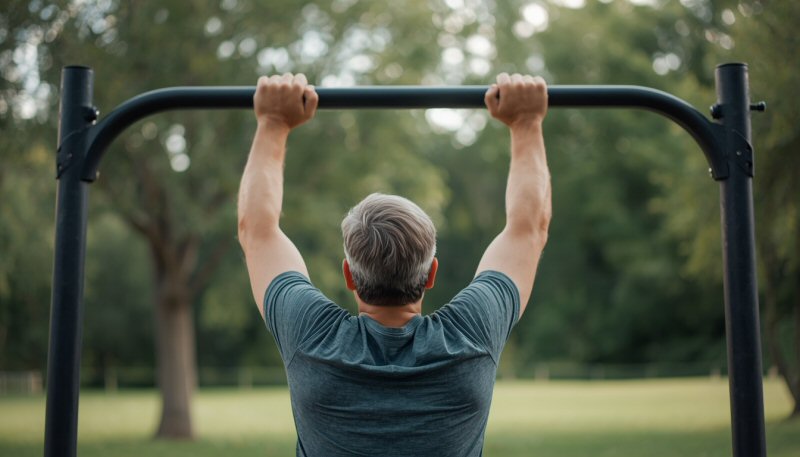
The widest muscle on the back is not a “wing” for photos. Latissimus dorsi is a climbing, rowing, swimming, and pulling muscle. It connects the upper arm to the pelvis and lower spine, which means it can pull the arm down and back — or pull the body up toward a hand that is already fixed on a branch, a ledge, or a child being lifted. A life spent with the arms in front of a keyboard rarely asks for that job. The lats get quiet, a little short, and then blamed when a single pull-up or a suitcase on a high shelf feels impossible.
This is another evolutionary mismatch in the shoulder girdle neighborhood. The scapulae still expect hanging. The pecs still expect a push. The upper back still expects reaching and pulling. The lats are the big engine behind those pulls. They did not disappear. They are waiting for a load that travels from hand to hip.
You do not need to become a climber. You need the qualities climbing used to demand: arms that go overhead and then pull, a ribcage that can stay organized, and a few minutes a week in which the back of the body does work instead of only the front.
What the Lats Are For
Latissimus dorsi is a broad sheet from the lower thoracic spine, thoracolumbar fascia, pelvis, and lower ribs to the inner upper arm. When the hand is free, it extends, adducts, and internally rotates the shoulder — bringing the arm down and in, as in a swim stroke or a row. When the hand is fixed overhead, the same fibers can lift the trunk. That is the mechanical heart of a climb, a rope pull, and getting out of a pool.
Because the muscle spans so much of the torso, it also influences posture and breath. Chronically shortened or guarded lats can flatten the lower-rib expansion and tug the shoulder into a slightly internally rotated rest position. Overly “locked” lats from only doing heavy straight-arm work without overhead reach can feel like a tight side-body rather than a strong back.
In ancestral movement, the lats were not isolated. They worked with the grip, the biceps, the teres major, the lower trapezius, and the core while the feet found purchase. Pulling yourself toward something and pulling something toward you were daily events, not a Wednesday machine.
The Ancestral Job Versus the Desk Job
Trees, rocks, riverbanks, game, and children all created overhead and front-of-body pulls. Even walking with a load in one hand asked the lat on that side to stabilize. Swimming and wading added long, rhythmic pulls through water. The muscle lengthened when the arm reached up and forward. It shortened under load when the elbow drove down.
The modern default is a mid-range hover. Elbows stay near the ribs or rest on a desk. Hands rarely go above the head except to grab a mug from a high shelf — a short, unweighted reach, not a pull. Gym time, if it happens, may be all pushing (presses) or all sitting rows in a flexed spine. The missing piece is the combination the lats evolved for: reach up, then pull the body or the object along that line.
That is why people can have “strong” gym numbers and still feel weak hanging from a bar. Strength in a seated row does not automatically transfer to an overhead pull if the shoulder never practices that path.
Why Quiet Lats Show Up as Shoulders, Sides, and Posture
People rarely say “my lats hurt.” They say the front of the shoulder feels crowded, the side of the ribcage feels tight when they reach up, or their pull-up progress stalled at zero. A lat that does not lengthen well limits overhead reach. A lat that does not fire well leaves the biceps and upper traps to yank the body up — a recipe for cranky elbows and necks.
The relationship with neighboring tissues is close. Hanging loads the scapulae; the lats help finish the pull. Reaching behind asks the rotator cuff to clear space the lats must allow. Carrying a pack asks the trapezius to hold; the lats help connect that hold to the pelvis. Those stories live in our pieces on scapulae that still expect hanging, the rotator cuff, the trapezius and a pack, and an upper back that still expects reaching and pulling.
Breathing is in the mix too. A lat that grips the lower ribs all day can make a full inhale feel like work. Seated life already biases shallow breath, as described in the breath that was never meant for seated life.
What “Pull Yourself Up” Means Now
The ancestral job translates into a short list of modern qualities:
- The ability to hang from a bar or sturdy branch with the shoulders active, not shrugged into the ears
- A pull that can start from an overhead or high position, even if the knees stay on the ground at first (inverted row, band-assisted pull)
- Occasional one-arm reaching and pulling — a suitcase off a high rack, a child lifted from the floor to the hip, a rope or strap
- A side-body that can lengthen when the opposite arm reaches up
- Rows that include a long arm, not only a bent-elbow squeeze at the end
Assisted versions count. A full unassisted pull-up is a bonus, not the entrance ticket to a healthy lat.
Hidden Triggers That Keep the Lats Offline
Several ordinary habits starve the muscle of its job:
- All-day sitting with the arms in front and the pelvis tucked
- Only training chest and arms, never a vertical pull
- Avoiding overhead work because an old shoulder ache made reaching feel unsafe — then never rebuilding the range
- Carrying bags only in the crook of the elbow instead of occasionally hanging a load from a straight arm
- Sleeping hunched or working with the screen so low that the arms never travel up
None of these are moral failures. They are missing inputs. The lat is a use-it-in-this-range tissue.
When Tight or Weak Lats Need a Closer Look
Most stiffness with overhead reach is deconditioning plus posture. Red flags are different: sudden weakness after a pull, numbness down the arm, night pain that is not positional, unexplained weight loss, or a shoulder that cannot lift after a fall. Those belong with a clinician, not another stretch video.
People with a history of shoulder dislocation, rotator-cuff repair, or thoracic surgery should rebuild pulling with guidance. The principle stays the same. The starting height of the bar changes.
Myths vs Facts
Myth: If you cannot do a pull-up, your lats are useless.
Fact: Pull-ups are a high skill under full bodyweight. Rows, hangs, and assisted pulls still train the job.
Myth: Stretching the lats is enough.
Fact: Length without strength in the new range does not last. The muscle needs to pull from the lengthened position too.
Myth: Wide-grip “lat pulldowns” with a huge lean and a jerk are functional climbing.
Fact: A controlled pull with the ribcage quiet and the elbow traveling toward the side of the body is closer to the real task.
Myth: Lats are only a back-day muscle.
Fact: They are a trunk-to-arm muscle. Carries, hangs, and reaches during ordinary chores count.
How to Give the Lats Their Job Back
Think in weekly doses, not a heroic session:
- Hang from a bar for 10–20 seconds, two or three times, most days if the shoulders tolerate it. Keep the ribs from flaring wildly.
- Add a bent-knee or band-assisted pull-up, or an inverted row under a sturdy table, twice a week.
- Reach one arm up a wall and gently side-bend away, breathing into the long side.
- Carry a bag at your side with a long arm for a short walk, then switch hands.
- When you take something off a high shelf, pause at the top and lower it slowly instead of dropping the elbows immediately.
- Balance pushing days with pulling days so the pecs and lats stay in conversation. The pecs’ side of this bargain is in why your pecs still expect you to push and climb.
Soreness after the first week of hanging is common. Sharp front-shoulder pain is a stop sign. Shorten the hang, bend the elbows a little, or use a higher support so the feet share the load.
When to See a Doctor or Therapist
See a professional if overhead motion is blocked on one side only, if pulling causes tingling, or if a recent injury started the problem. A physical therapist can tell whether the limit is the lat, the capsule, the thoracic spine, or the nerve. That distinction saves months of random stretching.
FAQs
Do I have to do pull-ups to “fix” my lats?
No. Hangs, rows, and assisted vertical pulls cover the same family of work.
Why do my hands give out before my back?
Grip is often the first weak link after years of smooth surfaces. That is its own mismatch, described in why your hands lost their daily workout. Use straps or shorter hangs while grip catches up if needed.
Can tight lats cause low-back pain?
They can contribute when they tug on the thoracolumbar fascia and the pelvis, especially if you only stretch the back and never load a pull. They are rarely the only cause.
Is swimming enough?
It is an excellent lat job if you actually swim with a full stroke. A timid paddle in a crowded lane is better than nothing and not the same as a committed pull.
How fast will overhead reach improve?
Many people feel more space in two to four weeks of daily hangs and side reaches. Strength to pull the body up takes longer and should progress gradually, the same way tendons expect gradual loading.
Should I stretch lats every hour at a desk?
A brief overhead reach each hour is useful. Marathon stretching without later strength work just makes a longer weak muscle.
Conclusion
Your lats still expect a world in which the hands sometimes go up and then bring the rest of you with them. Chairs and screens removed that sentence from the daily paragraph. The muscle did not forget how. It forgot the schedule. Hang when you can. Pull with help if full pull-ups are not there yet. Reach one arm long and let the side-body breathe. Pair those minutes with the hanging scapulae, the pushing pecs, and the carrying core already described on this site. You are not rebuilding a gym identity. You are putting a climbing muscle back on a human calendar.