
Your knees evolved for deep squatting and ground-level rest. Modern chairs limit that range, and the mismatch can leave them stiff and under-nourished.
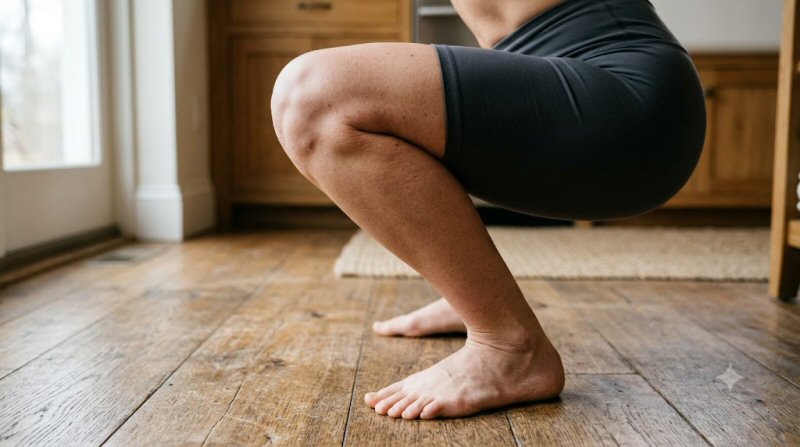
You stand up from a low couch or try to pick something off the floor and your knees protest with a stiff, creaky resistance. The movement feels awkward, almost unfamiliar, even though your legs are strong enough for a walk. That sensation is common in people who spend most of their day in chairs. Human knees spent most of their evolutionary history moving through a much deeper range of flexion, and the modern habit of sitting at roughly ninety degrees leaves part of that range unused.
Why Deep Flexion Was Once Everyday
Hunter-gatherer groups and many traditional societies still rest and work in deep squats or kneeling positions for long stretches of the day. In those postures the knee bends well past ninety degrees, sometimes approaching full flexion where the calf meets the thigh. Anthropologist David Raichlen and colleagues studied the Hadza people of Tanzania and found that their “inactive” time often involved these active-rest postures. Muscle activity in the legs stayed higher than it does during ordinary chair sitting, even while people were essentially resting. Squatting facets on ancient bones suggest this pattern reaches back through early modern humans and earlier Homo species.
The joint itself is built for that range. Cartilage and the menisci receive nutrition partly through the pumping action of synovial fluid. Full flexion and extension help circulate that fluid across the surfaces. When the knee rarely travels beyond chair height, the deeper portions of the joint get less of that cyclic loading and unloading. Over years the tissues can become less accustomed to the position, and the first time you need a deep bend the movement feels restricted or mildly uncomfortable.
What Changes When We Mostly Sit
Chair sitting keeps the knee near ninety degrees for hours. The quadriceps and hip flexors stay in a shortened position, the hamstrings lengthen, and the knee joint itself experiences relatively static pressure rather than the repeated deep compression and release of squatting or getting up from the ground. Raichlen’s work on the Hadza supports the idea of an inactivity mismatch: total sedentary time can be similar between hunter-gatherers and industrialized people, yet the postures differ enough to change muscle activity and joint loading.
In everyday life this shows up as stiffness after sitting, a sense that the knees “don’t want to go that low,” or a mild ache when you finally do a deep bend. People who grew up sitting on the floor or who still squat for work often keep that range more easily. Those who rarely leave a chair lose it gradually, sometimes without noticing until they try to garden, play with children on the floor, or sit cross-legged.
Related everyday patterns appear in other joints that also expect more variety. The same sitting habit that limits the knees often tightens the hips and changes how the lower back loads during a hinge. Articles on hips feeling tight after sitting and why the lower back still expects a hinge explore neighboring pieces of the same mismatch.
How the Joint Handles Deep Bend
At deeper flexion the contact areas between the femur, tibia, and patella shift. Load is shared differently once the soft tissues begin to wrap and the calf and thigh meet. Some biomechanical work has shown that retropatellar pressure does not simply keep rising with every extra degree of bend; beyond a certain point the wrapping of tissues and the changing contact patch can redistribute force. Cartilage responds to regular mechanical signals by maintaining its matrix; prolonged under-loading in part of the range can leave it less resilient when the demand finally appears.
None of this means every person needs to spend hours in a deep squat. Populations that squat for occupational reasons can develop their own joint issues if the posture is held statically for very long periods without variety. The evolutionary pattern was intermittent deep flexion mixed with walking, carrying, and standing—not a single frozen position. The modern problem is the near-total absence of that deep range for most of the day.
When the Limitation Becomes a Problem
Mild stiffness that eases after a few minutes of movement is usually the simple result of unused range. Pain that is sharp, localized, or accompanied by swelling, locking, or giving way deserves attention. Sudden inability to bend or straighten the knee, or pain that follows a specific injury, is different from the gradual loss of deep flexion that comes from chair living. People with existing osteoarthritis or prior knee surgery should approach deeper ranges carefully and often with guidance, because the joint surfaces and supporting tissues may no longer tolerate the same loads they once did.
Knee cracking or popping during a sit-to-stand is often harmless if it is not painful. An article on knees cracking when you stand up covers the common gas-release and soft-tissue explanations for that sound.
Myths Versus Everyday Reality
One persistent idea is that any deep squat is inherently dangerous for the knees. Controlled, progressive loading through a full range has been shown in reviews to be safe for healthy joints when technique is reasonable and loads are not extreme. The opposite myth—that chairs are neutral and the body needs no deep flexion—ignores the historical evidence and the Hadza data. Both extremes miss the middle: occasional deep bends, mixed with ordinary walking and standing, match the varied loading the joint appears built to handle.
Practical Ways to Give the Knees What They Still Expect
You do not need to replace every chair with a squat toilet. Small, regular exposures to deeper flexion help most people. Sitting on the floor for a few minutes while reading or watching something, practicing a supported deep squat with heels elevated if needed, or simply getting down and up from the ground a few times a day reintroduces the range. Walking on varied surfaces, taking stairs, and occasionally kneeling for short tasks add further variety without requiring a formal exercise program.
If the knees feel stiff at first, start with partial ranges and support—holding a counter or doorframe—and increase depth gradually. Warm the joints with a short walk before asking for a deeper bend. Strength in the quadriceps, hamstrings, and calves supports the joint at every angle; simple sit-to-stands from a chair already begin that work. Consistency matters more than intensity. A few minutes of deeper flexion most days is closer to the ancestral pattern than one intense session once a week.
Frequently Asked Questions
Is it bad to lose the ability to squat deeply?
Losing the range is common in chair-based lives and is not automatically harmful, but it can make everyday tasks like gardening or floor play less comfortable and may leave parts of the joint under-stimulated. Regaining a comfortable deep bend is usually possible with gradual practice.
Do deep squats cause arthritis?
In healthy knees, occasional deep squatting does not appear to cause osteoarthritis. Some occupational groups who squat for many hours daily without variety have higher rates of certain knee problems, but the broader evidence points more to total inactivity and other factors than to moderate deep flexion itself.
Why do my knees feel stiff only after sitting, not after walking?
Sitting holds the joint near one angle with little fluid movement. Walking cycles the knee through a useful range and pumps synovial fluid. The stiffness is often the difference between static posture and cyclic loading rather than a sign of damage.
Can older adults safely work on deeper knee flexion?
Many can, provided they progress slowly, use support, and stop at pain rather than mild stretch. People with significant arthritis, joint replacements, or balance issues should check with a clinician first. The goal is comfortable functional range, not a perfect heels-down squat.
How long does it take to regain a deeper squat?
Noticeable improvement often appears within a few weeks of daily short practice, though full comfort can take longer if the range has been unused for years. Soft tissues adapt to the loads they regularly receive.
Conclusion
Your knees still carry the expectation of occasional deep flexion because that was ordinary for most of human history. Chair sitting removes that stimulus for large parts of the day, and the joint can respond with stiffness and reduced comfort in low positions. The Hadza data and skeletal evidence both point to the same practical idea: light, varied muscle activity and full-range movement during rest and work kept the lower limbs more continuously engaged. Reintroducing a few minutes of deeper knee bend into an ordinary day is a simple way to meet that expectation without abandoning modern furniture. Most people find the knees become less reluctant once the range is used again, gently and regularly.


