Growth hormone has a marketing department it never hired. In gyms and supplement ads it is the overnight repair juice you can buy, inject, or hack with a late workout and a protein shake. The molecule is real. The briefing is incomplete.
In a healthy young adult, especially a man, the largest and most reliable pulse of the day is not the one after a squat session. It arrives shortly after sleep onset, in tight company with the first block of slow-wave sleep. Eve Van Cauter and Laurence Plat mapped that pairing across decades of night sampling. Johannes Veldhuis and colleagues showed the same axis is also hungry: a fast multiplies pulse number and amplitude. The system still expects two old conditions at once — a deep first third of the night, and a gut that is not still processing a late meal.
Miss either cue often enough and you do not instantly shrink. You lose a nightly metabolic shift that used to be free: fat mobilization, protein sparing, and a quiet window in which liver and muscle could listen to a hormone that daytime insulin had been shouting over.
What This Hormone Actually Does
Growth hormone is a 191-amino-acid peptide from somatotroph cells in the anterior pituitary. Two hypothalamic peptides write the script. Growth hormone–releasing hormone from arcuate neurons opens the gate. Somatostatin from periventricular and arcuate neurons slams it. Ghrelin from an empty stomach can add a third vote. The pituitary does not drip GH. It fires pulses. Between pulses, circulating levels are often near the floor of the assay.
Those pulses are not decorative. GH binds receptors on liver, muscle, fat and bone. The liver answers by making insulin-like growth factor 1, which carries much of the growth and repair story in children and a large part of the protein-sparing story in adults. GH itself is more lipolytic and anti-insulin than IGF-1. In the first hours of a fast it helps free fatty acids leave adipose tissue so the brain and muscle can use fat instead of tearing down protein. That is why a night without food and a night with deep sleep were never separate designs. They were one shift.
In children the axis is about stature. In adults it is about overnight metabolism, lean-mass maintenance, and the timing of fuel use. Adult GH deficiency after pituitary disease is a medical diagnosis with a different scale of loss than a few late nights. The everyday mismatch is smaller and quieter: less slow-wave sleep, more late eating, more fragmented first-cycle rest, and a hormone that still shows up looking for a night that modern calendars rarely keep.
Why Deep Sleep Was the Original Cue
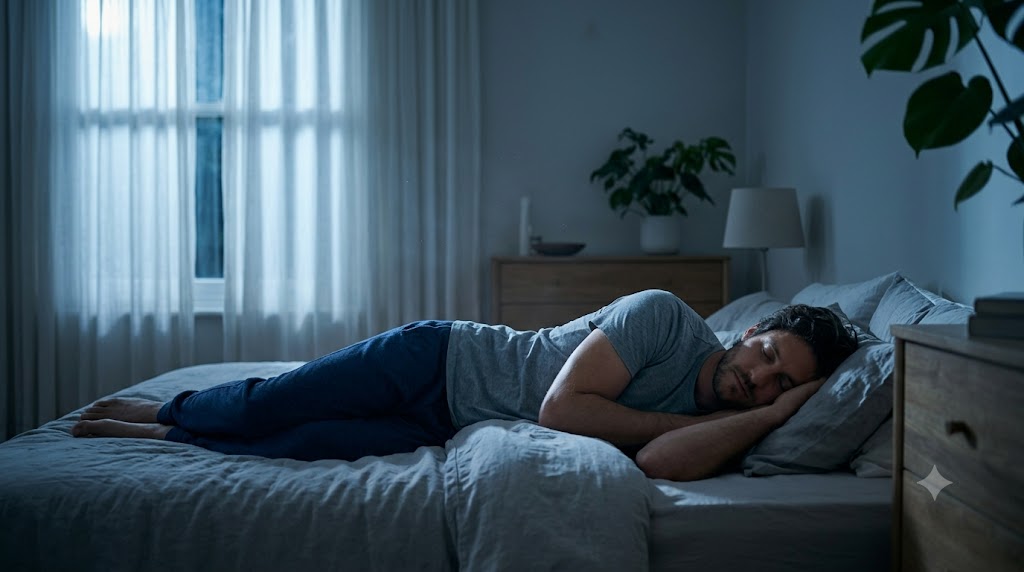
Slow-wave sleep is the high-voltage, low-frequency stretch of non-REM sleep that dominates the first cycle after you fall asleep, if you fall asleep at a biologically reasonable hour. Delta waves on the EEG mark it. Van Cauter’s group showed that the amount of GH released in the sleep-onset pulse tracks the amount of concurrent slow-wave activity. Shift the night and the pulse usually follows sleep, not the clock on the wall. Keep people awake through the usual bedtime and that large pulse shrinks. Let them sleep at 4 a.m. and a pulse can still appear — smaller, later, and less useful to a body that already spent the night on alert.
The pairing is not magic. Hypothalamic GHRH is involved in both sleep architecture and GH release. Somatostatin tone also falls at a time of night when the circadian system is relatively permissive. The result is a gate that opens most cleanly when you actually enter deep sleep, not when you lie in bed scrolling and call it “winding down.”
Ancestral nights made that gate easy to find. Darkness arrived early. The last substantial meal was hours before lying down. There was no bright rectangle in the hand. First-cycle slow-wave sleep was long because the sleep pressure from a moving day was high and the evening light was dim. The pituitary did not need a protocol. It needed a dark room and a quiet gut.
The Fast the Axis Still Expects
Donal Parker’s early sleep studies and later work by Mark Hartman, Michael Thorner, and Veldhuis showed that fasting does not invent a new GH rhythm. It turns the volume up. Pulse frequency rises. Amplitude rises. Twenty-four-hour integrated GH can several-fold increase across a multi-day fast while IGF-1 falls — a pattern that favors fat use over growth. You do not need a five-day fast to see the principle. A true overnight gap after an early dinner is already closer to the design than a 10 p.m. meal plus a midnight snack.
Insulin and free fatty acids are part of the conversation. A late, carbohydrate-heavy meal keeps insulin up and can blunt nocturnal GH. High circulating fatty acids can also restrain GH release. The axis is not trying to grow you while you are still absorbing dinner. It is trying to switch fuels once absorption is done. That is why this story sits next to the liver’s night shift in why your liver still expects an overnight fast: glycogen drawdown, fat oxidation, and GH pulses are co-scheduled, not competing hobbies.
Exercise still matters. A hard session can elicit a GH pulse of its own, especially if it is intense and relatively brief. That pulse is real and useful. It is not a substitute for the sleep-onset surge in men, who may put about seventy percent of daily GH into the early night across adulthood. Women have a more variable pattern, with more daytime pulses and a smaller relative share locked to sleep, which is one reason a one-size “GH hack” fails both sexes.
What Modern Nights Do to the Pulse
The mismatch is ordinary, not exotic.
Late light and late clocks push bedtime past the hour when sleep pressure and circadian gating would have produced a long first slow-wave block. You may still sleep eight hours. You sleep them later, lighter in the first cycle, and richer in the early-morning REM that does less for this particular hormone.
Alcohol near bedtime fragments the first half of the night. It can knock you out and still steal slow-wave quality. The GH pulse cares about the architecture, not the fact that you lost consciousness.
Sleep apnea breaks the first cycle into micro-arousals. Slow-wave sleep shrinks. GH output falls with it. Treating the airway can restore some of the nocturnal surge — a reminder that snoring is not only a noise problem.
Aging does some of the same work without any bad habit. Across the thirties, slow-wave sleep and 24-hour GH both drop sharply in many adults. Van Cauter argued that the two declines share a chronology, and that part of adult “hyposomatotropism” is a sleep-architecture story, not only a dying pituitary. You cannot out-supplement that with a powder if the night remains chopped.
A late gym session is mixed. The exercise pulse is real. The delayed bedtime, bright locker-room light, and post-workout meal can still blunt the night pulse you were hoping to stack on top.
Hidden Triggers That Quiet the Night Surge
A “just one more episode” that pushes sleep onset past midnight does more than steal minutes. It steals the first-cycle delta that the pulse tracks.
A heavy dinner inside two hours of bed keeps insulin and gut work running through the window when somatostatin should ease and GHRH should speak.
Evening screens and overhead LEDs do not have to ruin the whole night to damage this system. They delay melatonin, delay sleep onset, and shorten the deep block. The GH axis shares that evening with the same light story told in why your cortisol still expects dawn: both hormones still assume darkness first and day later.
Obesity and high free-fatty-acid tone flatten GH pulses. The relationship runs both ways. Low nocturnal GH does not cause obesity by itself, but the metabolic conversation is poorer when both adiposity and broken sleep are present.
Shift work and jet lag move sleep off the usual clock. A pulse can still follow sleep, but the rest of metabolism — insulin sensitivity, liver clock genes, appetite hormones — is no longer aligned with it.
Chronic sleep restriction produces a strange extra: pre-sleep GH pulses in some studies, as if the hypothalamus is trying to pay a debt before you even lie down, then a smaller or missing pulse once sleep finally starts.
When to Take the Pattern Seriously
See a clinician if short stature or delayed puberty is the concern in a child — that is a different work-up than adult sleep hygiene. In adults, consider evaluation when low energy, increased abdominal fat, reduced muscle, and poor recovery travel with known pituitary disease, a significant head injury, or other hormone deficits. Adult GH deficiency is diagnosed with stimulation testing, not a single morning blood draw, because a random GH level is often low even in healthy people.
Sleep apnea symptoms — loud snoring, witnessed pauses, unrefreshing sleep, morning headache, sleepiness at the wheel — deserve a sleep study more than a GH supplement. Fixing the airway treats a cause the pituitary can actually use.
Do not treat ordinary midlife decline in nocturnal GH as a license for unsupervised injections. Excess GH causes edema, carpal tunnel symptoms, insulin resistance, and, in true excess disease, the tissue overgrowth of acromegaly. More is not the ancestral setting. A deep early night is.
Myths vs Facts
Myth: Most adult GH comes from lifting weights. Fact: Exercise pulses are real. In men, the sleep-onset pulse is still the day’s main deposit.
Myth: You can replace the night surge with a secretagogue powder. Fact: Over-the-counter “GH boosters” rarely recreate a physiologic slow-wave pulse. Sleep and meal timing change the actual output.
Myth: Growth hormone is only for children. Fact: Adult GH is a metabolic hormone. Height velocity ends. Overnight fuel switching does not.
Myth: Any eight hours will do. Fact: Timing and architecture matter. Late, fragmented, alcohol-cut sleep can log hours and still miss the first slow-wave block.
Myth: A midnight snack helps overnight repair. Fact: For this axis, an empty-enough stomach is part of the repair briefing.
Myth: Women and men run the same night pattern. Fact: Women often have more daytime pulses and a less sleep-locked share of the daily total. Advice copied from young-male lab graphs misfires.
How to Give the Axis a Night It Recognizes
Protect the first ninety minutes. The goal is not a perfect sleep score. It is an early, uninterrupted descent into slow-wave sleep. Dim the last hour. Keep the room dark and cool. Put the phone outside the reach of a “quick check.”
Finish the last real meal two to three hours before bed when you can. That is the same overnight gap the liver is asking for. Protein at dinner is fine. A second dinner at 11 p.m. is the mismatch.
Keep a regular bedtime more nights than not. The pulse can follow a shifted sleep, but a stable early night is when slow-wave pressure and circadian gating usually line up.
Treat alcohol as a first-cycle thief, not a sleep aid. If you drink, earlier and less does less damage to delta sleep than a nightcap at lights-out.
If you train in the evening, leave a buffer before bed and keep the post-workout meal from becoming a second supper in bed. The training pulse and the sleep pulse can coexist. They coexist better when sleep still starts on time.
Walk and lift across the week. Daytime load still raises sleep pressure. Sleep pressure still builds the slow-wave block the pituitary is waiting for. This is the same logic as using movement to brief other night systems, including the circadian meal story in why your appetite still expects daylight meals.
If you snore or wake unrefreshed, get the airway assessed. No supplement restores a pulse that micro-arousals keep canceling.
When to See a Doctor
Seek care rather than a protocol if a child is falling off the growth curve, if an adult has symptoms of pituitary disease, if headaches and visual change suggest a sellar problem, or if sleepiness, gasping, and high blood pressure suggest apnea. Ask for a proper endocrine or sleep evaluation. A social-media GH panel is not that evaluation.
Urgent care is for sudden severe headache, double vision, or collapse — rare pituitary emergencies, not a weak gym pump.
FAQs
Does staying up late but sleeping in still give you the GH pulse?
A pulse can still follow delayed sleep. It is usually smaller and mistimed relative to the rest of overnight metabolism. Catch-up sleep is better than none. It is not the same as an early deep first cycle.
Will a late workout ruin nocturnal growth hormone?
Not automatically. Intense training can add a pulse. The risk is the delayed bedtime, bright light, and late meal that often come with it. Train, then still protect sleep onset.
Do women miss out on sleep-related GH?
No. Women secrete GH. Their 24-hour pattern is often less dominated by a single sleep-onset spike and more spread across the day. Deep sleep still matters for them. It is not the only chapter.
Is it safe to take growth hormone to replace a bad week of sleep?
Unsupervised adult GH is a medical drug with real side effects. A bad week of sleep is treated with sleep, not a peptide. Prescription GH belongs in documented deficiency under specialist care.
Does melatonin supplementation increase growth hormone?
Melatonin can help some people fall asleep in dim conditions. It is not a reliable GH secretagogue. The hormone the pituitary wants is the slow-wave state, not a capsule that mimics dusk.
Why does GH fall so hard in the thirties if the pituitary is still there?
Slow-wave sleep falls across the same years. Somatostatin tone and body composition change too. The gland is not empty. The night cue and the metabolic background are quieter.
Conclusion
Growth hormone is not a luxury branded for athletes. It is an old night-shift peptide that still expects the conditions under which human adults used to sleep: darkness early enough to produce a long first slow-wave block, and a stomach empty enough that insulin is no longer running the meeting. Van Cauter, Plat, Veldhuis and Parker did not discover a hack. They described a pairing the hypothalamus already knew.
You do not need to chase childhood levels. You need to stop treating the first ninety minutes of the night as optional. Give the room to darkness. Give the gut a gap. Give the first cycle a chance to go deep. The pulse that follows is not a reward for buying the right powder. It is the briefing your pituitary still writes when the night looks like a night.