
Your gluteus maximus evolved for hills, stairs, and rising from the ground. Prolonged sitting leaves it underused—here is why that matters and what to do.
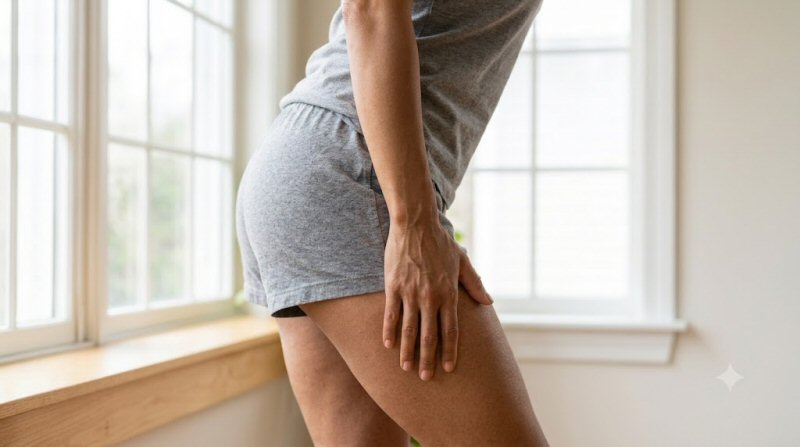
Most of us spend the day with our hips folded in a chair. The large muscle that powers hip extension—the gluteus maximus—barely works. Then we stand up, climb a few stairs, or try to get off the floor and the area feels weak, tight, or simply absent. That mismatch is not a personal failing. It is what happens when a muscle built for varied outdoor locomotion meets long hours of sitting.
What This Muscle Is Built to Do
The gluteus maximus is the biggest muscle in the body. It extends the hip, stabilizes the pelvis, and helps control the trunk when you walk, climb, or rise from a low position. In gait research, electromyography shows it is most active during the early stance phase on level ground and becomes substantially more active on inclines or when you push up from a deep bend. Evolutionary biologists such as Daniel Lieberman have noted that human walking and running on varied terrain, including hills, placed consistent demand on powerful hip extension. Ancestral daily life included squatting, rising from the ground, carrying loads, and covering distance over uneven surfaces—exactly the motions that recruit the gluteus maximus fully.
When the muscle is under-used, people often notice:
- A sense that the glutes “don’t fire” during bridges or squats
- Tightness across the front of the hip or lower back after sitting
- Difficulty or fatigue getting up from a low chair or the floor
- A feeling that stairs or hills require more effort than they should
Why Prolonged Sitting Changes the Demand
In a typical seated posture the hip is flexed roughly 90 degrees. The gluteus maximus is lengthened and quiet. Over many hours the nervous system down-regulates its contribution. Meanwhile the hip flexors and lumbar extensors take on more of the postural work. Clinicians sometimes describe this pattern as part of a lower-crossed tendency, in which the glutes and abdominals become relatively inhibited while the hip flexors and erectors become over-active. Stuart McGill’s work on spine stability has repeatedly shown that effective glute recruitment reduces shear and compressive loads on the lumbar discs during lifting and carrying. Without that contribution the lower back and hamstrings are asked to do more of the job.
Modern environments remove the natural cues. Elevators and escalators replace stairs. Cars and desks replace walking with a load. Chairs replace floor sitting and rising. The muscle that once handled daily hip extension now receives only brief, low-load signals—unless you deliberately restore them.
Related patterns appear in other under-used systems. The knees still expect frequent full extension after long periods of sitting, and the hamstrings still expect you to hinge and pick things up rather than stay locked in a chair.
Common Everyday Triggers
Several modern habits keep the gluteus maximus quiet:
- Hours of uninterrupted sitting at a desk or in a vehicle
- Avoiding stairs in favor of elevators
- Standing or walking only on perfectly flat surfaces
- Using a chair for every transition instead of occasionally lowering to the floor
- Tight hip flexors that limit full hip extension at the end of a stride
None of these are dangerous by themselves. Over months and years they simply remove the loading the muscle was shaped to receive.
Less Common but Worth Noting
True gluteal weakness can appear after nerve injury (for example, superior gluteal nerve compression), significant lumbar disc problems, or prolonged immobilization. In those cases the deficit is usually more pronounced and may be accompanied by clear changes in gait, such as a Trendelenburg sign. Most people who simply feel their glutes are “asleep” after desk work do not have a neurological lesion; they have an activity mismatch.
Hidden Contributors
Sleep position, footwear, and overall daily step count matter more than people expect. Sleeping with the hips flexed all night (fetal position) keeps the muscle lengthened. Very cushioned shoes that reduce ground reaction forces can slightly blunt the sensory feedback that normally helps recruit the posterior chain. Low daily walking volume means fewer stance-phase contractions. Even the way you rise from a chair—pushing with the arms instead of driving through the hips—removes another opportunity for the glutes to work.
When to Pay Closer Attention
See a clinician if you notice:
- Sudden, marked weakness on one side
- Pain that radiates below the knee or is accompanied by numbness
- Difficulty controlling the hip while walking that does not improve with simple movement
- Night pain or unexplained weight loss alongside the weakness
For the common desk-related sensation of under-active glutes, simple daily loading is usually enough to restore the pattern.
Myths vs Facts
Myth: You must feel a strong “burn” in the glutes during every exercise or the muscle is not working.
Fact: Electromyography shows the gluteus maximus contributes meaningfully at moderate intensities during walking and stair climbing. High-effort isolation is not required for everyday function.
Myth: Tight glutes are the main problem and stretching is the solution.
Fact: After long sitting the muscle is often lengthened and inhibited rather than short and tight. Loading it through its full range—especially into hip extension—usually helps more than passive stretching alone.
Myth: Only heavy squats or deadlifts count as glute training.
Fact: Stairs, hills, single-leg bridges, and simply rising from the floor several times a day provide the kind of repeated, moderate loading the muscle evolved to handle.
Practical Ways to Give the Muscle What It Expects
You do not need a gym program. Small, frequent signals restore the pattern:
- Take the stairs. Even one or two flights several times a day increases glute demand compared with level walking.
- Add a short hill or incline walk when possible. Research on gait shows incline walking raises gluteus maximus activity substantially.
- Practice rising from a low seat or the floor without using your hands. Start with a chair and gradually lower the surface.
- Perform a few hip-hinge movements (body-weight good mornings or Romanian deadlift patterns) focusing on pushing the hips forward at the top so the glutes finish the extension.
- Break up sitting every 30–45 minutes with 30–60 seconds of standing and a couple of gentle backward steps or bridges.
These actions reintroduce the extension moments the muscle still expects. Over a few weeks many people notice stairs feel easier and the lower back feels less overworked.
The same principle appears in other postural systems. The erector spinae still expect an upright day rather than constant flexion, and the hips still expect occasional deep folding and extension rather than a fixed 90-degree bend.
When to See a Doctor or Physical Therapist
If simple daily loading does not improve the sense of weakness after several weeks, or if you develop pain, clear asymmetry, or neurological symptoms, a physical therapist can assess activation patterns, hip mobility, and gait. In rare cases imaging or nerve studies are warranted. For the majority of people the issue remains an activity mismatch rather than an injury.
Frequently Asked Questions
Is it normal for my glutes to feel inactive after a desk day?
Yes. Prolonged hip flexion reduces the usual demand on the gluteus maximus. The sensation usually improves once you restore regular extension loading through stairs, walking, and rising from low positions.
Do I need to do special glute-activation exercises every day?
Not necessarily. Ordinary activities that require hip extension—climbing stairs, walking inclines, and getting up from the floor—already supply the signal the muscle evolved to receive. Extra bridges or hinges help if those activities are scarce.
Can weak glutes cause lower-back pain?
They can contribute. When the gluteus maximus does not share the work of extending the hip and stabilizing the pelvis, the lumbar extensors and hamstrings take more load. Restoring glute contribution often reduces that extra demand.
Will sitting less completely fix it?
Reducing uninterrupted sitting helps, but the muscle still benefits from occasional higher-demand tasks such as hills or rising from the ground. Both less sitting and more varied extension loading work together.
Is the gluteus maximus different from the other glute muscles?
Yes. Gluteus medius and minimus primarily stabilize the pelvis in the frontal plane during single-leg stance. Gluteus maximus is the primary hip extensor and is especially active on inclines and when rising from deep flexion.
Conclusion
Your gluteus maximus still carries the expectation of hills, stairs, carrying, and rising from the ground. Modern chairs and flat surfaces quietly remove those demands. The result is a muscle that feels under-active and a lower back or hips that sometimes compensate. Restoring even modest daily hip extension—through stairs, short inclines, and the simple act of getting up from a low position—gives the muscle the loading it was shaped to handle. The change is usually noticeable within weeks and requires no special equipment, only the return of movements that were once ordinary.


