
The deep calf muscle that flexes your big toe and helps power push-off was built for barefoot or flexible footwear. Modern stiff shoes leave it under-stimulated.
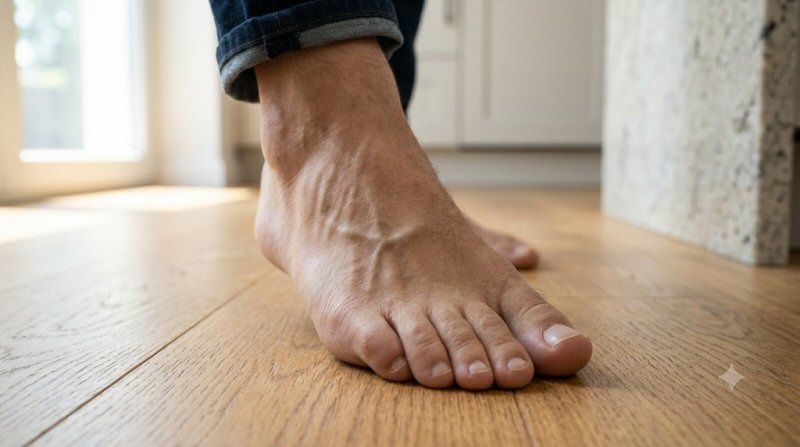
You kick off your shoes at the end of the day and try to curl your big toe under. It feels sluggish, almost disconnected, as if the muscle that should do the work has been sitting idle. That muscle is the flexor hallucis longus, a deep calf muscle whose long tendon reaches all the way to the tip of the big toe. For most of human history it flexed the big toe with every step. In modern shoes it often has far less to do.
What the Flexor Hallucis Longus Actually Does
The flexor hallucis longus (often shortened to FHL) starts on the back of the fibula in the lower leg, deep to the larger calf muscles. Its tendon travels behind the ankle, under the foot, and attaches to the base of the last bone in the big toe. When it contracts it flexes the big toe at both the main joint and the smaller one nearer the tip. It also assists with pointing the foot downward and helps support the medial arch.
Electromyography studies, including work by Annamária Péter, András Hegyi, Taija Finni, and Neil Cronin, show that the FHL is highly active during the push-off phase of walking. Force under the big toe rises especially as walking speed increases, indicating the muscle contributes more relative work at faster paces. Classic observations and later pressure studies have long noted that a substantial portion of the push-off load travels through the first ray and big toe. The FHL is a major part of that force pathway.
In quiet standing the muscle is relatively quiet. It becomes busy when the foot needs to grip, stabilize, or propel. That pattern matches the way people once moved: barefoot or in soft, flexible footwear on uneven ground where the big toe had to flex, stabilize, and push.
Why Modern Shoes Leave It Underused
Most everyday shoes have a relatively stiff sole, a slightly elevated heel, and a toe box that does not always allow the big toe to sit in a natural line or to flex freely at the end of a step. When the sole is rigid, the foot cannot bend through the ball and the big toe cannot complete the same range of flexion it would on bare ground. The FHL therefore receives fewer opportunities to shorten and lengthen through its full functional range.
Research comparing footwear has found that walking in conventional shoes can alter the timing and amount of plantar-flexor activity compared with barefoot or minimal footwear. One series of intramuscular EMG studies noted that shoes may impose a more uniform motion pattern and can increase overall plantar-flexor demand for propulsion in some people, while still limiting the natural individual variation of foot and toe movement. Over months and years of limited toe flexion, the muscle and its tendon simply get less practice at the task they were built to perform.
This is a classic evolutionary mismatch. Ancestral walking and running required repeated big-toe flexion to maintain balance on varied surfaces and to generate push-off. The FHL, along with the shorter intrinsic toe flexors, developed the capacity for that work. Contemporary life, with its long periods in supportive or restrictive footwear and on flat indoor floors, rarely asks for the same active toe curling. The muscle does not disappear, but its day-to-day stimulus declines.
Common Everyday Signs
Many people notice the underuse only when they deliberately try to move the toe. Curling the big toe while the foot is bare can feel weak or uncoordinated. Balance on one foot may feel less secure when the toes cannot grip. Some notice more fatigue in the arch or ball of the foot after a long day in the same pair of shoes. Others simply find that their big toe no longer points as actively during the end of a step when they walk barefoot at home.
These sensations are usually not painful. They are more a sense of reduced responsiveness. Because the FHL also helps stabilize the arch, prolonged underuse can coexist with a feeling that the foot “collapses” a little more easily under load. Related articles on the site explore how the big toe still expects a true push-off and how the plantar fascia still expects a springy first step; the FHL participates in both of those actions.
When Restricted Toe Motion Becomes a Problem
Occasional stiffness after a day in shoes is common and usually harmless. Persistent inability to flex the big toe, pain along the inside of the ankle or under the big toe, swelling, or a progressive loss of range that limits walking are worth attention. Long-standing restriction of FHL excursion has been linked in clinical literature to certain forms of hallux rigidus and to altered ankle motion. Sudden sharp pain or a tearing sensation while pushing off can indicate a tendon strain, which is less common in everyday walking but possible with abrupt increases in barefoot activity or hill walking.
If toe flexion is accompanied by numbness, color change, or significant swelling that does not settle, those are clearer signals to have the foot examined. For most people the issue remains one of under-stimulation rather than injury.
Myths Versus Facts
- Myth: Only the large calf muscles matter for walking. Fact: The FHL contributes measurable force under the big toe during push-off; studies show its relative contribution rises with walking speed.
- Myth: Strong shoes protect the foot so the toes do not need to work. Fact: Support can be useful in some settings, but a sole that never lets the big toe flex removes the stimulus the FHL expects.
- Myth: If the big toe does not hurt, the muscle is fine. Fact: Underuse can exist without pain; the first clue is often reduced active flexion or a sense of less spring.
- Myth: Toe exercises are only for dancers or runners. Fact: Simple toe-curling practice is relevant for anyone who spends most of the day in conventional footwear.
How to Give the Muscle Occasional Work
The goal is not to abandon supportive shoes when they are appropriate, but to restore occasional full flexion. A few minutes of deliberate toe curling most days is usually enough to reintroduce the stimulus.
- Sit or stand barefoot and slowly curl the big toe down toward the floor, hold for two or three seconds, then release. Repeat ten to fifteen times. Keep the smaller toes relaxed if they want to join in.
- Practice the short-foot exercise: while standing, gently draw the ball of the foot toward the heel without curling the toes excessively, then add a light big-toe press into the floor.
- Spend short periods barefoot on safe indoor surfaces or on grass when conditions allow. The varied contact and the need to stabilize encourage natural FHL activity.
- Choose shoes with a flexible forefoot and a toe box wide enough for the big toe to sit straight when you can. Stiff rocker soles or very narrow boxes limit the motion more.
- Progress gradually. If you have been in stiff shoes for years, sudden long barefoot walks on hard surfaces can overload the tendon. Start with short sessions and build.
These practices also complement the work of the opposing muscle, the extensor hallucis longus, discussed in the article on occasional toe raises. Flexion and extension together keep the toe joints mobile.
Frequently Asked Questions
Is it normal for my big toe to feel weak after wearing shoes all day?
Yes. Hours in a shoe that limits full flexion give the flexor hallucis longus fewer contractions. The sensation usually improves within minutes of barefoot movement or a few deliberate curls.
Can weak big-toe flexion affect my balance?
It can contribute. The big toe and its flexors help stabilize the foot during single-leg stance and the end of the step. People often notice better steadiness after a few weeks of consistent toe-strength work.
Should I worry if I cannot curl my big toe as far as I used to?
A gradual reduction in active range is common with long-term shoe use and is usually reversible with practice. Sudden loss, pain, or locking of the joint is different and merits a check.
Do minimalist shoes automatically strengthen the flexor hallucis longus?
They can increase the mechanical demand on the foot, and some studies have observed larger toe-flexor muscles after months of minimal footwear. The change is gradual; abrupt switches can irritate the tendon if the muscle is deconditioned.
How is this muscle different from the shorter toe flexors in the foot?
The flexor hallucis longus is an extrinsic muscle with its belly in the calf and a long tendon. The flexor hallucis brevis and other intrinsics sit inside the foot itself. Both groups flex the big toe; the longus is especially active in powerful push-off and longer-range flexion.
Can this underuse contribute to arch discomfort?
It can play a supporting role. The FHL helps maintain the medial arch during stance. When it is under-stimulated, other structures, including the plantar fascia, may take more load. Strengthening the toe flexors is one practical piece of arch care, not a complete solution by itself.
Conclusion
The flexor hallucis longus still expects the occasional full flexion of the big toe that barefoot or flexible-footwear walking once provided every day. Modern shoes do not make the muscle unnecessary; they simply remove many of the natural opportunities for it to work. A few deliberate curls, short barefoot intervals on safe surfaces, and footwear that allows the toe to move are usually enough to restore the stimulus. Most people find the toe feels more responsive and the step a little springier once the muscle is reminded of its old job. If pain, swelling, or a sudden change in motion appears, that is the moment to seek a professional assessment rather than simply adding more exercise.


