
Your extensor hallucis longus helps lift the big toe for clear steps and balance. Modern shoes and long sitting reduce that occasional lift, leaving the muscle under-used and the toe less responsive.
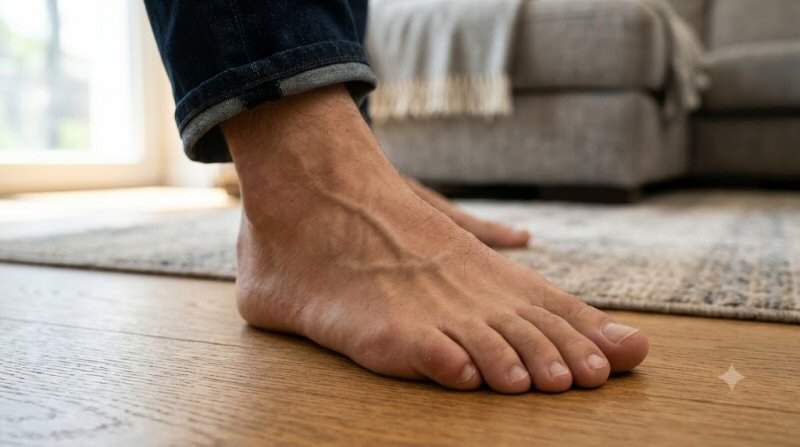
You stand up from your desk, take a few steps, and notice the big toe feels a little slow to lift. Or you try a simple toe raise and the movement is weaker on one side. That small muscle on the front of your lower leg and the top of your foot—the extensor hallucis longus—has spent most of human history helping the big toe clear the ground and steady each step. It still expects an occasional, deliberate lift. Most modern days give it almost none.
What This Muscle Actually Does
The extensor hallucis longus (often shortened to EHL) runs from the middle of the front of the lower leg, down across the ankle, and attaches to the top of the big toe. Its main job is to lift the big toe upward—dorsiflexion of the hallux—and to help the ankle bend upward. In normal walking it works during the swing phase so the toe does not drag, and it contributes to the final push and the control of the foot as it lands.
Gait researchers such as Jacqueline Perry described how the EHL and the other toe extensors coordinate with the tibialis anterior to keep the foot clear of the ground. Without that lift, people develop a compensatory high step or the toe catches. The muscle also helps stabilize the first ray (the big-toe metatarsal and toe) when you stand on one foot or walk on uneven surfaces. It is a small but precise contributor, not a powerhouse like the calf, yet the body built it for regular, low-level use throughout the day.
Related reading on the neighboring muscle: Why Your Tibialis Anterior Still Expects Occasional Toe Raises.
Why It Still Expects Occasional Raises
For most of human evolutionary history people walked barefoot or in minimal footwear on varied ground. The big toe actively spread, gripped, and lifted many times each hour. Electromyography work following the tradition of researchers such as John Basmajian showed that the EHL fires in short bursts during ordinary walking and standing balance tasks. The tendon on the top of the foot stayed mobile, the joint stayed nourished by motion, and the muscle retained its length and responsiveness.
That occasional demand was not a workout; it was simply part of moving through a day. The muscle and its tendon expect those short, repeated lifts to keep the sliding surfaces healthy and the neural control sharp. When the lifts disappear for weeks or months, the tissue does not vanish, but it becomes quieter and less ready for the next time you need a clean toe lift.
How Modern Days Quiet the Muscle
Most shoes have a relatively stiff sole and a toe box that limits active big-toe movement. Once the foot is inside, the EHL has little reason to lift the toe against resistance or through a full range. Prolonged sitting removes even the low-level activity of standing and walking. Desk work, driving, and evening screen time can leave the front of the lower leg almost silent for eight or ten hours.
When people do walk, many use a shorter stride and flatter foot placement than their ancestors. The big toe does less independent work. Over time the EHL can feel stiff when you finally ask it to raise the toe, or the tendon can become tender where it crosses the ankle. Some people notice the big toe drifting or the top of the foot feeling tight after a long day in shoes. These are usually signs of under-use rather than damage.
For context on the big toe’s larger role in propulsion, see Why Your Big Toe Still Expects a Push-Off.
Common Everyday Sensations
People often describe a mild ache along the top of the foot or the front of the shin after a day of new shoes or extra walking. Others notice that the big toe feels “lazy” when they try to lift it while sitting, or that balance feels slightly less steady when they stand on one leg. The tendon may be more visible or feel tight when the ankle is pointed. These sensations are usually benign and improve once the muscle receives a few deliberate, gentle lifts again.
In some cases the EHL can become overworked if the neighboring muscles are weak or if a person walks with an exaggerated toe-up pattern. The more common modern pattern, however, is simple disuse.
When to Pay Closer Attention
Most quietness in the EHL is harmless. Seek an evaluation if you develop true weakness that makes the toe drag with every step, sudden inability to lift the big toe, numbness or tingling that spreads into the foot, or pain that wakes you at night and does not ease with rest. Swelling, redness, or a history of trauma to the top of the foot also warrants a check. These can point to nerve irritation, tendon injury, or other conditions that go beyond ordinary under-use.
Persistent one-sided weakness, especially with back or leg pain, should be assessed promptly to rule out nerve compression higher up.
Myths Versus Facts
Myth: You need strong toe raises in the gym to keep the EHL healthy.
Fact: The muscle evolved for frequent, light activity during ordinary walking and standing, not heavy isolated lifts. A few mindful raises and more barefoot or flexible-shoe time usually restore its readiness.
Myth: A stiff big toe is just aging.
Fact: Reduced daily motion is a larger driver for many people than calendar age. Restoring occasional lifts often improves mobility even in older adults.
Myth: Pain on the top of the foot always means a stress fracture or serious tendon tear.
Fact: Mild, activity-related discomfort that settles with rest and gentle movement is far more often simple overload or under-use of the EHL and surrounding tissues.
Simple Ways to Give It What It Expects
You do not need special equipment. While sitting, slowly lift the big toe toward the ceiling while keeping the other toes relaxed, hold for a second, and lower. Ten to fifteen gentle repetitions a few times a day are enough for most people. Standing and practicing a slow toe raise while holding a counter for balance also wakes the muscle.
Time spent barefoot on a safe indoor surface or in flexible, wide-toe-box shoes lets the toe move more naturally during ordinary steps. Short walks that include gentle hills or varied surfaces give the EHL brief, real-world work. If the top of the foot feels tight, a light calf and ankle stretch followed by the toe lifts often helps.
Avoid forcing a painful range. The goal is occasional, comfortable activation, not fatigue. People who already have big-toe arthritis or a bunion should keep the movement small and pain-free; the same principle of light daily use still applies.
For more on how the smaller toes and the forefoot were built to move, read Why Your Toes Still Expect to Spread and Grip.
Frequently Asked Questions
Is it normal for one big toe to lift less easily than the other?
Mild differences are common and often reflect habitual posture or shoe wear. If the difference is new, large, or accompanied by dragging or numbness, have it checked.
Can sitting all day really affect a muscle in my foot?
Yes. The EHL receives almost no stimulation during prolonged sitting. Over weeks the neural drive and tendon glide can feel less ready when you stand and walk again.
Should I do toe raises every day?
A few sets of gentle lifts most days are reasonable for people who otherwise spend long hours in shoes or at a desk. They are a supplement to ordinary walking, not a replacement.
Why does the tendon on the top of my foot sometimes feel tight?
Reduced daily motion lets the tendon and its sheath become less mobile. Gentle toe lifts and ankle circles usually restore easier sliding within a few days.
Will stronger shoes or orthotics fix this?
Supportive shoes can be useful for other reasons, but they often reduce the very toe motion the EHL expects. A balance of protection when needed and freer movement at other times tends to serve the muscle better.
Conclusion
Your extensor hallucis longus is a small, precise muscle that still carries the expectation of occasional big-toe lifts—exactly the kind of low-level work that kept feet clear and steady for most of human history. Modern shoes and long periods of sitting quietly remove that demand. Restoring a few mindful raises and allowing the toe a little more daily freedom usually brings the muscle back to the responsive state it was built for, without any dramatic intervention.


